'%3e%3cellipse%20cx='185.202'%20cy='292.401'%20rx='236.2'%20ry='212.4'%20transform='rotate(180%20185.202%20292.401)'%20fill='url(%23paint0_radial_6113_7068)'/%3e%3c/g%3e%3cdefs%3e%3cfilter%20id='filter0_f_6113_7068'%20x='-130.996'%20y='0.000976562'%20width='632.398'%20height='584.8'%20filterUnits='userSpaceOnUse'%20color-interpolation-filters='sRGB'%3e%3cfeFlood%20flood-opacity='0'%20result='BackgroundImageFix'/%3e%3cfeBlend%20mode='normal'%20in='SourceGraphic'%20in2='BackgroundImageFix'%20result='shape'/%3e%3cfeGaussianBlur%20stdDeviation='40'%20result='effect1_foregroundBlur_6113_7068'/%3e%3c/filter%3e%3cradialGradient%20id='paint0_radial_6113_7068'%20cx='0'%20cy='0'%20r='1'%20gradientUnits='userSpaceOnUse'%20gradientTransform='translate(-43.0144%20248.324)%20rotate(-25.0248)%20scale(462.733%20514.489)'%3e%3cstop%20stop-color='%23FF9DDA'/%3e%3cstop%20offset='0.44'%20stop-color='%23F7FF9D'%20stop-opacity='0.52'/%3e%3cstop%20offset='0.84'%20stop-color='%23FF8B7B'%20stop-opacity='0.2'/%3e%3cstop%20offset='1'%20stop-color='%23F7FF9D'%20stop-opacity='0'/%3e%3c/radialGradient%3e%3c/defs%3e%3c/svg%3e)




The year the Cold War drew to a close, Warren Jenson was appointed CFO of NBC. He oversaw a stunning rise in the stock price before joining Delta as CFO, and then, in 1999, a small Seattle-based internet retailer named after the world’s greatest river. They say of experts that at some point of mastery, you begin to break the rules. You see potential in businesses that sound crazy to others because only you recognize them. Which is how he wound up CFO at Acxiom, a database marketing company, where he pursued an M&A strategy that the market didn’t quite approve of.
It would turn out to be profoundly profitable, but only after he and the CEO Scott Howe endured wave after wave of pushback. The integration stalled out. Investors started questioning their competence. Eventually, they had to sell. But they didn’t sell what you’d expect.
Today, the story of the most audacious and counterintuitive digital transformation we are aware of, by one of the most iconoclastic CFOs of the century.
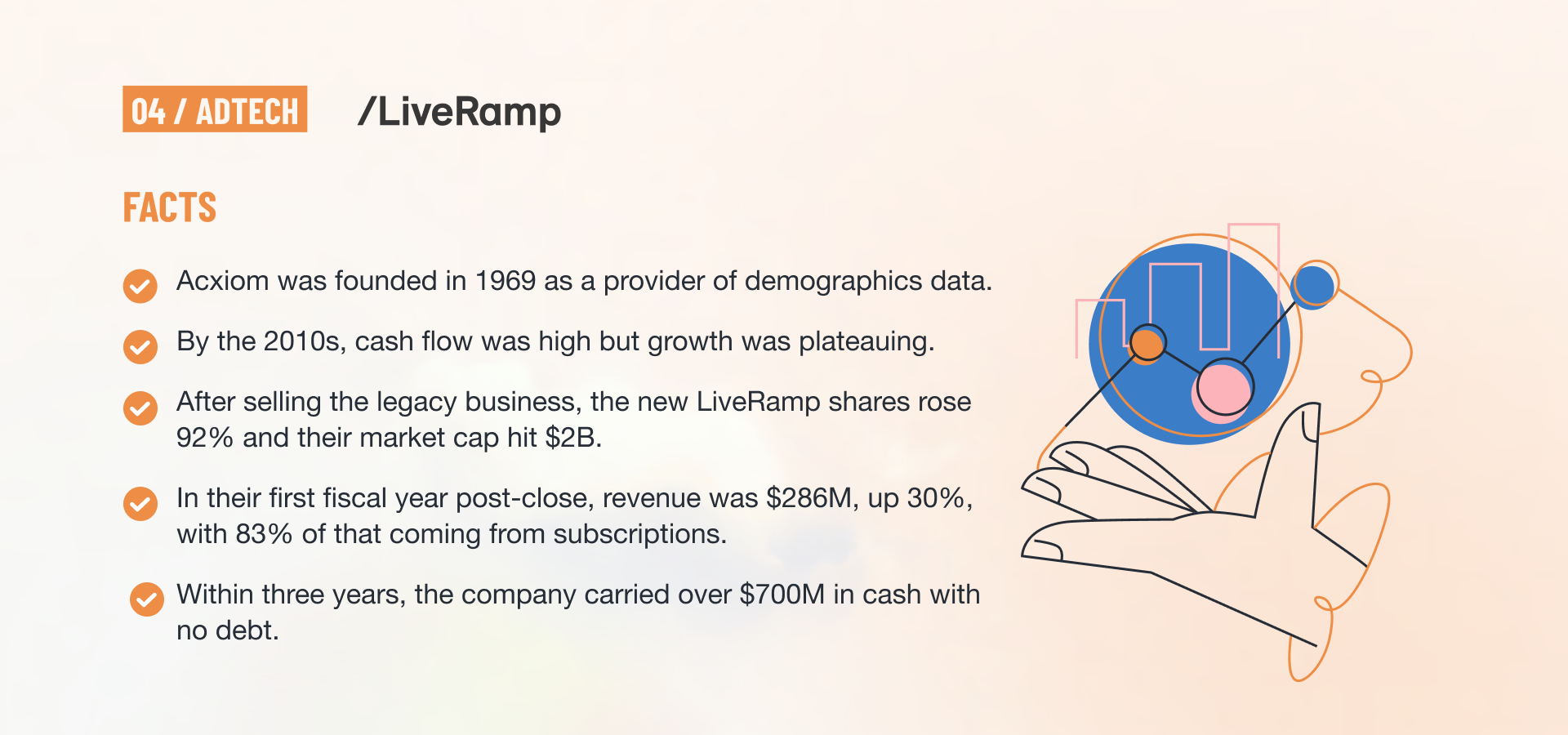
By the numbers:

Trading the horse you rode in on
In 2012, Warren found himself CFO of Acxiom, a database marketing company with strong profit margins and a respectable growth trajectory. Yet Warren and the then CEO were on the lookout for opportunities to buy smaller, faster-growing technology companies that would speed up their growth. Further, the leadership had a vision of turning Acxiom into an advertising giant with the technology to merge the online and offline ad worlds, which were largely separate.
From his time at NBC, Warren was aware of just how vital first-party data could be to media companies struggling to maintain their margins, and the role that data brokers could play. He started conversations with one company, LiveRamp, still losing money, and realized this was the answer. It was a high-growth business that aimed to become the data-driven center to an ad market where first-person identities mattered more. In LiveRamp, Warren saw the potential to eclipse the overall market for Acxiom’s core business.
They purchased LiveRamp for $310 million and, by Warren’s estimation, “overpaid.” The public markets gave him the benefit of the doubt … for a time. But eventually investors soured on the combined business. Stock watchers wrote about it being two not entirely complementary businesses fused together. Plus, the integration was going slowly. The story grew less and less clear, and the stock started to suffer.
“All too often, business leaders lament the one that got away—the deal they didn’t pursue or targeted too late,” McKinsey would later write of Warren and the leadership team of this moment. “Senior leaders at [Acxiom] held some of those same fears. But they acted anyway.” Warren and team doubled down on their decision. They decided to sell the business. But not the one you think.
Warren and Acxiom’s CEO, Scott Howe, decided to sell Acxiom.
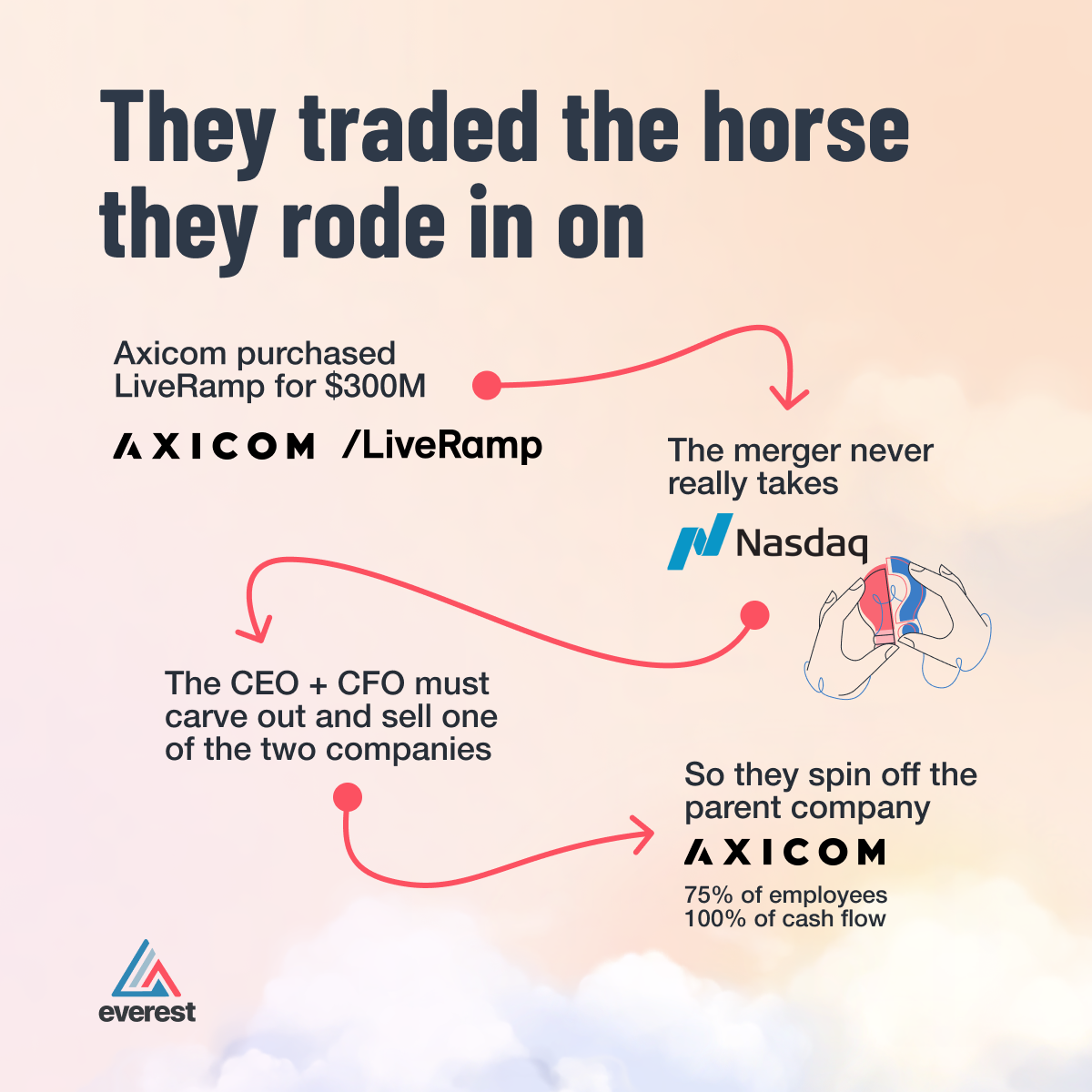
“Acxiom Marketing Solutions was our slow-growth, high-touch service business that generated a lot of cash,” says Warren. “LiveRamp was our high-growth SaaS platform, and while it had significantly fewer employees and lower capital requirements, it was also still very much in investment mode—in other words, losing money … and through our analysis, we learned that divestiture could unlock more value for both companies.”
What followed was a methodical master class in long-term preparation and message control. They were considering a divestiture of 75% of the company’s employees and 100% of its cash flow—about as risky a move as a company can make. They slowly backpedaled on the long-planned integration between the two companies, then quietly started to reverse it. They worked with management consultants to devise the plan and surrounding media communications. They started keeping two separate sets of books long in advance, for an auditable trail, and drafting richly detailed scenario plans.
When the time came in 2017 to announce the divestiture, they already had a data-backed valuation range and ready answers to every investor question. They announced the strategic move in February, found a buyer in July, and closed the deal in October.
As part of the transition, the newly singular LiveRamp documented more than 125 transitional service agreements and eight intercompany agreements. It used the $3.6B in sale proceeds to pay down its $230M in extant debt and switch over into growth mode on all fronts. Since 2018, the share price has more than doubled and they’ve returned $750M to shareholders. “And the best part is, Acxiom is flourishing under new shareholders,” says Warren.
Mutually successful splits
Warren Jenson has since moved on from LiveRamp but his and Scott Howe’s decisions proved prescient. In 2026, Publicis Group paid $2.2 billion for LiveRamp, declaring data the essential moat in the era of AI. Acxiom generated lots of cash but was never going to sell for 7x its value. Which makes this a story about conviction. About knowing when the public markets aren’t buying a story because they can’t see it, not because it isn’t there. And being able to justify it.
“You need courage at the top and relatively fearless leadership in your pursuit of value creation,” says Warren. “Scott Howe, our CEO, provided that. There are a thousand times in a process like this where you can easily stop; some people don’t ever start. The process worked for us because we believed in the vision, and we had confidence in our numbers and analysis.”