'%3e%3cellipse%20cx='185.202'%20cy='292.401'%20rx='236.2'%20ry='212.4'%20transform='rotate(180%20185.202%20292.401)'%20fill='url(%23paint0_radial_6113_7068)'/%3e%3c/g%3e%3cdefs%3e%3cfilter%20id='filter0_f_6113_7068'%20x='-130.996'%20y='0.000976562'%20width='632.398'%20height='584.8'%20filterUnits='userSpaceOnUse'%20color-interpolation-filters='sRGB'%3e%3cfeFlood%20flood-opacity='0'%20result='BackgroundImageFix'/%3e%3cfeBlend%20mode='normal'%20in='SourceGraphic'%20in2='BackgroundImageFix'%20result='shape'/%3e%3cfeGaussianBlur%20stdDeviation='40'%20result='effect1_foregroundBlur_6113_7068'/%3e%3c/filter%3e%3cradialGradient%20id='paint0_radial_6113_7068'%20cx='0'%20cy='0'%20r='1'%20gradientUnits='userSpaceOnUse'%20gradientTransform='translate(-43.0144%20248.324)%20rotate(-25.0248)%20scale(462.733%20514.489)'%3e%3cstop%20stop-color='%23FF9DDA'/%3e%3cstop%20offset='0.44'%20stop-color='%23F7FF9D'%20stop-opacity='0.52'/%3e%3cstop%20offset='0.84'%20stop-color='%23FF8B7B'%20stop-opacity='0.2'/%3e%3cstop%20offset='1'%20stop-color='%23F7FF9D'%20stop-opacity='0'/%3e%3c/radialGradient%3e%3c/defs%3e%3c/svg%3e)




When Meredith Kopit Levein, now CEO of The New York Times, joined as EVP of advertising in the early 2010s, friends advised her not to. What was there to gain? The Times’ best business days were behind it.
Then, change was thrust upon the 160-year-old institution from within. Editor A.G. Sulzberger had been given six months to study the newsroom and wrote his findings into an innovation report so secret that he printed only eight copies and delivered them by hand. The report claimed the paper was winning at journalism but “failing” at nearly all else, especially running a sound business and adapting online. It’s the last news you’d want to leak, but sure enough, a copy was fed to gleeful BuzzFeed reporters. Suddenly, “Nobody at the paper needed convincing that we needed to change,” Levein recalls. News of the paper’s sclerosis “was everywhere.”
This initiated a chain of events that led the paper to start acquiring, pushing digital subscriptions, and hiring tech talent. Over the next decade, it would build a self-reinforcing ecosystem of apps and offerings to reach new audiences and expand its existing one. Unlike others, most of its ventures succeeded. This has made the paper unlike any other media company. This is the story of how Meredith guided it there.
By the numbers:
It wasn’t exactly clear that people would pay for online news
The early internet was not kind to print media, to say the least. Institutions that had only ever known one medium—papers stocked in newsstands and hurled at doorsteps—were bewildered. First off, it wasn’t obvious that the internet was anything more than just a fad. Even as late as the early 2000s, pundits foretold its doom. And second, a transformation of this magnitude was totally foreign to these companies. How would they recreate that “browsing the Sunday edition” feeling online? What counted as “front page” when the page was just a 12-inch-wide screen? What was to stop anyone from stealing those articles?
The New York Times made most of its money from print subscriptions, followed by advertising. Executives greatly feared cannibalizing that income with something that felt as cheap as web access. And they didn’t want to spook premium advertisers. But the internet was coming for them and revenue dipped as people consumed more and more news from digital-native sites like BuzzFeed and Mic, or the burgeoning blogosphere—a profusion of free writing and media without modern precedent. Initially, people read on their computer, then on their phones.
At first, papers disdained digital. Bloomberg and the Financial Times decided to ignore it while other papers entered it defensively, filing lawsuits against online publishers reposting their work. Papers would often create a separate “web” newsroom and delay their stories so they wouldn’t break first. As such, many papers entered the 2000s in poor financial shape, with anemic online readerships.
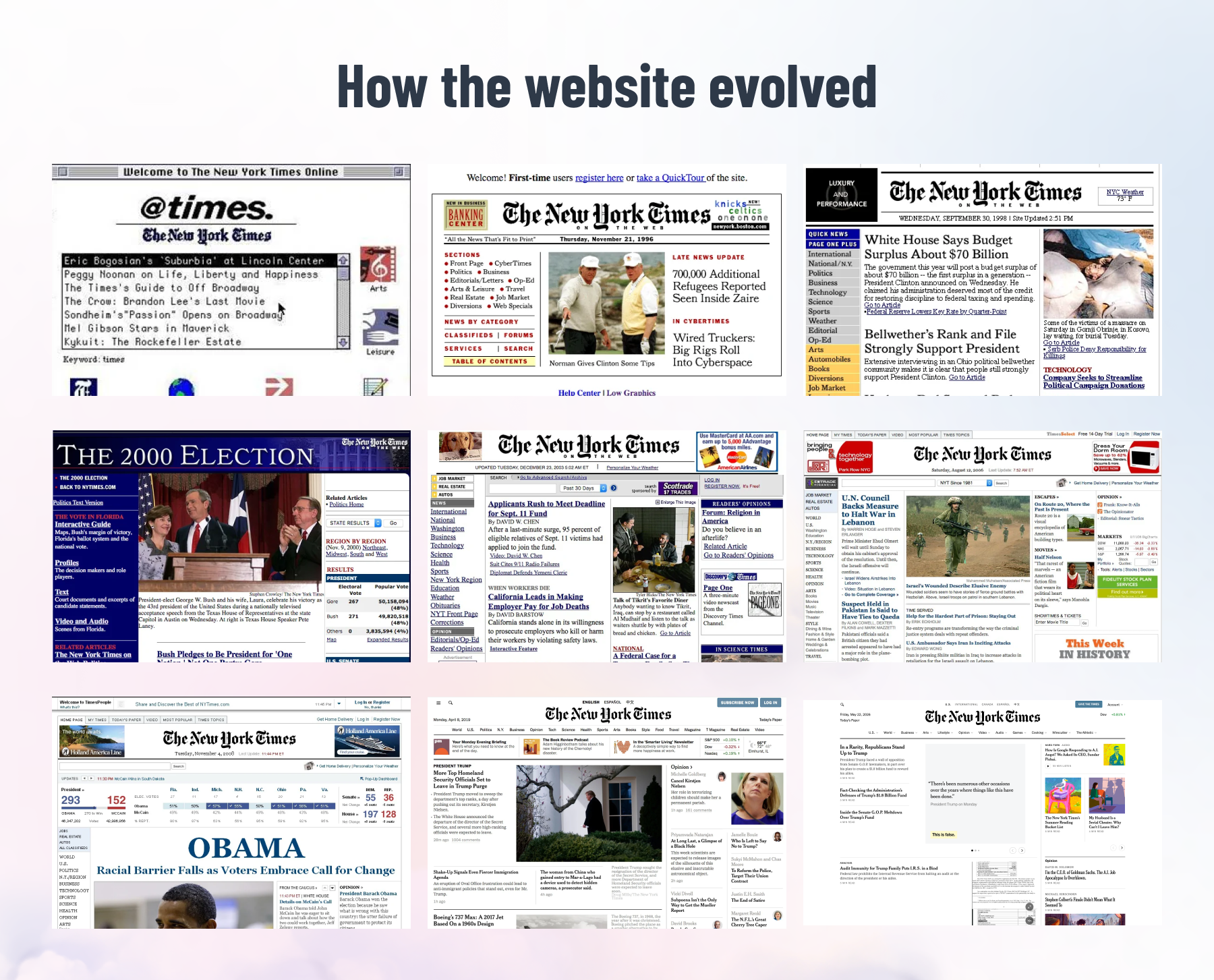
The New York Times was ahead of most. By 2004, its online paper was taking precedence over the print version. In 2008, it launched online games along with a mobile and tablet app. Yet the paper decided to make all online content free to compete for reach and sell ads. This left it dangerously dependent upon ad networks, and less and less in control over its destiny.
Meredith joined the paper as EVP of advertising and she saw it more clearly than most: Digital offered a new, global reach unconstrained by supply chains and paper routes; and multimedia offered inroads to new audiences who cared less about breaking news. She was not quiet about her desire to see the paper embrace digital and convert free readers to subscribers. In 2015, she was made chief operations officer, which gave her the freedom to do so—and to make the acquisition that kickstarted the paper’s winning streak.
Cutting the advertising wires
What The New York Times is world-class at is generating true, trusted, first-person journalism. A.G. Sulzberger’s 2014 report acknowledged this. But as he describes it, in the shift to digital, the paper had lost its reverence for distribution and the muscle of pushing stories out to people. “We got into publishing like people were supposed to come to us,” he says. “We’d forgotten that history of printing and throwing papers.” Whereas digital competitors like BuzzFeed were scrambling the net with clickbait like “34 ways to eat a banana.” It was funny, but not funny. It was costing them real revenue.
Levein initiated a series of hard calls. She declared the business’ intention to become digital first without abandoning the core imperatives that made the paper the institution it was: “We were going to honor the destination, the direct relationship, the daily good, and not be just a drive-by [source of social feed headlines],” she recalls. “And come hell or high water, we were going to keep investing in journalism.”
The paper acknowledged they were competing with new, buzzy media, but decided their journalism wasn’t the problem. The issue was their reach and reliance on fickle online advertising income. “The question was, could we get a bigger audience for what we were already doing?” she says. She also acknowledged that they were now in a battle with the biggest tech platforms such as Google and Facebook, and as such, “We had to become a software company.”
So Levein pushed the company to start charging digital subscriptions, while expanding what subscribers got. This led her to pursue and acquire the tech product review site, Wirecutter. Unlike buzzier media, Wirecutter was committed to journalistic integrity in its reviews—it stated its conflicts, explained how it made money, and went to great lengths to prove its trustworthiness. And an internet awash in spam, scams, and secret affiliate payoffs, Wirecutter stood apart and earned trust just like The Times.
Wirecutter offered The New York Times a number of advantages:
It opened an affiliate revenue stream.
It helped them diversify away from pure ad revenue.
It provided much-needed website and tech talent.
It diversified into new domains and readers the news would never reach.
It opened relationships with direct-to-consumer advertisers.
The acquisition was so successful that within a year, the company was in full build mode. It moved into fuller sports coverage, cooking, audiobooks, and games. It built most, but made occasional exceptions—like the purchase of Wordle. The new strategy acknowledged the manifold interests of people across the internet reading at times other than the morning. And people looking for more than to ‘monitor the situation.’ Each new offering built trust with a tangential audience, and everything benefitted from the ‘halo effect’ of the paper’s core journalism. If it could be trusted to report, it could be trusted to recommend products. If the games were fun, maybe the style section was too.
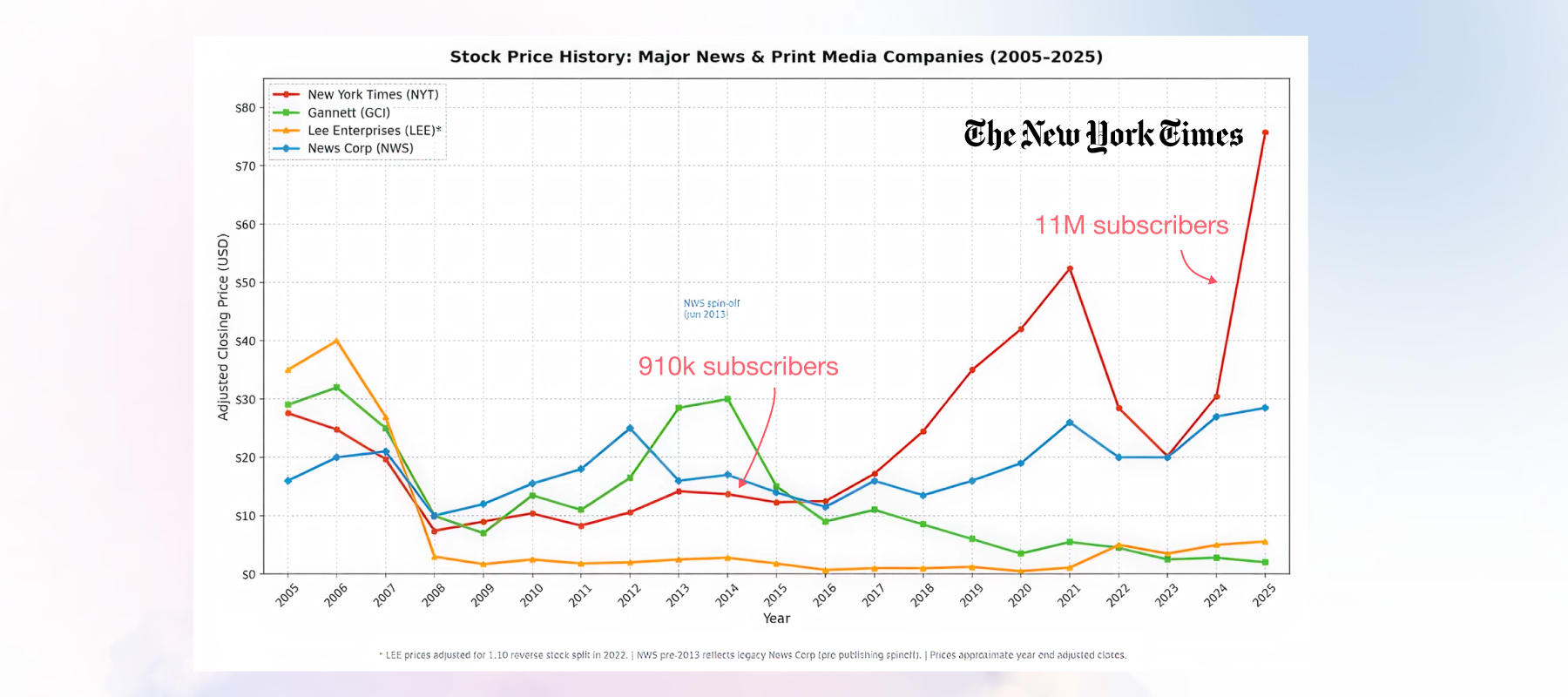
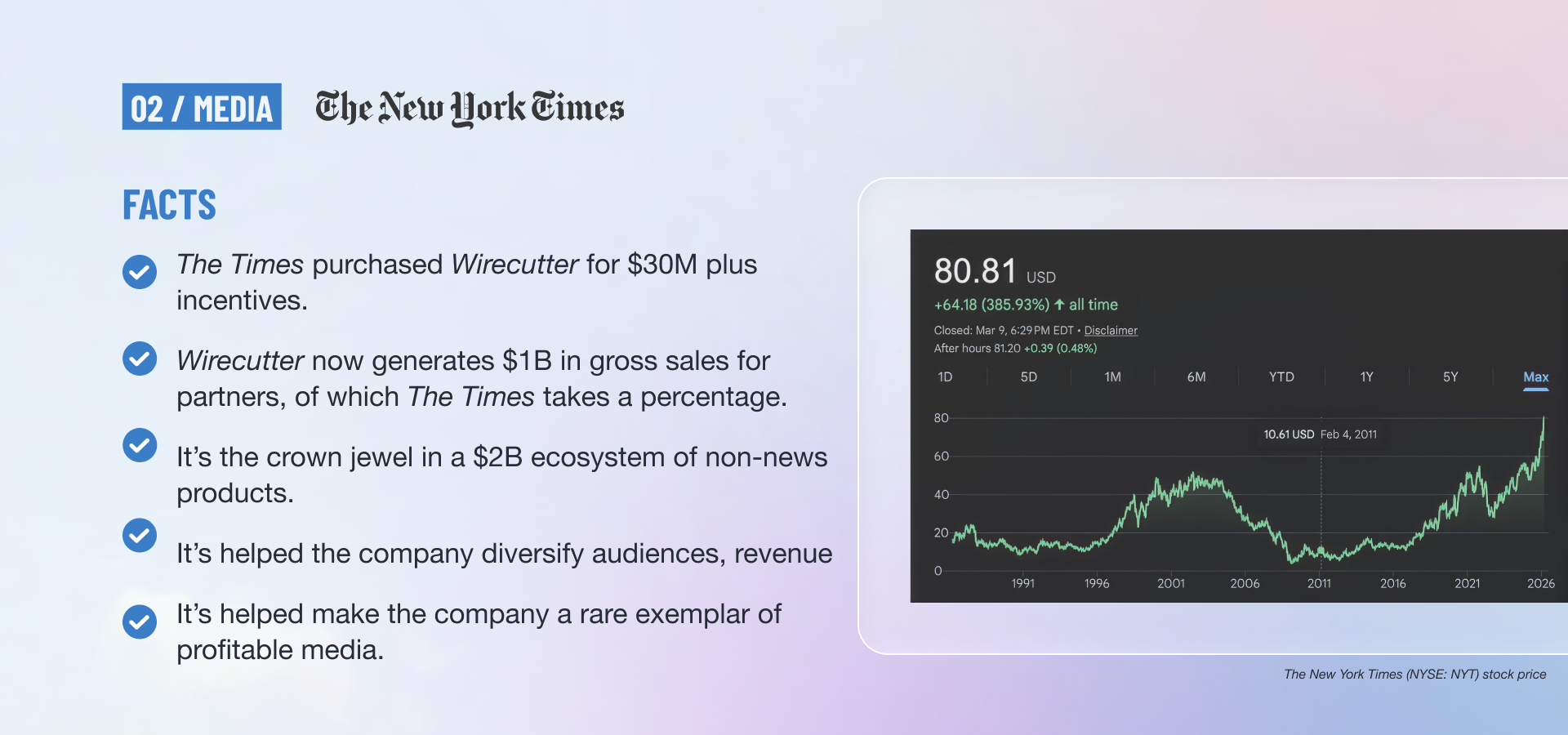
No paper ever escapes the gravity of advertising revenue but The New York Times has lessened that dependence to a great degree. It grew from 910k paying subscribers in 2014 to 11 million subscribers in 2024. And while its advertising revenue has held constant for the past decade at $500 million per year, the overall revenue has nearly doubled. In 2016, advertising accounted for 37% of the company’s revenue. By 2025, it was down to less than 20%.
The new pillar of profitable media
There’s plenty to take away from Meredith’s strategy but one thing that stands apart is her commitment to the core business. Other papers, which have since changed hands several times, diversified and diluted. They made acquisitions that degraded people’s trust in them, rather than reinforced it. The choice of Wirecutter as a first foray set a tone—that journalism was the core product and source of truth, and everything else orbited that.
And conviction. It takes a lot to weather the shocks and strife of online media, and leadership willing to allow teams to experiment without losing sight of what made the company great.