'%3e%3cellipse%20cx='185.202'%20cy='292.401'%20rx='236.2'%20ry='212.4'%20transform='rotate(180%20185.202%20292.401)'%20fill='url(%23paint0_radial_6113_7068)'/%3e%3c/g%3e%3cdefs%3e%3cfilter%20id='filter0_f_6113_7068'%20x='-130.996'%20y='0.000976562'%20width='632.398'%20height='584.8'%20filterUnits='userSpaceOnUse'%20color-interpolation-filters='sRGB'%3e%3cfeFlood%20flood-opacity='0'%20result='BackgroundImageFix'/%3e%3cfeBlend%20mode='normal'%20in='SourceGraphic'%20in2='BackgroundImageFix'%20result='shape'/%3e%3cfeGaussianBlur%20stdDeviation='40'%20result='effect1_foregroundBlur_6113_7068'/%3e%3c/filter%3e%3cradialGradient%20id='paint0_radial_6113_7068'%20cx='0'%20cy='0'%20r='1'%20gradientUnits='userSpaceOnUse'%20gradientTransform='translate(-43.0144%20248.324)%20rotate(-25.0248)%20scale(462.733%20514.489)'%3e%3cstop%20stop-color='%23FF9DDA'/%3e%3cstop%20offset='0.44'%20stop-color='%23F7FF9D'%20stop-opacity='0.52'/%3e%3cstop%20offset='0.84'%20stop-color='%23FF8B7B'%20stop-opacity='0.2'/%3e%3cstop%20offset='1'%20stop-color='%23F7FF9D'%20stop-opacity='0'/%3e%3c/radialGradient%3e%3c/defs%3e%3c/svg%3e)




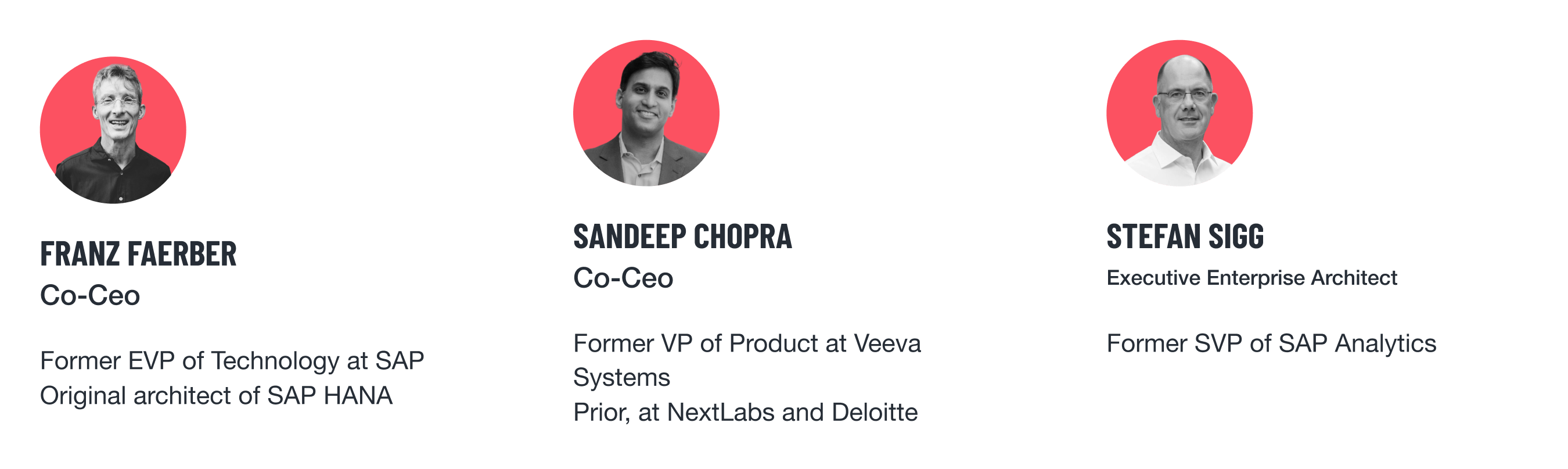
After 30 years as technology leaders at major ERP companies, Everest’s founding executives gathered to pursue a question: What sort of ERP could they build with all that accumulated wisdom if they started entirely over?
Some things today are different, like the speed of competition and AI. But a lot has remained the same. ERP is a company’s central nervous system and must connect every office and workflow. That means the software is really just a mirror of your actual operations: The processes and the people. And those really haven’t changed.
In this guide, we share our team’s reflections on many decades of building and implementing ERP, to help you make yours work better for you.

1. ERP is the art of managing complexity
As a company grows, it generates complexity as a sort of byproduct. More people, more regions, more products, and more discount matrices mean more interdependencies. All that complication can really start to weigh down an organization.
Sometimes companies don’t see that complexity for what it is and try to fight it by adding more complexity. More overlay teams. More programs. More reporting. At a truly advanced stage of intricacy, systems start to jam and workflows crumble. The test for this is simple: If you add more people, does it slow work down further, rather than speed it up? Complexity can do that.
Unfortunately, you can’t just manage complexity by eliminating it. Like all types of debt, complexity debt isn’t inherently bad. It is just a tool. You take on debt to achieve growth. You take on complexity to better fit your customer and market.
Find an ERP that allows you to manage complexity as an instrument, dialing it up or down.
2. The future belongs to financially flexible companies
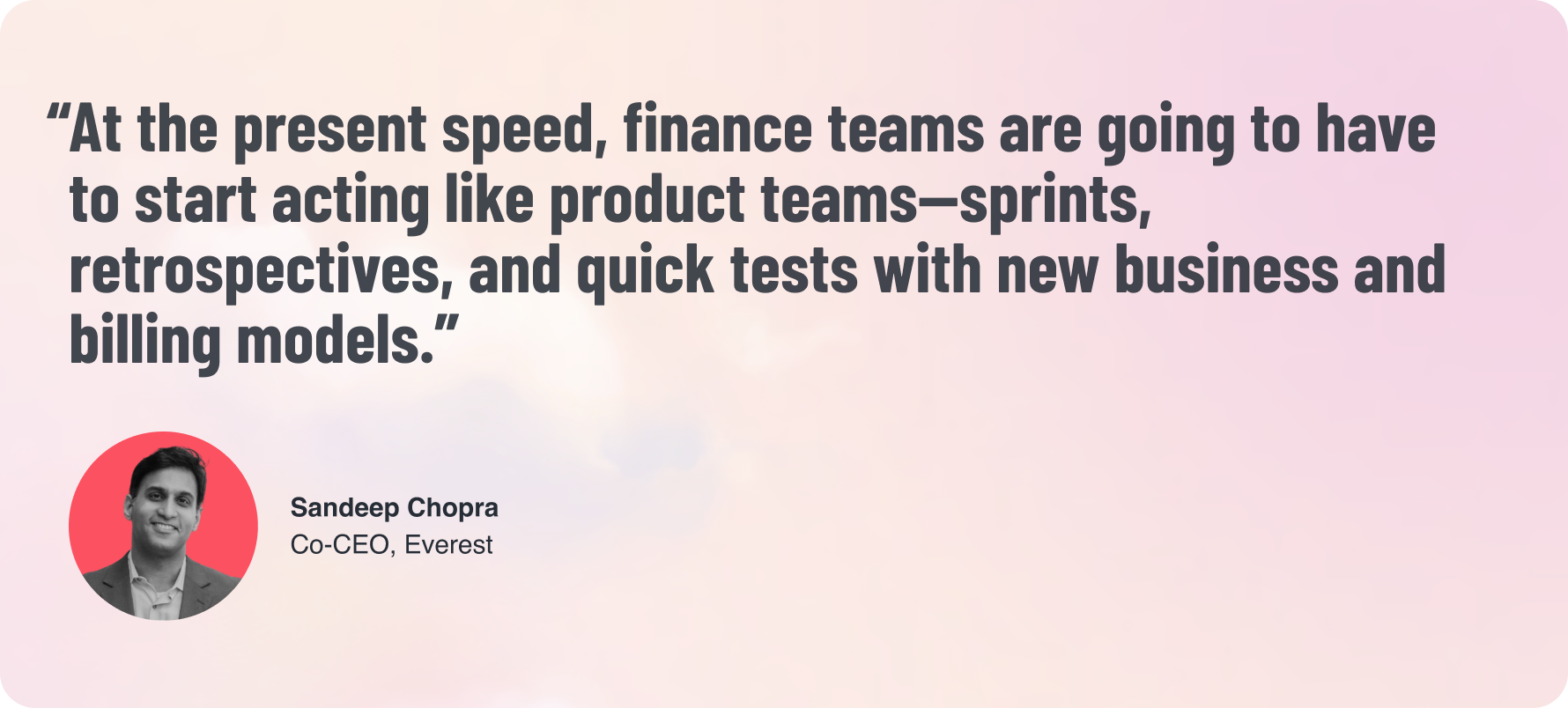
The lifespan of a large company is half what it once was. Of companies on the Fortune 500 list in 1955, only 10% are still present. In a collective sense, this is good. Creative destruction usually means greater efficiency for customers. But in an individual sense, it is bad for your company. The top cause of company death is now tech disruption. To survive tech disruption, companies must be able to scenario plan and run faster tests—to think up new business models, enter new markets, and actually act on those impulses. Anything that deters you will inter you, strategically. ERPs coded in the 80s and 90s tend to prevent you from adapting. They are built to be unchanging.
3. Your ERP must model your uniqueness
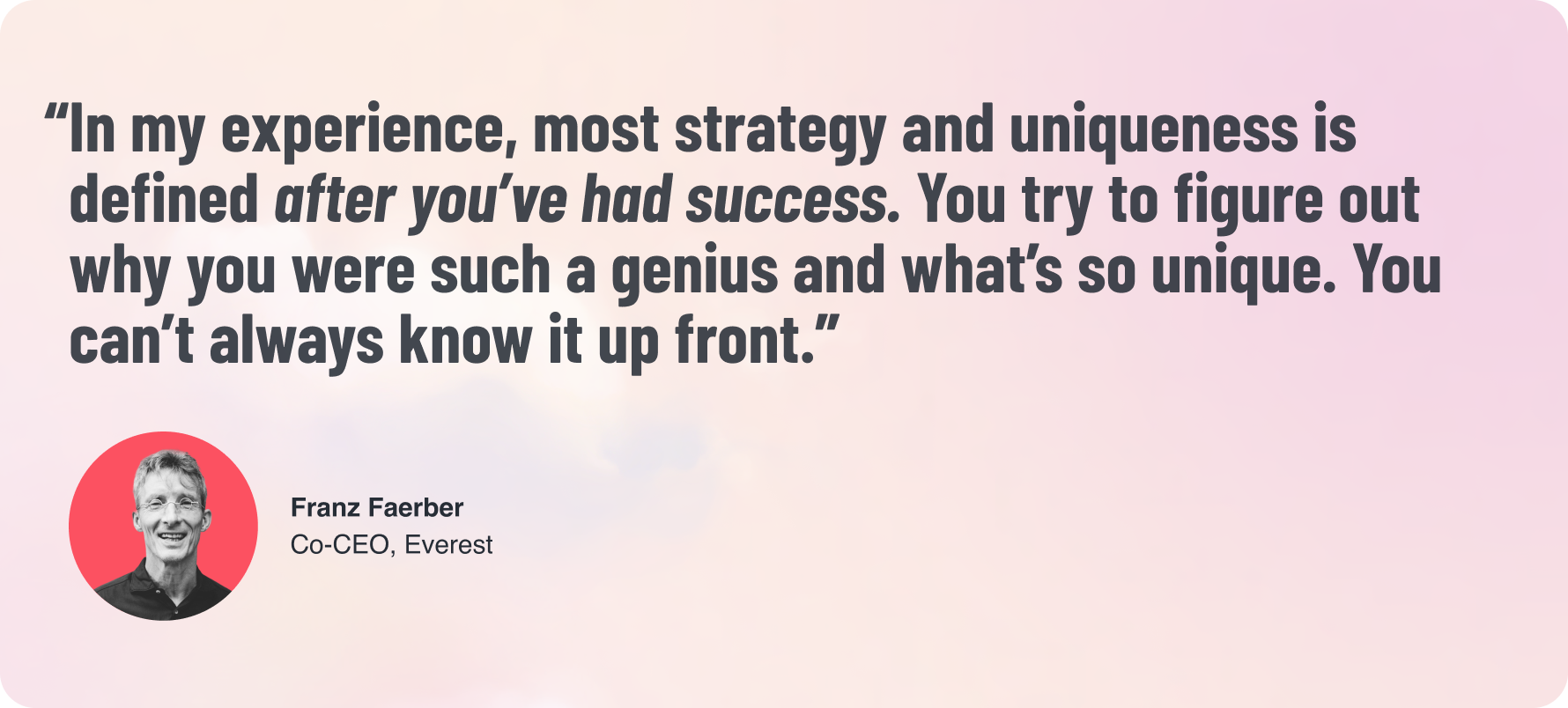
Many companies want to borrow someone else’s “best practices.” But no two businesses are alike. So when a leader asks their ERP implementation partner to give them what everyone else has, all they do is erode their unique advantages.
Some of your company’s seemingly inefficient processes may be vital to your competitive differentiation. Your airline’s policy of allowing passengers to choose their own seats upon boarding may sometimes cause delays and also be such a powerful marketing tool that it more than offsets the cost.
We’ve seen this time and time again: A large business will hire an outsider CEO who runs the standard playbook that makes the business … standard.
True power lies in having an ERP that can model your uniqueness. Resist the urge to mold your business to fit someone else’s software.
4. Yield to short-termism at your own peril
If successful, you will outgrow whatever you need today. And though it is difficult to imagine, tomorrow will come sooner than you think. That future success is guaranteed to break your systems.
Despite this, many companies succumb to short-term thinking and over-optimize for the present. This is only natural. Our tenures are only so long, and many of us are measured by the quarter. This incentivizes most leaders to defer maintenance, assigning it, effectively, to their future selves. But eventually the bill comes due.
Hold space in your scenario planning for the long term, too; dedicate some percentage of team time and focus to tuning your work systems. It is far cheaper than the occasional catastrophic failure or total migration.
5. The clearer your strategy, the better your choice
It actually isn’t a good idea to buy for your company’s far future needs if you have no way of knowing what that future is.
Predictions are difficult, especially about the future, the quip goes. If your executive team does not have enough insight into your competitive strengths, visibility into where customer tastes are headed, and can’t model your finances more than a few years out, then you need extremely flexible finance systems to adapt with you.
Flexibility, in practice, means business users can customize their workspace. That controllers and accountants can implement new features and applications without undue delay or complication. It means your financial systems must be friendly enough that people’s first instinct isn’t to try to circumvent it.
6. Partner with tech teams who are willing to say "no"
Let’s say you meet with an AI fintech sales team and present a list of requirements, and before you finish, the salesperson says, “We can do all of that.” And when you raise an exception, they say, “We can handle that too.”
How much do you trust this vendor? Hopefully, less than the vendor who replies to your questions with clarifying questions and says “We can do about 70% of that.”
Honesty is vital in financial technology. No vendor can do it all. Some will say they can. But the truly experienced ones know to front-load the difficulty and have those hard conversations up front—not wait until later. You want tech partners who are thinking, not about their sale, but your renewal. Who have the calm confidence to risk losing the deal to help you get it right.
7. The real innovators aren't always in the major metros
One of our favorite observations in meeting with hundreds of large public companies is that some of the most innovative are far from the big cities. Out there, they have no choice but to be better. They must try harder to attract workers with advanced skills. They must be cleverer in their use of technology. And they must often solve the problem on their own, without copying off someone else’s test. This is very different from Silicon Valley or Alley, where companies have the luxury of mimicking their competitors.
There’s no specific takeaway here other than a reminder to consider how innovation often emerges from friction. When resources are limited and the geography a barrier, how much cleverer are you? For clues, look to those in agriculture, energy, and materials conglomerates who operate in the hinterlands.
8. You'll buy features, but end up fixing workflows
People feeling the pain of a broken process often struggle to see beyond software features. They overweight the technical aspects of that new software and overlook the equal importance of reimagining their own internal workflows.
Consider a major conglomerate that grew through acquisition. When it evaluates ERPs, the financial and supply chain leadership may overweight the chosen ERP’s multi-book feature and underestimate the cost of change management. The branch managers and finance teams who’ve struggled to build their processes on their own in spreadsheets will probably cling to them bitterly. Just because the software offers a better way doesn’t mean the organization will adopt it.
Spend more time than you think discovering your own workflows, in successive waves: information flows, then systems, then modes of work, then the physical layer. Walk the shop floor and see if it really works.
9. Plan for cycles of consolidation
All systems go through cycles where they absorb additional complexity. But you usually don’t notice because it's framed as an opportunity. Adding new SKUs seems like a net-positive way to sell more. And launching an international subsidiary sounds like progress. But each change quietly complicates your financial systems and delays your closes.
It is rare for companies to plan for an equal and opposite period of consolidation— though they should. You must spend equal if not more effort processing that complexity by simplifying, reducing, and integrating. Can you collapse SKUs? Retire bundles? Streamline reconciliations? Join teams? Merge reporting? Scale the sales and marketing without hiring?
Any team can think of ways to do more. It takes a rare team to recognize that succeeding faster often involves deciding to do less.
We’ve only once or twice seen anyone with such a title, doing this work proactively, before the complexity builds into a crisis. But every company handles it eventually. It’s just a question of whether you choose to or are forced to.
10. We'll never be rid of the humble spreadsheet
We aim to lessen our customers’ reliance on spreadsheets. When a company tells us that despite their legacy ERP, 80% of critical processes still run through spreadsheets, we agree that’s bad. However, we believe we’ll never be rid of Excel entirely.
Spreadsheets are a digital manifestation of people’s attempts to manage complexity in their own sphere. There are plenty of cases where that’s good. You don’t need to encode every little thing in your financial systems. There is a time and place for a one-off spreadsheet calculation.
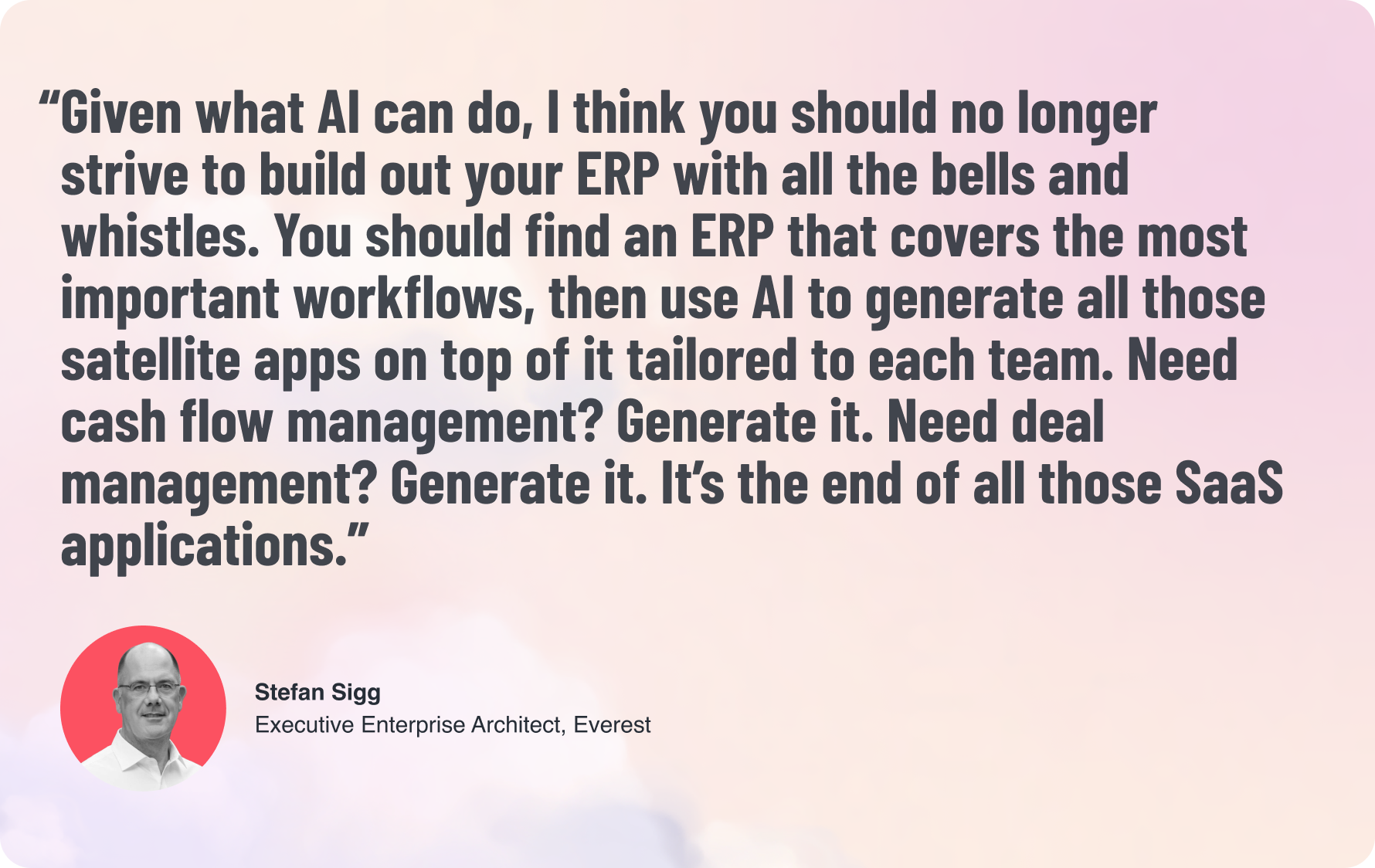
However, with AI, we envision people using them far less. When you can simply chat with your AI-native ERP and ask it to build you extra functionality, like an ephemeral reporting app, and then delete it, Excel will become a rarity.
11. You must build with experts in the room
The reason financial software tends to be clunky is partly due to physical seating arrangements: Product teams don’t sit near finance. They know how to talk about financial work. But they have never done it.
This does not mean these people cannot be useful in building the product. But we believe every company has a founding core competence that becomes very difficult to change. If an ERP vendor’s core competence is software first, finance second, that will show up in every layer of the system.
This problem is particularly acute for ERP software companies, where the details make all the difference, and those differences compound over time. Was yours built by CPAs, or just people who know what a CPA is?
12. The first 80% is simple. The final 20% is excruciating
There is a reason so many new softwares and AI applications demo smoothly and then fail in everyday use: The first 80% of any team’s requirements are easy to solve with software. It’s the last 20% of critical workflows that present most of the difficulty. Because it is only after deep discovery that the implementation team will learn that, say, the company must sometimes recognize revenue in multiple categories, or reconcile multiple currencies, or consolidate multiple books on different accounting standards into one. Handling those critical exceptions is most of the work.
13. If you can't de-risk change, you will decelerate
Most of the traditional ERPs strike fear into the hearts of ordinary administrators because they feature no “back button.” Some changes, once pushed into production, are irrevocable. Some configurations are unrecoverable. This is because most traditional ERPs were invented in the 1980s and 1990s, and despite successive replatformings and updates, don’t benefit from the latest developer operations (devops) paradigms. You can’t test, fork, merge, and review changes, nor roll them back.
This means users, who once tried to make a change that broke an integration before quarter’s end and accidentally misconfigured the tax code, will try to avoid ever changing the ERP again. In a market that keeps changing, their ERP falls further and further out of sync with reality.
Seek an ERP that allows you to de-risk updates and changes. For example, the ability to spin up many sandboxes that use real production data, so anyone can easily run a test. And the ability to roll back error-filled updates.
14. However expensive, ERPs are still undervalued
The true value of an ERP is only ever clear by principle of subduction: Remove it and see what takes its place. However burdensome employees feel the software is, however long it takes to load, however much they try to circumvent it, not having it would almost always be worse. The number of people and the volume of paperwork necessary to replace that foundational functionality would vastly outweigh the cost.
And still, the easier the ERP is to use, and the more people use it, the more value you will get from it. Just because others are satisfied with a meager return doesn’t mean you must settle.
15. It is a law of physics that expectations will be unrealistic
And it would be more of a shame if they were not. Humanity’s great power is envisioning what could be.
16. 'All in one' can never exist, nor should it
If an ERP were truly be built to be “all in one,” there would be no market for it—only one company. Every ERP vendor you encounter is grappling with its own version of the question, “How much do we standardize versus how much do we let users customize?” None have a perfect answer.
The more that ERP vendor moves modules into their application layer, so they are standard and available to all, the more they satisfy a specific set of customers at the expense of the rest. Whereas if they productize very little and allow any finance team to hire developers to build anything, the harder they make their software to use and maintain.
For decades, it made sense to seek out a vertical-specific ERP that could handle your specific use case. But the way business is headed, every leader must mix and match revenue models. Physical goods companies are launching subscriptions. Manufacturers are becoming media companies. Because of AI, the cost of producing software and features has plummeted.
If we were buying an ERP today, we would seek out an ERP that handled all basic financial functions out of the box, where we could be up and running within three months. But we would also demand that it give us AI tools that allow us to customize and extend that functionality without buying bolt-on software.
17. Data cleanliness is not the user's fault
Blaming users for poor data quality is like blaming citizens for the state of an economy. It is probably due less to their individual choices than to what behavioral economists call “choice architecture,” or the default choices their environment presents them with.
When building and implementing ERPs, we get to design those choices. The easier we make it for your team to add, move, and change information, the more they will do it. And the better quality that information will be.
AI is improving this paradigm further: The best information update is the one that no person has to make, because the AI agent monitored the calls and email exchanges and simply notified your controller, “Here is an updated draft of the contract for your approval.”
18. ERPs fail at usability because everyone ignores the user
If an ERP software has a clunky user experience, it is typically a result of their go-to-market model. You see, ERP companies tend to have sales organizations that target executives who control the budget. Because they control the budget, they are far removed from having to log into the system. There is an inherent mismatch in requirements. And while both decider and user would benefit from a tidy user experience, it tends to matter less to the vendor than stories that win new business.
It takes a very serious ERP product team to build in user analytics and feedback loops to produce a system that people actually want to use. And it takes a rare ERP founding team to institute a culture of design from the start.
19. Implementation partners are used to being punished for honesty
ERPs implementations are similar to great public works projects where the engineering partner is faced with a dilemma: Do they quote honestly, and risk losing the bid? Or do they under-quote to win the business, and trust that any later increases will seem tolerable?
The perverse incentives continue well on into the project. If the implementation partner charges an hourly rate, they will be paid more for taking longer.
There are plenty of ethical, rational, reliable implementation partners who do the right thing regardless. And a partner is almost always essential. Most finance team members will only undergo an ERP migration once or twice in a career. An implementation agency will have seen hundreds, and that is valuable.
To find an honest partner, search as you would for an ERP vendor: Look for those who are willing to tell you “No,” and risk the deal to reframe your expectations.
20. The rule of repetition: Can your implementation partner explain it back to you?
There is a corollary to the rule of implementation partner honesty: Many people throughout the ERP implementation and update process will feel pressure to say “Yes,” they understood you. But the only way to know for sure is to ask them to explain what you’ve said back to you.
If you can each repeat the other's position back to one another, and the other side confirms it is right, you have removed any miscommunication. And thus, averted future trouble.
21. Founder intentions matter
We believe that how something starts is typically how it goes. There is a core spirit to every company, just as there is a core competence. And when an ERP company is founded in truth, by financial experts, it will tend to grow and evolve in a much more ethical fashion.
Fintech startups founded without expertise will tend to chase trends and see the market in terms of exploitation. Whereas a company founded by experts feels a greater loyalty to their profession. They see the market in terms of peers who need help. Salespeople at the latter type of company will be far more concerned about trying to understand your problem, so they can actually solve it. They are more concerned with their reputation and so, your success.
22. You cannot scale without a unified data model
While it is theoretically possible that a legacy ERP vendor with decades of technical debt could completely “replatform” to achieve a unified data model, it is unlikely. In fact, having come from several of those vendors, we can tell you, we have never seen it happen. The costs are catastrophic. Both in development hours and in terms of disrupting legacy customers long accustomed to the existing way of doing things. Whereas when a company’s data model starts out unified, it has a better chance of remaining unified. This will matter more than you can possibly know as your company grows—every fracture will become a chasm. Every integration, a burden. Every gap, a new role you must hire for.
23. Build for international from day one
Plan for your eventual international success early, if only because it will force you to build the foundations of an international company earlier. Many that focus on just the continental U.S. or Europe will have to “replatform” their financial applications later at great expense, when it is harder, and the delay is more damaging. Conversely, the cost of going international early is falling. Newer ERPs are built to allow for multiple general ledgers, multiple entities, multiple currencies, and seamless translation.
24. Companies underestimate their complexity
Companies tend to think they are complex. And even so, they tend to underestimate that complexity by an order of magnitude. They know they are complicated at a high level. But it isn’t until an analyst starts digging in to draw visual workflow maps and interrogate team members that they understand just how deep it all goes.
The most successful companies at implementing ERPs make provisions for this additional complexity, and allow for longer discovery and design. Any question marks in your present workflow map are areas for further investigation—and places that you will later sorely wish you had investigated.
25. You cannot migrate your way out of a wrong culture
Companies often try to buy technology to avoid critical people and process issues. It is not always clear at the time. But skills, culture, and habit can easily overcome the best of software if you do not address both at once. This is to say, there is a massively underreported change management component to implementing or migrating an ERP.
For this, human resources and teams can be your best partner. They’ll have the keenest insights into what compels people to change, and help you recompensate and reorganize to achieve it.
26. Invest more in training than you think
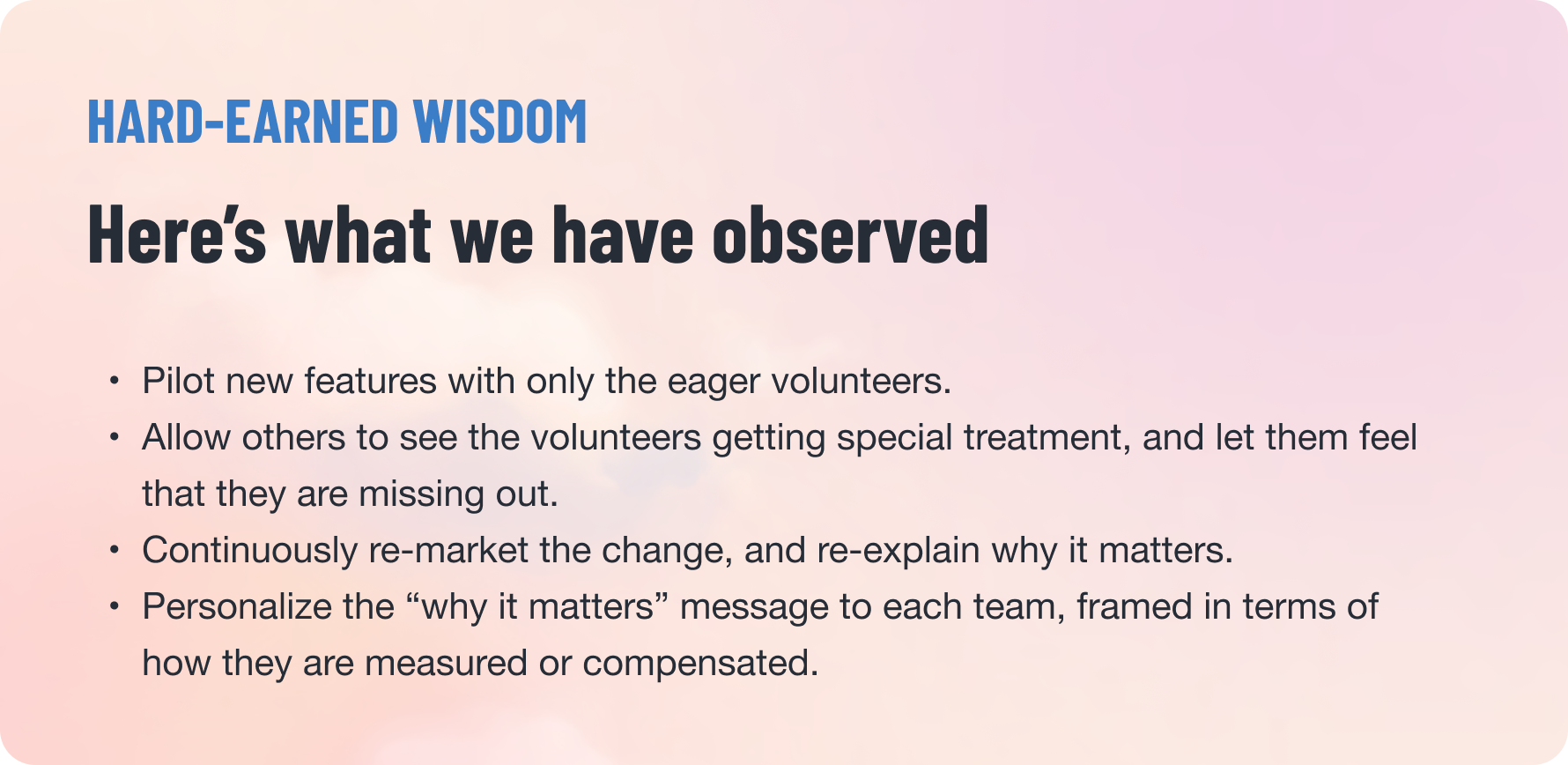
However much effort you believe it will take to train a team on a new software, it is likely 3-4x harder. It is not uncommon for finance leaders implementing traditional ERPs to report that several years into the process, people are still asking why the switch occurred, and resorting to their old spreadsheet workarounds. This is all to say, there is a psychological and marketing component to convincing teams to change.
27. It's all won or lost in the moment someone says, "Fine, I'll do it myself"
You can spend millions on an ERP implementation and undergo a two-year migration only for, at the end of it all, users to say, “I don’t like this, I’ll just use Excel.” Expectations for usability are sky-high these days. Warehouse shift leaders and finance managers alike are not comparing your work software to other work software—they are comparing it to their smartphone, to payment apps, and to social media. And they are most definitely not looking for more tasks to complete—they are asking, “Why is this not more like ChatGPT?”
28. "User experience" is a complex way to say "have empathy"
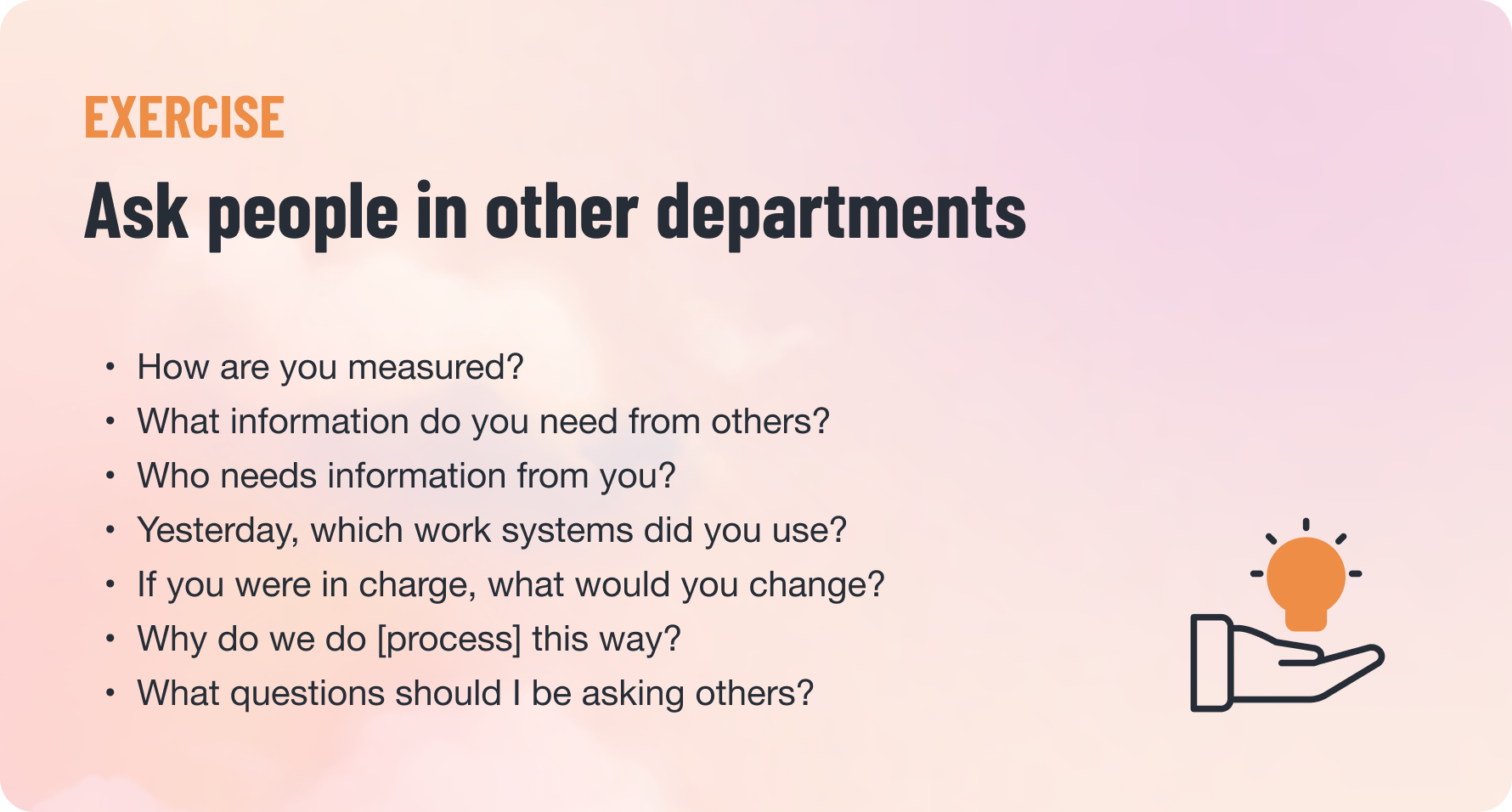
Any finance team that wants to rewire its company’s workflows with an ERP must contend with its own knowledge gap. Do your transformation initiative a favor and dedicate time to walk the plant floor and shadow real customers. You can only automate financial systems and reconciliations when you understand the physical processes in question. As the mathematician Albert Korzybski put it, “The map is not the territory.” Meaning, do not mistake the software process map for the actual workflow that real people must follow at the cost of their time.
29. The true dream is a system of action, not just a system of record
Finance roles are changing rapidly, and the average CFO’s job description has grown 20% longer in just the past five years. That is because CFOs are being asked to do more strategy, and play an active role, not simply budget and report. To achieve that, CFOs need to know more about the levers they can pull to help each functional leader hit their targets. Until now, most ERPs have been systems of record—a place where people recorded information, then pushed it into bolt-on software for payments, human resources, inventory, and supply chain where they could take action. With the benefit of 30 years of observation, we can say there are finally ERPs that do it all. Both record, and act. With all the features of the box for your team to spend their time in one system—gathering all they need from one screen. Fewer steps and clicks and software and integrations means more time back for your finance team to actually guide the business.
30. AI is the first ever tool for diminishing system complexity
Until now, system complexity has only ever increased. Smoother interfaces and faster databases have done little for ERP usability and data quality. Because ultimately, the challenge was complexity, and it only ever accrued until it broke and companies were forced to address it.
But now, for the first time in history, ERPs contain a technology that can act on its own: AI. Of all the trends we have witnessed, this is perhaps the most transformative, and we haven’t even begun to see the results. ERPs are now capable of synthesizing their own information. Updating their own fields. Modifying their own contacts and strategizing newer, simpler approval workflows.
That’s an exciting place to be, and an exciting view for the next 30 years.
Learn how companies use AI to build out their ERP.