'%3e%3cellipse%20cx='185.202'%20cy='292.401'%20rx='236.2'%20ry='212.4'%20transform='rotate(180%20185.202%20292.401)'%20fill='url(%23paint0_radial_6113_7068)'/%3e%3c/g%3e%3cdefs%3e%3cfilter%20id='filter0_f_6113_7068'%20x='-130.996'%20y='0.000976562'%20width='632.398'%20height='584.8'%20filterUnits='userSpaceOnUse'%20color-interpolation-filters='sRGB'%3e%3cfeFlood%20flood-opacity='0'%20result='BackgroundImageFix'/%3e%3cfeBlend%20mode='normal'%20in='SourceGraphic'%20in2='BackgroundImageFix'%20result='shape'/%3e%3cfeGaussianBlur%20stdDeviation='40'%20result='effect1_foregroundBlur_6113_7068'/%3e%3c/filter%3e%3cradialGradient%20id='paint0_radial_6113_7068'%20cx='0'%20cy='0'%20r='1'%20gradientUnits='userSpaceOnUse'%20gradientTransform='translate(-43.0144%20248.324)%20rotate(-25.0248)%20scale(462.733%20514.489)'%3e%3cstop%20stop-color='%23FF9DDA'/%3e%3cstop%20offset='0.44'%20stop-color='%23F7FF9D'%20stop-opacity='0.52'/%3e%3cstop%20offset='0.84'%20stop-color='%23FF8B7B'%20stop-opacity='0.2'/%3e%3cstop%20offset='1'%20stop-color='%23F7FF9D'%20stop-opacity='0'/%3e%3c/radialGradient%3e%3c/defs%3e%3c/svg%3e)




To write our latest guide, we talked to the director of finance at one of the world’s largest food distributors, plus a half dozen others who lead their company’s M&A center of excellence. We asked them what becomes apparent when you acquire and integrate often? How do you triage your decisions, weigh the benefits of various ERP systems, and decide whether or not to proceed?
We distilled all that into your five essential options, which we present here along with a go/no-go checklist.

Assume nothing, and revisit the investment thesis
Integration success is, in large part, about timing. Integrate too quickly and you overlook vital matters that could later derail it; an estimated 70-75% of integrations fail, found one NYU study of 40,000 businesses. Companies rush and wreck the morale of employees on both sides, or turn off old systems without adequate replacements. They assume that the synergies will materialize as planned—a big assumption.
But integrate too slowly and you squander your momentum. Employees who are told that everything is about to change, who then watch it not change, lose trust. They’re twice as hard to rally the next time. And investors, vendors, distributors, and partners are watching each misstep.
The key advantage that so-called “super-acquirers” seem to have over the median company is repetitions. Their teams see enough integrations and migrate enough ERPs and revenue recognition processes and reports that they develop a rich and varied intuition about what will or won’t work. They’re bored by what’s the same and keenly attuned to what’s different.
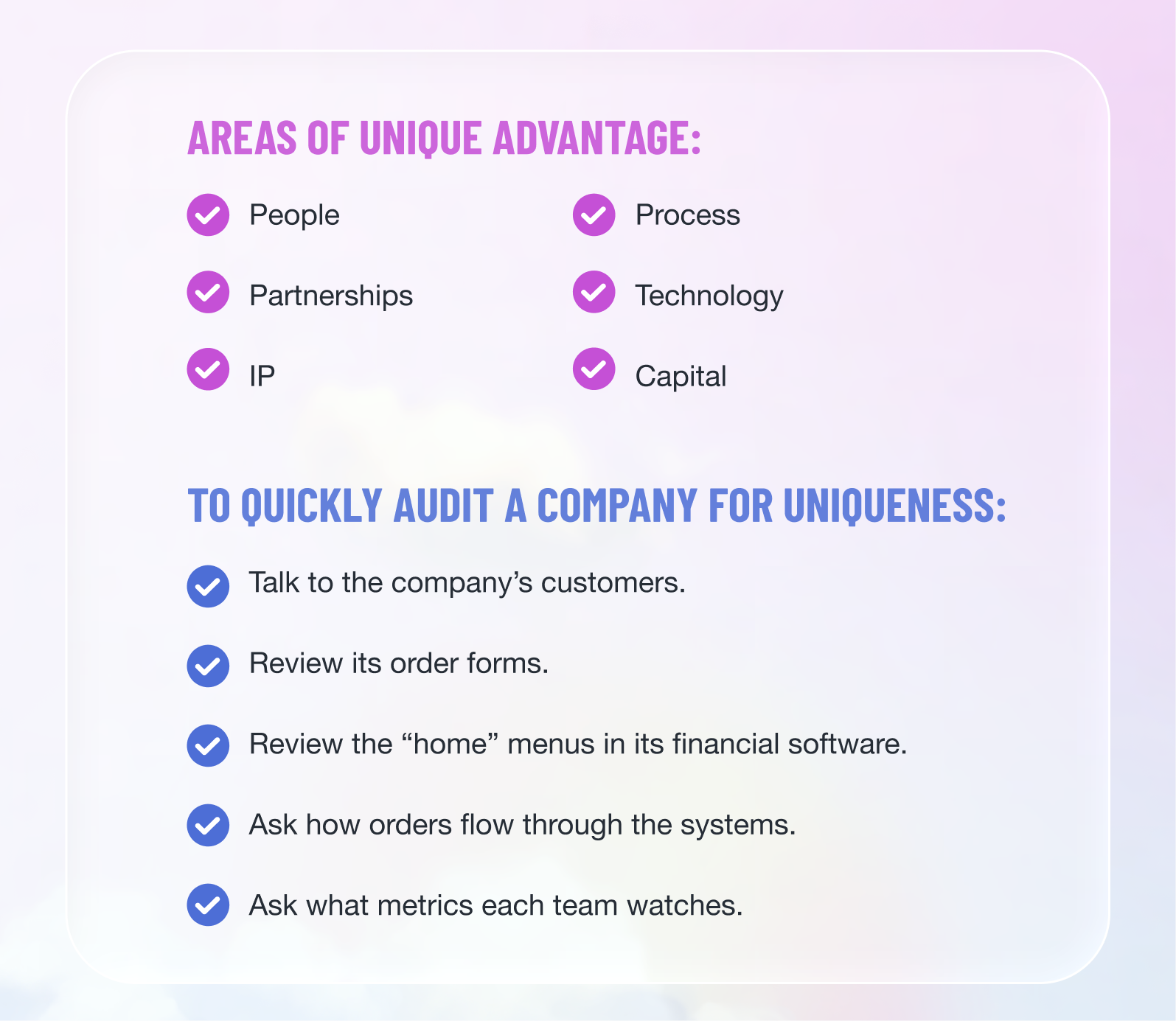
They also uncover the core uniqueness of an acquired company faster, which is vital. There is something that makes the business unique, or at least uniquely useful in the context of the new structure, and this isn’t always one-to-one with the thesis or anything that came out of due diligence. The business development team can push the deal through without a total understanding of its workflows and methods, systems, and databases. That’s your job. And we recommend you question the thesis and do your own discovery.
An integrations expert can tell nearly everything they need to know by looking at order forms and core fintech system menus.
Integrating the financial systems
Our theory on integrations is simple: Integrate financial systems as fully as you can up and to the point you erode value. That’s a difficult balance to find, but crucial. A company that leaves its integration alone to incubate may preserve its unique advantage (good) but also its known and unknown wasteful practices. It also tourniquets off all possibility of finding additional cost, revenue, or financial synergies. You can’t run co-marketing campaigns or unify master agreements when the systems are linked only by painstaking Excel work.
Questions to ask:
How flexible is the acquired company’s ERP?
Is it generic or vertical-specific?
Is it well-funded or barely supported?
Is it proven, or just a startup?
How heavily customized is it?
The newer the ERP, generally, the greater risk but also potential to customize. ERPs developed in the 1980s and 1990s were built on a very different theory of software—largely, waterfall with infrequent code releases. Those vendors are now locked into customer bases with loads of customizations and they cannot afford to innovate at the speeds newer ones—with smaller, more forgiving install bases—can. They were built to never change, which is strange, but not in the integration context.
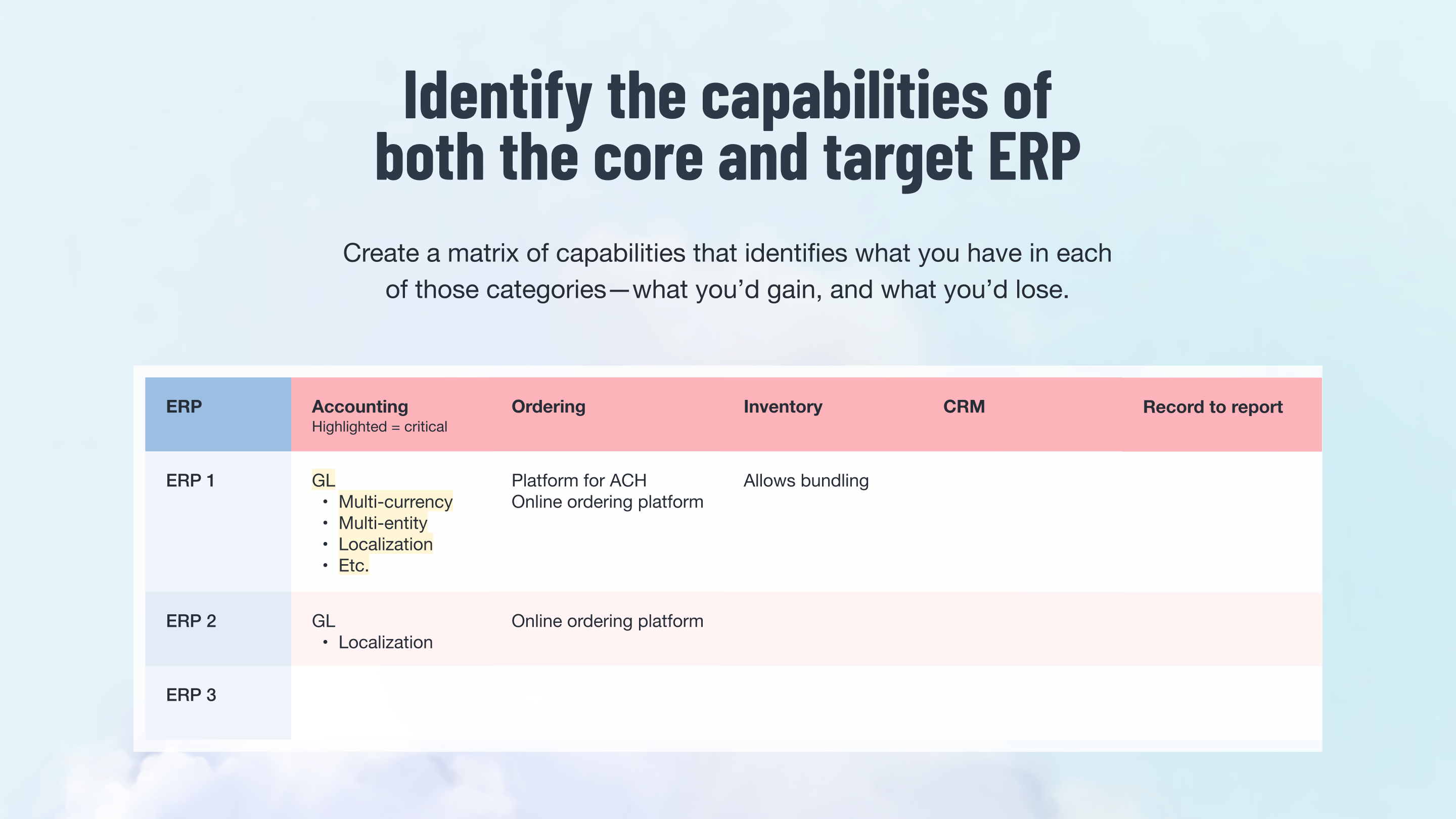
Create a matrix of capabilities that shows what you have in each of those categories: what you’d gain, and what you’d lose.
Your five integration choices
Applying everything you’ve gathered in this article, it’s time to make a decision. Each option has tradeoffs. Consider this your go/no-go checklist.
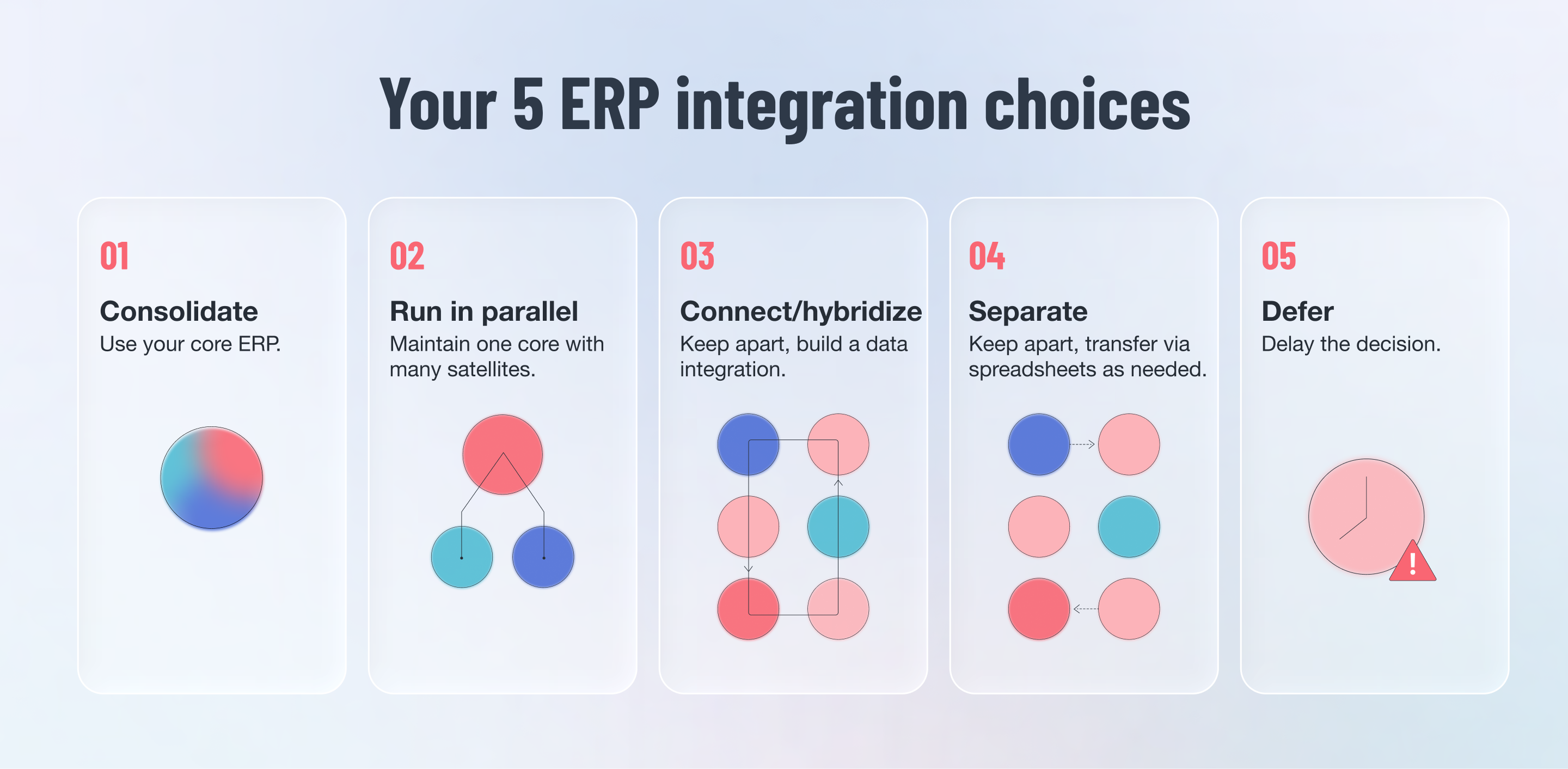
Consolidation should be your default. Even if the acquisition target loses some fidelity in its reporting and functionality in its customizations, the unified data and reporting is usually worth it. One telecommunications provider we worked with discovered that by consolidating, it eliminated an entire cottage industry of salespeople “claiming” sales that had simply been passed through a series of legacy systems to no net-revenue gain to the company.
However, consolidation can erode serious value. The food distribution conglomerate we talked to in writing this guide shared that when they acquired specialty producers and distributors, about half the time, those companies have such vertical-specific ERPs that it doesn’t make financial sense to change them. They’d lose too many features and too much of their unique advantage.
The cost of replacing legacy software is plummeting, by the way
With AI spec-driven development, you can use agents to entirely rewrite legacy software in newer languages and migrate it to a new environment. Learn about AiSpecify →
Run in parallel is a good option if you’ve acquired vertically and that company needs some of those vertical-specific applications to function. Pull as much functionality as you can into the core ERP, but allow them to use their own systems, integrated through API.
Hybridize is a good option if the systems really aren’t interoperable, but you need to conduct multi-entity reporting and have all the data you need for your period closes. It’s not ideal in the sense that the businesses will continue to operate independently. There is less opportunity for cross-selling and cost savings.
Separate is a reasonable decision if the acquired company is so different from the parent company that integrating offers more risks than benefits.
Defer is a smart decision if you just don’t know enough yet. If you can’t be confident that you know the critical data flows and workflows involved, wait. Waiting causes harm, but often less than pushing forward with an incomplete plan.
To integrate or defer?
Knowing your options will help you decide what's best for your organization. Companies with more flexible financial systems are at a great advantage. The easier it is to consolidate, the more use cases the core ERP can support. And in turn, the less reason there is to keep systems separate. More consolidation usually produces more synergies, which unfold with time.
Or at least that’s what teams that integrate dozens of ERPs every year have learned from successful repetition.