'%3e%3cellipse%20cx='185.202'%20cy='292.401'%20rx='236.2'%20ry='212.4'%20transform='rotate(180%20185.202%20292.401)'%20fill='url(%23paint0_radial_6113_7068)'/%3e%3c/g%3e%3cdefs%3e%3cfilter%20id='filter0_f_6113_7068'%20x='-130.996'%20y='0.000976562'%20width='632.398'%20height='584.8'%20filterUnits='userSpaceOnUse'%20color-interpolation-filters='sRGB'%3e%3cfeFlood%20flood-opacity='0'%20result='BackgroundImageFix'/%3e%3cfeBlend%20mode='normal'%20in='SourceGraphic'%20in2='BackgroundImageFix'%20result='shape'/%3e%3cfeGaussianBlur%20stdDeviation='40'%20result='effect1_foregroundBlur_6113_7068'/%3e%3c/filter%3e%3cradialGradient%20id='paint0_radial_6113_7068'%20cx='0'%20cy='0'%20r='1'%20gradientUnits='userSpaceOnUse'%20gradientTransform='translate(-43.0144%20248.324)%20rotate(-25.0248)%20scale(462.733%20514.489)'%3e%3cstop%20stop-color='%23FF9DDA'/%3e%3cstop%20offset='0.44'%20stop-color='%23F7FF9D'%20stop-opacity='0.52'/%3e%3cstop%20offset='0.84'%20stop-color='%23FF8B7B'%20stop-opacity='0.2'/%3e%3cstop%20offset='1'%20stop-color='%23F7FF9D'%20stop-opacity='0'/%3e%3c/radialGradient%3e%3c/defs%3e%3c/svg%3e)




As the industry pivots from pure subscription to consumption-based and hybrid pricing models, the cracks in legacy finance and GTM stacks are becoming fault lines, costing companies margin, expansion revenue, and forecast accuracy. I believe the CFO who cannot see product telemetry in real time is flying blind in pricing the wrong deals, forecasting the wrong numbers, and losing the expansion motion to competitors who can.
And yet the default when I talk to other leaders is a disconnected stack, where despite all the expensive software, CSVs still dominate, and the parts don’t scale.
For this guide, I draw upon my 15 years of operating experience across GTM operations, RevOps, and finance leadership—spanning traditional SaaS and hybrid-consumption businesses—to map the exact gap between where most finance organizations are today and where the AI-native, connected data stack is taking the leaders.
The billion-dollar leak: What 3-5% lost ARR feels like
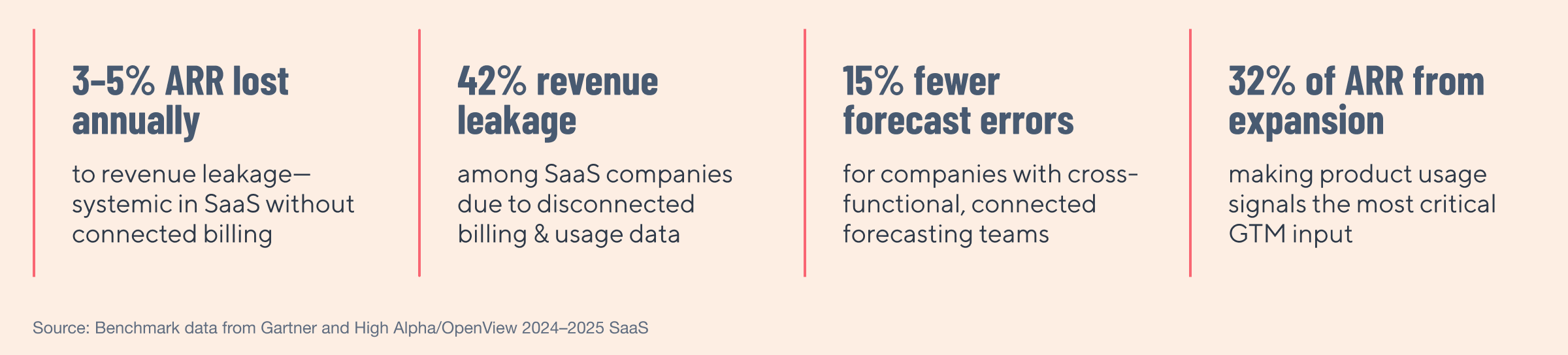
Revenue leakage is not an abstract percentage. At scale, 3–5% ARR leakage, the benchmark for SaaS companies without connected billing and usage data, compounds into an annual loss that dwarfs most finance transformation budgets. See the table below for reference.
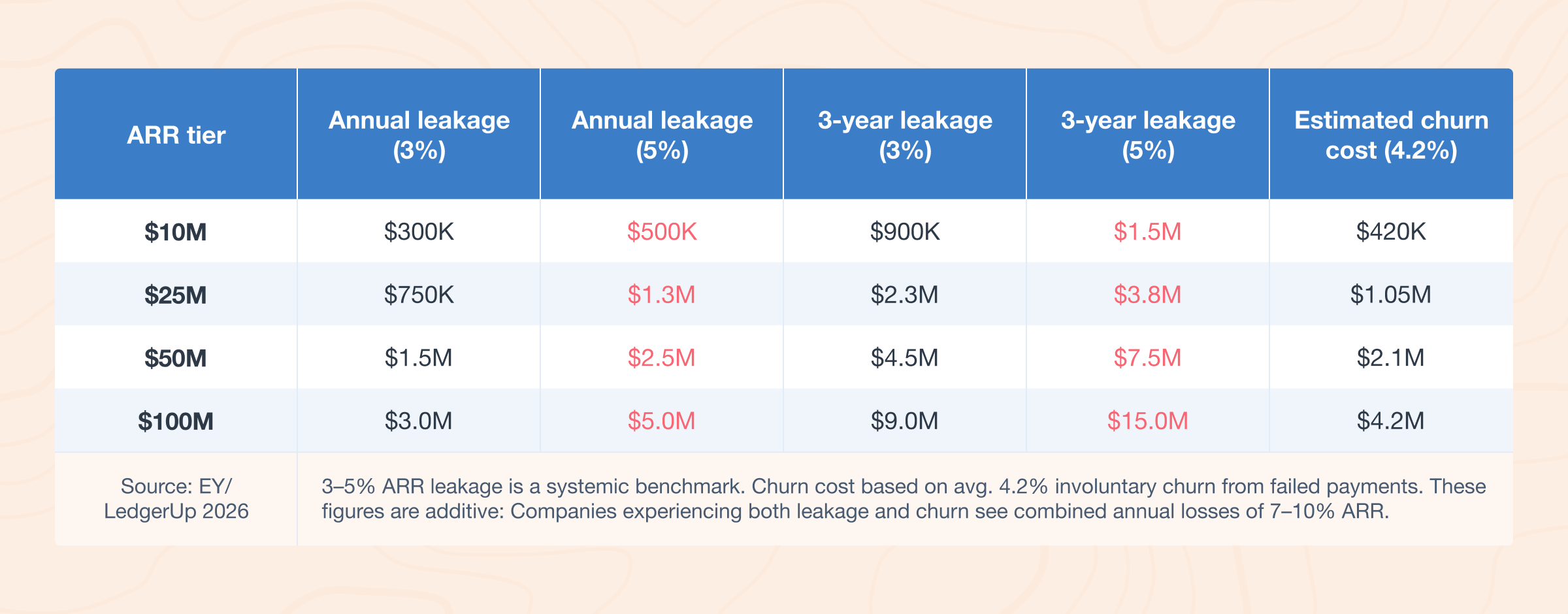
Revenue leakage is systemic and silent, unlike churn, which is visible and tracked. The cost of inaction in this area compounds. Here is what happens to a $25M–$50M ARR SaaS company that delays the connected stack transformation by 12–18 months:
The leakage accumulates. Over 18 months at 20% ARR growth, cumulative unrecovered leakage exceeds $4M. That’s plenty to have invested in better systems and then some.
The board stops believing your forecast. Without connected consumption data, FP&A variance widens each quarter as usage-based revenue grows as a share of ARR. By month 18, the CFO is presenting guidance with 20–30% variance. The board is sure to notice.
Big expansion windows close, permanently. The land-and-expand motion depends on acting on usage signals within 7–14 days of an inflection point. Every month without a connected GTM signal layer is a month of expansion revenue that cannot be recovered retroactively.
Engineering and finance diverge. As the product evolves, billable event definitions drift further from finance's billing logic. Each sprint cycle without a shared data dictionary makes the eventual reconciliation more expensive and the shadow close period longer.
The talent gap widens. Experienced RevOps and finance operations leaders who can build the connected stack are increasingly rare and expensive. Organizations that delay building this capability internally will face a more competitive hiring market in 18–24 months.
It’s a critical unaddressed issue. But what’s the alternative? That is, increasingly, what I call the “connected stack,” which isn’t easy, but is now feasible. And it recovers gaps in the first phase of implementation, making it the highest ROI finance initiative available to a growth-stage SaaS CFO.
As it is not a single tool or platform, the connected stack is the deliberate architecture designed to eliminate the latency and manual translation layer between what is happening in your product, your CRM, and your financial systems, and surface that context directly to CFO, CRO, customer success, and FP&A teams.
If you have built a connected stack, that means four things:
No batch exports, no spreadsheet bridges: Product usage telemetry flows in real time to your billing engine.
No manual reconciliation: Billing events (overages, expansions, renewals) automatically update CRM, FP&A, and ERP.
Immediate insight into customer changes: AI-assisted analytics surface which accounts are expanding, contracting, or at risk before the CFO has to ask.
Not siloed in departmental dashboards: All intelligence is aligned to company objectives and board-level indicators.
This will invariably require at least some new technology, for not everything can be connected with iPaaS pipelines. A simpler architecture is better. But before you launch an RFP, consider a new model for evaluating technologies this time around.
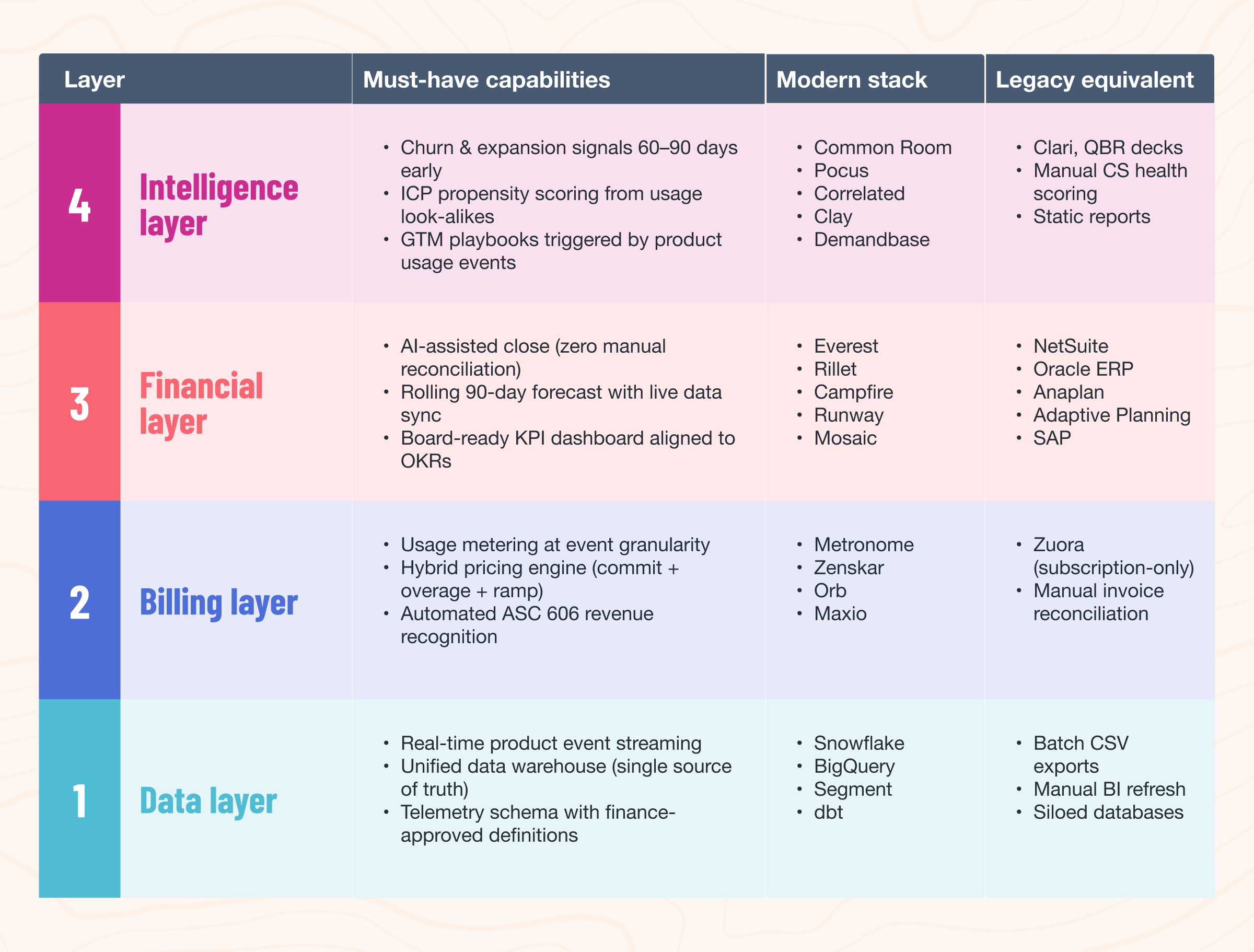
A four-layer model for the connected finance stack
Every capability of every tool you purchase hereafter should map to one of four layers. Your current state assessment and implementation sequencing should follow this architecture from the bottom up.
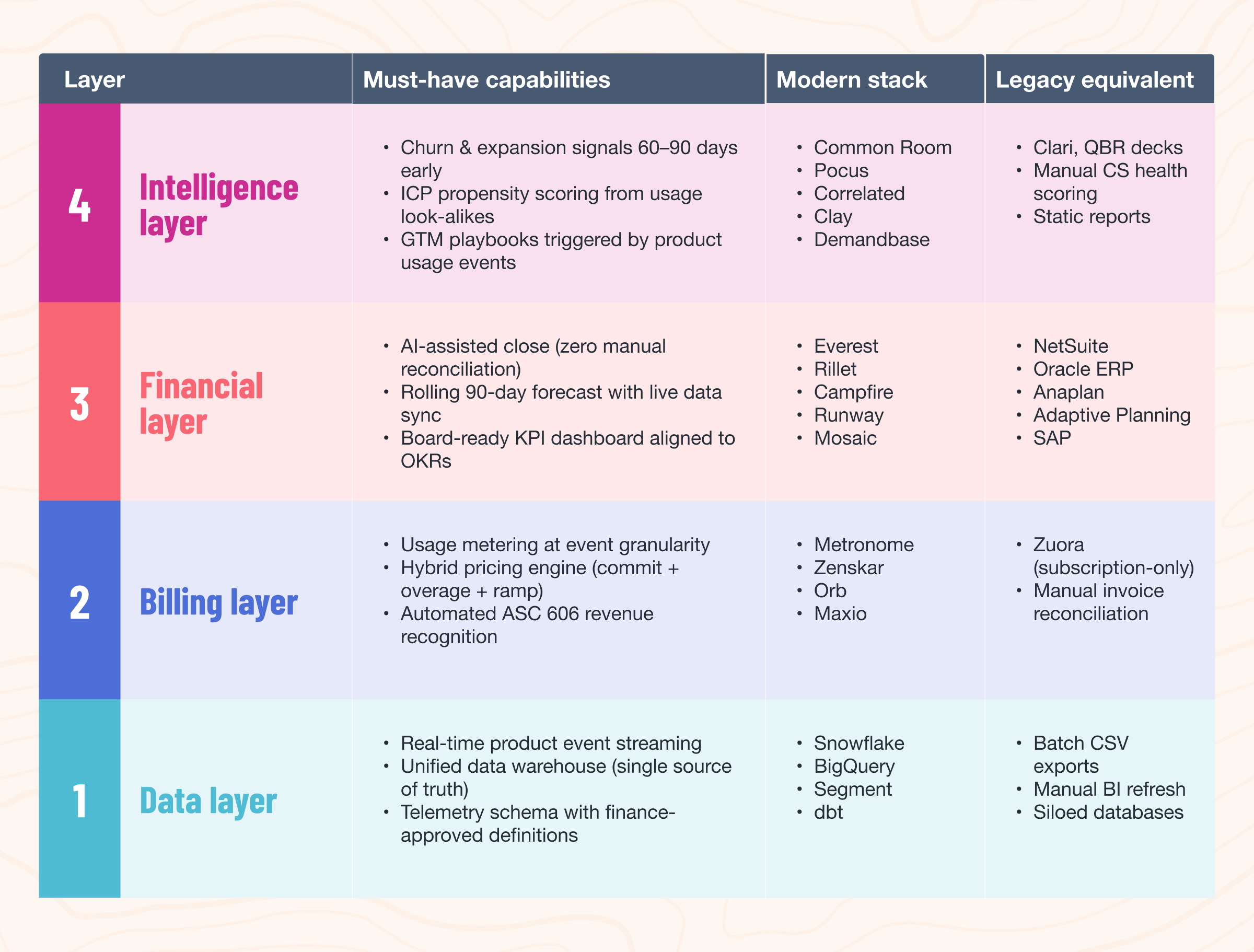
To use this model, audit your current stack against these four layers. Most organizations doing $10M–$50M ARR have layer 3 (some ERP) and partial layer 4 (Salesforce/Tableau reports), but are missing layer 1 (real-time product telemetry) and layer 2 (consumption-aware billing). The absence of layers 1 and 2 is why layers 3 and 4 produce unreliable outputs. Fix the foundation first.
Go with an API-first architecture
When I say modern tools are API-first, built for consumption models and designed to sync bidirectionally with the product data layer, I mean something specific and important for any CFO or COO evaluating a stack transformation. Every capability should be exposed via documented API. Systems should communicate in real time, not through nightly CSV exports or manual data entry.
This way, consumption pricing generates billing events every minute, not once a month. Legacy batch systems were not designed for this event density. Manual handoffs introduce lag, errors, and leakage. Do this and the CFO will see real-time revenue. FP&A forecasts will update continuously. Sales can pull live consumption baselines. The entire org operates from the same data, aligned to today’s objectives, not yesterday's exports.
The connected stack generates data, but also trust
When presented with an AI-native stack transformation, most CFOs have an immediate and valid objection: "My data is already a mess. AI can't fix that." This is true. This is not a technology problem. It is a governance problem, and it must be solved before any AI-assisted analytics or automated billing can be trusted.
In a consumption-based model where billing events happen every minute rather than once a year, poor governance doesn't just create messy reports. It creates direct revenue leakage, customer billing disputes, and forecasts that finance will never trust enough to present to a board.
Let’s say you want to prepare to address those issues. What’s most likely to kill your connected stack project? In my experience, it’s three things:
1) Unit definition mismatch: Engineering defines a 'query' differently than finance defines a 'billable unit.’ The forecast will never reconcile.
2) Data-quality drift: Usage spikes or telemetry errors get billed before anyone validates them, generating customer disputes within 30 days.
3) Audit readiness gap: Continuous close is fast but not audit-ready. Revenue is recognized in the wrong period, creating restatement risk.
To remedy that, I propose the governance framework in five layers.
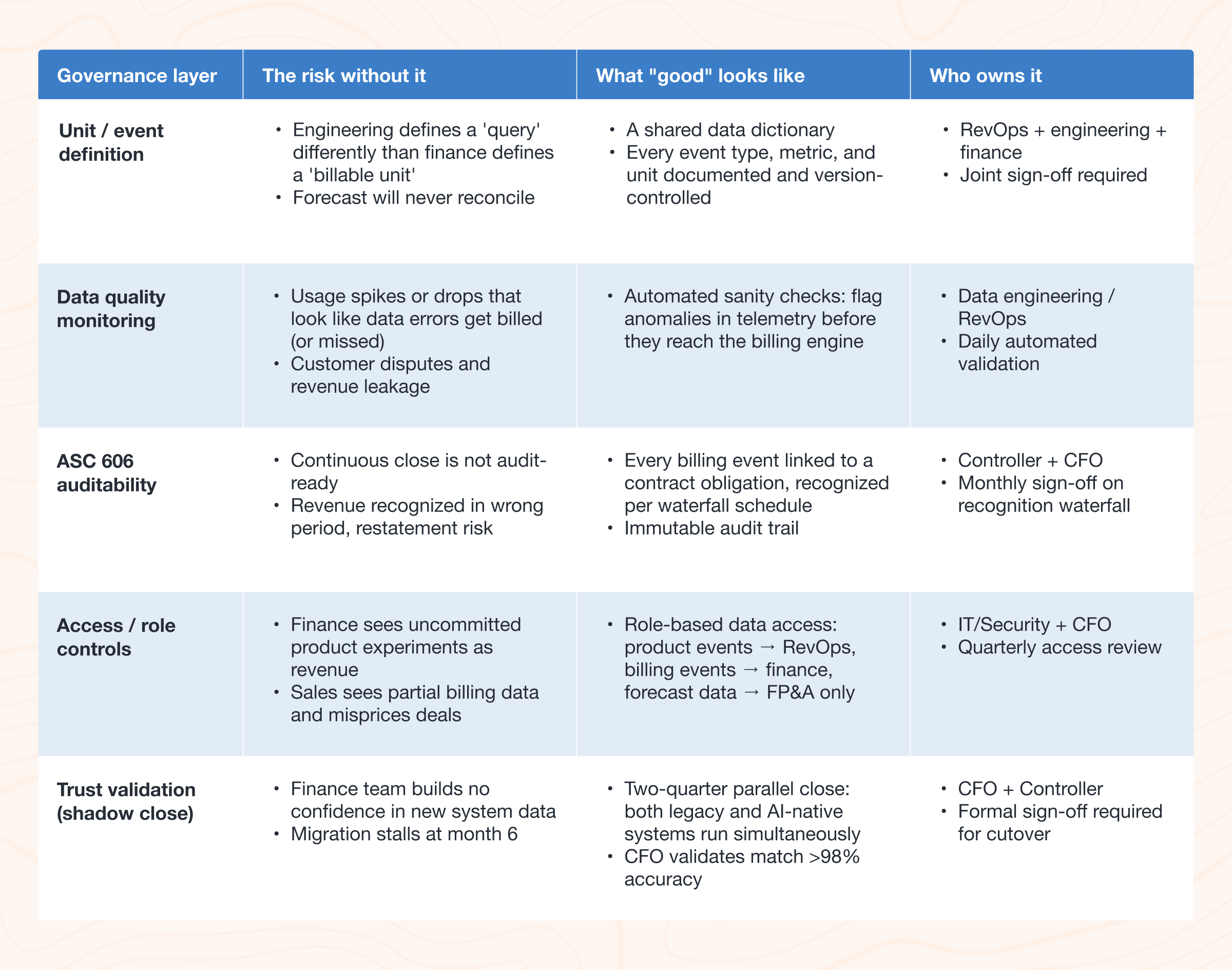
The trust factor is a big one. As noted throughout, finance teams must trust the data before they will build forecasts from it. You will need to run a shadow close period: two quarters of parallel close in both legacy and connected systems. It is the governance mechanism that converts skeptical controllers into advocates. When the connected stack's data matches the legacy ERP at >98% accuracy for two consecutive quarters, organizational buy-in happens automatically. Without that validation, even the best technology will be abandoned.
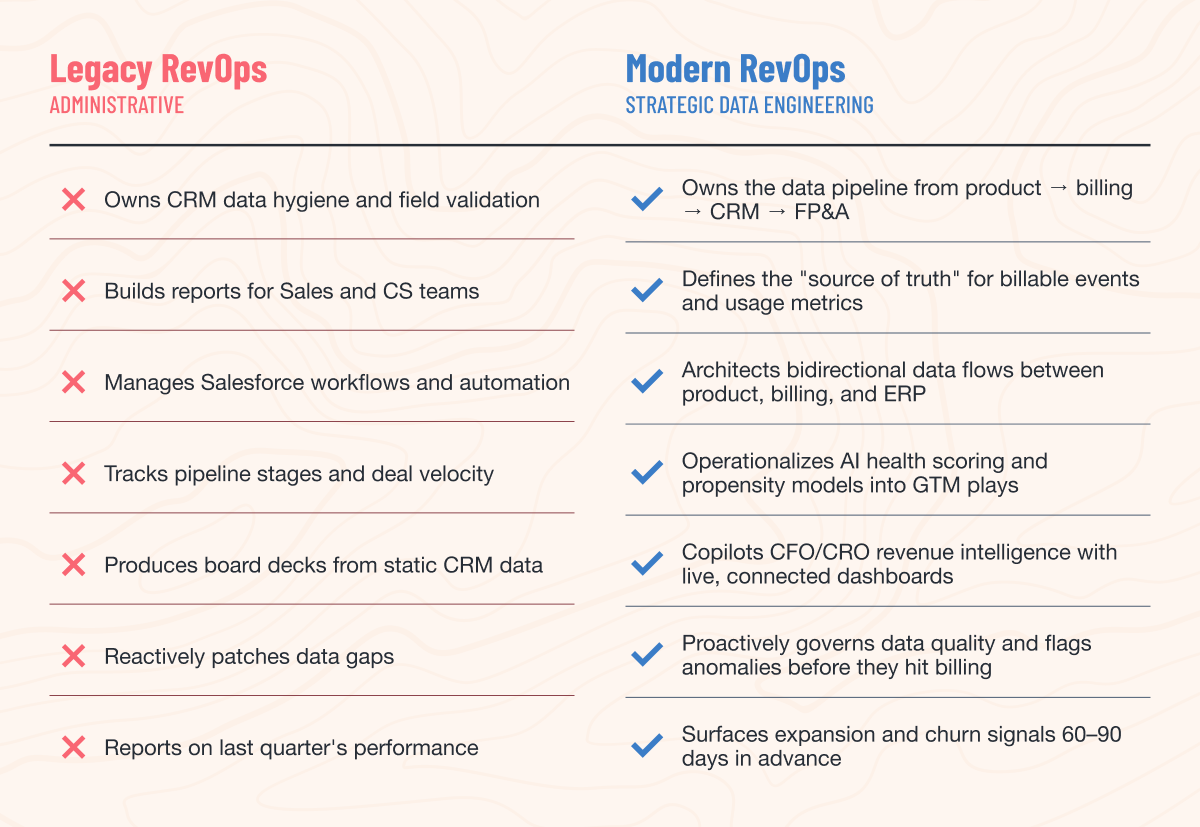
Who will lead this transformation?
The connected stack transformation requires a fundamentally different kind of RevOps leader than the one most organizations currently have. The transformation demands a strategic data engineering leader who owns the data pipeline, defines the governance framework, and copilots revenue intelligence with the CFO and CRO.
The leader of this project must have both technical credibility as well as financial fluency of standard indicators. If this person doesn't exist in your organization today, it is the first hire the CFO should make before any technology vendor is engaged.
Lead-to-cash before and after the connected stack
The GTM motion in a consumption-based world is fundamentally different from the annual contract SaaS playbook. Every stage of the funnel is affected, from how you identify ICP prospects to how you price a deal to how you recognize revenue and identify expansion signals.
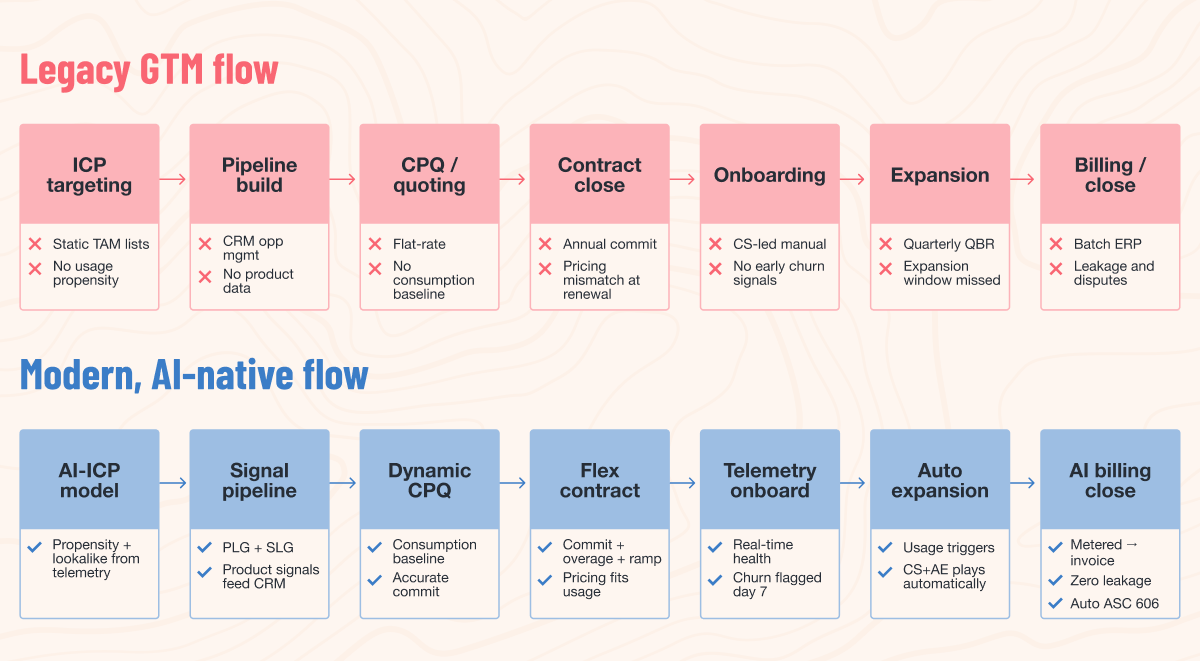
These modern tools are not direct replacements for legacy systems on a feature-by-feature basis. The primary ROI driver is consolidation of fragmented data flows, elimination of manual reconciliation, and significant reduction in implementation cost, licensing complexity, and ongoing maintenance burden. A $25M ARR SaaS company running NetSuite + Zuora + Anaplan + Salesforce CPQ may have 4–6x the implementation and maintenance cost of a well-designed, connected modern stack, but with a fraction of the real-time intelligence and a higher total cost of inaction.
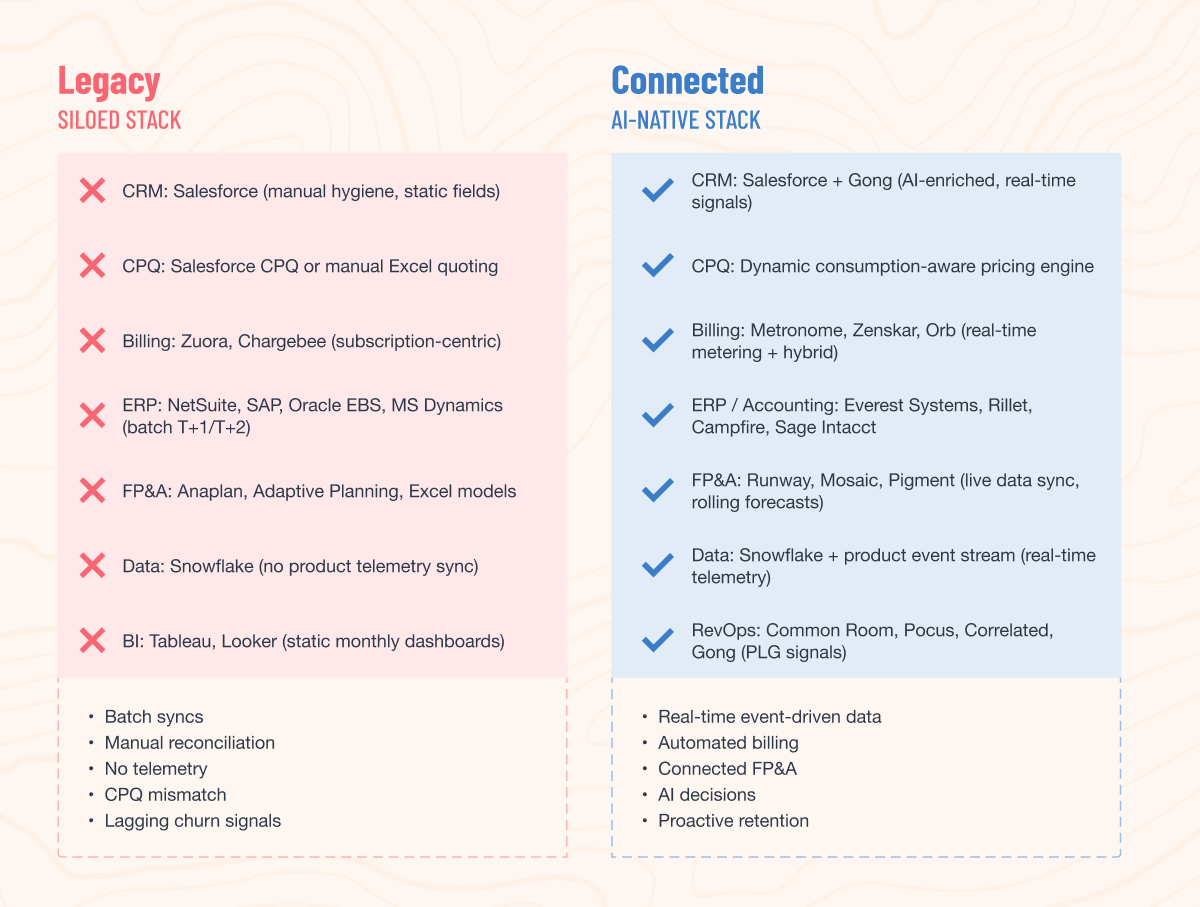
Consider each tool’s contribution to at least one of the four layers
Every tool in the market maps to one of the four layers. The question is whether your current stack provides each capability at the right data latency and integration depth. The capability map below shows the three non-negotiable capabilities per layer, the modern tools that deliver them, and the legacy equivalents being replaced.
By “AI-forward stack,” I mean they deliver on the spirit of what every modern CFO and COO is trying to do. And that is to drive impactful, real-time decision making with proper governance, auditability, and alignment to company OKRs. The goal is to reduce the distance between a business event and a coordinated organizational response from weeks to minutes.
Real-time intelligence unlocks everything
When product telemetry, billing events, and CRM signals are unified in a connected data layer and surfaced through AI-assisted analytics, the CFO and CRO gain the following capabilities that were simply not possible in the legacy stack.
Pipeline forecasting: Consumption trajectory + CRM pipeline = rolling 90-day forecast. Best-in-class variance <5%. Connected teams achieve it; siloed teams average 15-20%.
ICP propensity: ML on product usage patterns identifies lookalike prospects, ranks whitespace by account, and scores ICP fit from real-time telemetry.
Pricing intelligence: Usage distribution vs. committed tiers reveals actual consumption, enabling dynamic pricing optimization and accurate commit structure design.
Churn and expansion: Leading indicators from engagement surface 60-90 days early. NRR >111% is a top-quartile target. 90%+ GRR is median and requires real-time signal.
This newfound pricing flexibility gives you an additional strategic lever. The shift from pure subscription to consumption-based and hybrid pricing is accelerating. Hybrid pricing only creates competitive advantage when the finance stack can operationally support it. A company offering consumption pricing on a billing system built for flat subscriptions faces three compounding problems: revenue leakage from unmetered overages, forecast variance from consumption unpredictability, and misalignment when sales cannot configure accurate consumption-based quotes.
How to achieve a connected stack in 9 months
The 9-month sprint is the right model when: (a) the board or CEO is demanding visible ROI within one fiscal year, (b) revenue leakage is quantified and immediate—the cost of inaction exceeds the cost of a fast transformation, or (c) the organization has already done the data foundation work (Snowflake/BigQuery in place, product telemetry streaming).
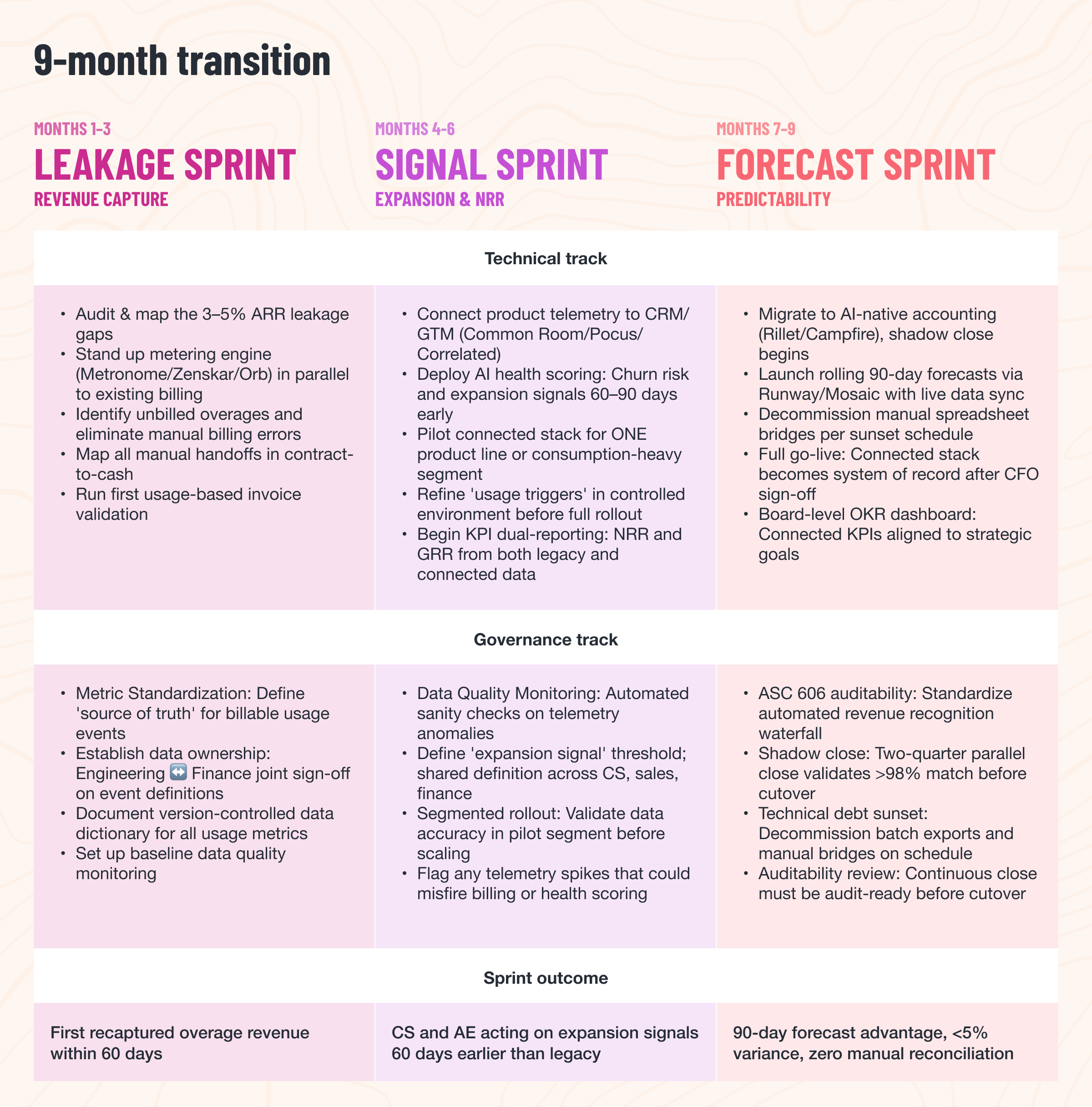
The governance track is not optional as it runs concurrently. It is not a phase 4 activity as it runs alongside every technical milestone from day 1. Teams that skip governance in the sprint model to move faster invariably hit the same wall at month 7: Finance refuses to trust the new data, the shadow close reveals unexplained variances, and the project stalls. The teams that treat governance as foundational and not cosmetic, complete the sprint in nine months instead of 18.
How to achieve a connected stack in 18 months
This is similar to the 9-month rollout, but with the luxury of a shadow close, segmented rollout, and sunset schedule. The 18-month transformation is the right model when the legacy stack is deeply entrenched, the finance team needs a longer trust-building period, or the business is mid-series and cannot afford operational disruption.
For organizations with deeply embedded legacy stacks, a longer transformation arc allows finance teams to build data trust incrementally through structured validation and not blind migration. The 18-month model introduces the three critical mechanisms absent from most digital transformation playbooks outlined here:
The shadow close: Schedule a two-quarter parallel close: Finance performs month-end in both the legacy ERP (NetSuite) and the AI-native system (Rillet/Campfire) simultaneously. CFO validates match >98% accuracy before authorizing cutover. This is the trust-building mechanism that is not optional.
Segmented rollout: Instead of a global launch, pilot the connected stack for a single product line or consumption-heavy customer segment first. Refine 'usage triggers' and 'dynamic CPQ' in a controlled environment. When the pilot segment shows clean data and validated billing, expand to the next segment.
Technical debt sunset: To prevent 'parallel' from becoming 'permanent,' publish a clear decommission schedule for legacy manual spreadsheet bridges, batch exports, and point-to-point integrations. Each module of the connected stack gets a validation milestone. Once met, the corresponding legacy process is sunset.
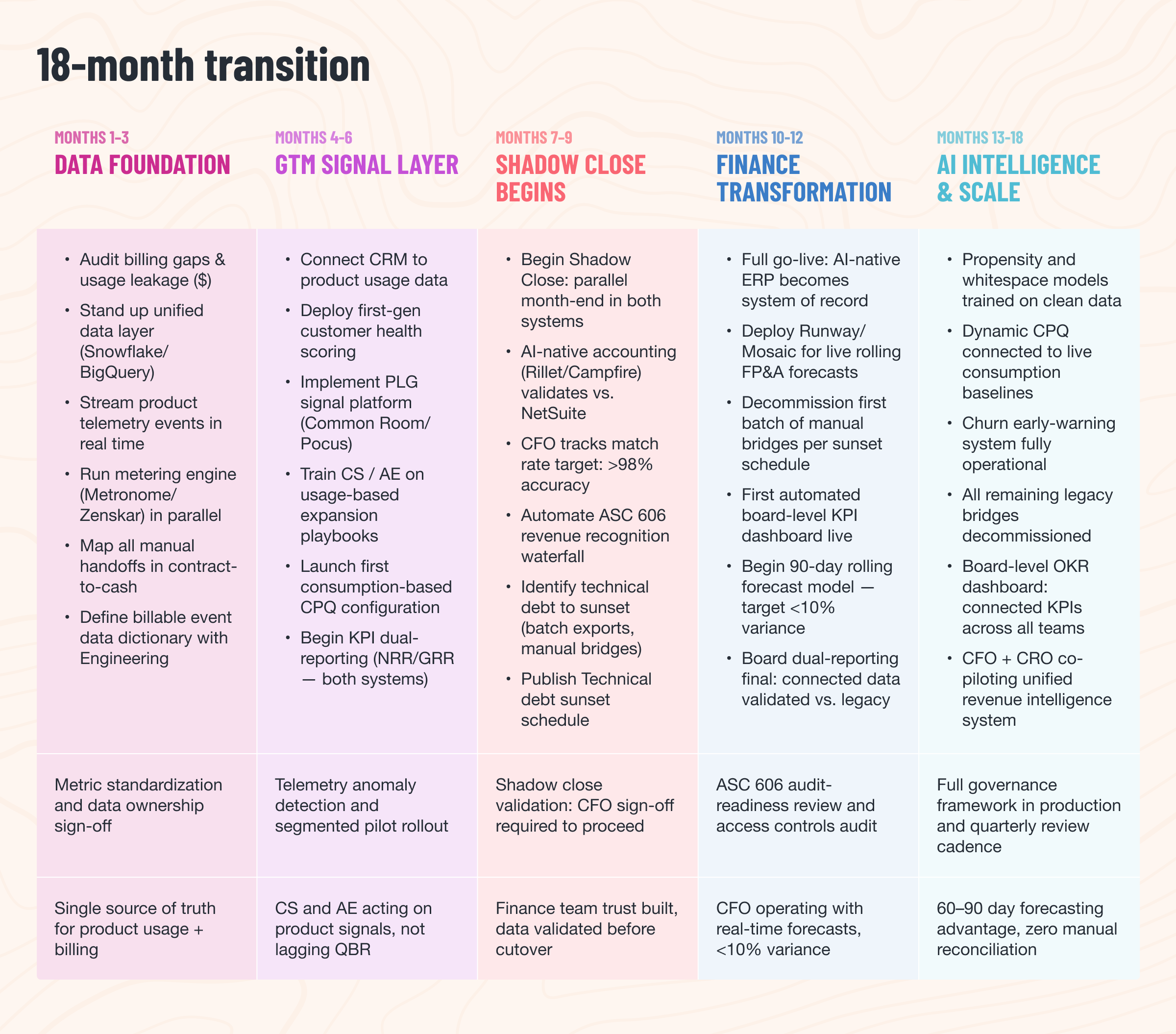
KPI dual-reporting will get you the buy-in you need. During the transition (months 4–12), report board-level KPIs using both legacy and connected data simultaneously. Present both numbers side by side in every board deck. When the connected stack begins surfacing churn risks 60 days earlier than the legacy system, and the prediction proves accurate, organizational buy-in happens automatically. No change management program required. The data makes the case.
The imperative is now, and this is your call
The companies winning in the consumption era are not winning because they have better products. They are winning because their finance and GTM systems are wired together which allows the CFO to see the same real-time signals as the CRO, the CS team, and the billing engine. And they have built the governance infrastructure to trust that data at board level.
The legacy stack was built for a world of stable annual contracts and predictable growth. That world is over for most of the software industry. The modern CFO who invests in the connected stack will grow faster, retain more, and expand with precision.
Whether you choose the 9-month velocity sprint to attack revenue leakage immediately, or the 18-month transformation to build data trust incrementally through shadow close and segmented rollout, the direction is the same. The CFOs who move now will have a 60–90 day intelligence advantage over competitors who are still building forecasts from yesterday's exports.
There have been many periods of transformation before, but this one is different. The connected stack is not a technology upgrade. It is a governance framework, a data architecture, and a strategic operating model, all in one. Build the trust infrastructure first, and the AI intelligence follows.