'%3e%3cellipse%20cx='185.202'%20cy='292.401'%20rx='236.2'%20ry='212.4'%20transform='rotate(180%20185.202%20292.401)'%20fill='url(%23paint0_radial_6113_7068)'/%3e%3c/g%3e%3cdefs%3e%3cfilter%20id='filter0_f_6113_7068'%20x='-130.996'%20y='0.000976562'%20width='632.398'%20height='584.8'%20filterUnits='userSpaceOnUse'%20color-interpolation-filters='sRGB'%3e%3cfeFlood%20flood-opacity='0'%20result='BackgroundImageFix'/%3e%3cfeBlend%20mode='normal'%20in='SourceGraphic'%20in2='BackgroundImageFix'%20result='shape'/%3e%3cfeGaussianBlur%20stdDeviation='40'%20result='effect1_foregroundBlur_6113_7068'/%3e%3c/filter%3e%3cradialGradient%20id='paint0_radial_6113_7068'%20cx='0'%20cy='0'%20r='1'%20gradientUnits='userSpaceOnUse'%20gradientTransform='translate(-43.0144%20248.324)%20rotate(-25.0248)%20scale(462.733%20514.489)'%3e%3cstop%20stop-color='%23FF9DDA'/%3e%3cstop%20offset='0.44'%20stop-color='%23F7FF9D'%20stop-opacity='0.52'/%3e%3cstop%20offset='0.84'%20stop-color='%23FF8B7B'%20stop-opacity='0.2'/%3e%3cstop%20offset='1'%20stop-color='%23F7FF9D'%20stop-opacity='0'/%3e%3c/radialGradient%3e%3c/defs%3e%3c/svg%3e)




For example, have you ever added a new required field to, say, an expense report? What was the result? You probably noticed that it didn’t immediately produce the desired outcome. More likely, you saw a sudden spike in “bank fee” reports which makes no sense until you consider it’s the first item on the list, and people are being lazy. This dropdown is standing between them and picking up their kid from daycare.
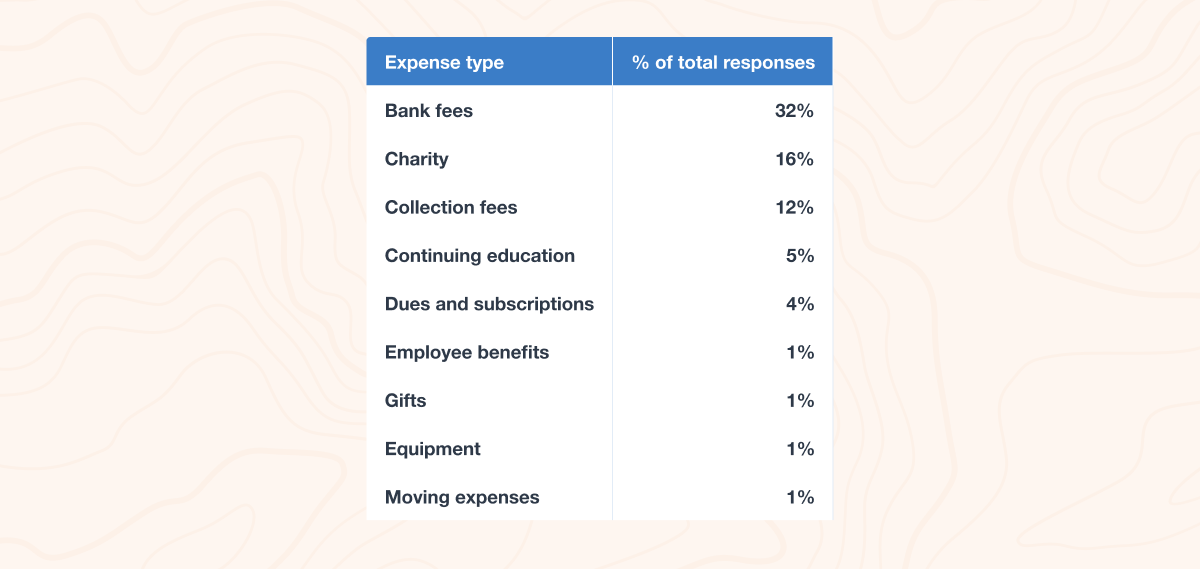
This is called the primacy effect. People will tend to check whatever box first just to move on. Forcing them to care as much as you do by adjusting the software—aka strengthening the scaffold—only ensures they make your day harder and their day worse.
Perhaps that’s inconvenient for us to say as makers of an ERP software, but it’s the truth. The non-tech factor is a major factor. You cannot force people; they’ll keep squirming around the rules. You can’t use the ERP to make two departments talk if they don’t want to. You can’t force a line of business leader to start sharing utilization data if that leader thinks it’ll make her look bad.
Software makes it possible. But it doesn’t make it likely. And you can see that in major blowups, like when the city of Birmingham, UK blew £129 million over three painful years.
The city of Birmingham had an ERP strategy, but no people strategy
We rarely get first-person insight into how ERP implementations go wrong. But when they occur in the public sector, documents tend to leak. Or they are shared freely, as was required of Birmingham’s auditor, Grant Thornton. We analyze those documents here.
The story is fairly simple: In 2023, Birmingham purchased Oracle’s ERP for a project total of £39 million, including implementation. Two years later, Grant Thornton was brought in to conduct an audit. They catalogued all manner of malpractice, including the embarrassing fact that the city never got it set up—and had been without any functioning core financial system for two years. They’d paid all that money and then continued to work from spreadsheets.
Pictured is Grant Thornton’s executive summary from the report. Notice anything about it?
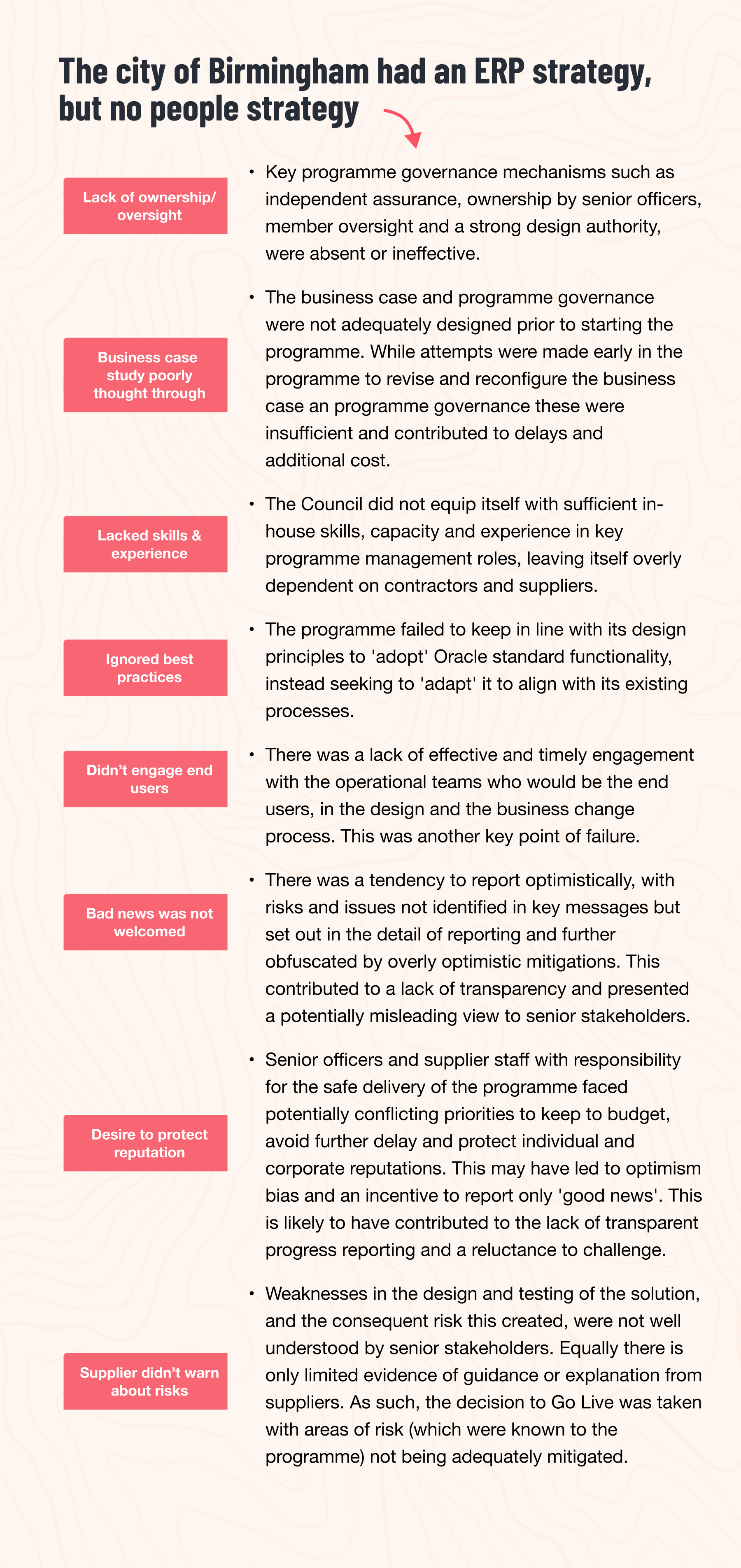
That’s right—eight out of eight deficiencies were human issues. No doubt Oracle’s systems did not help, nor did their aggressive sales culture. But any ERP would have struggled in this situation. There was a lack of ownership. The city’s IT team lacked the right skills and experience, and didn’t plan to find the right people. They ignored their Oracle implementation team’s best practices, did not consult end-users, and leadership created a culture where bad news wasn’t welcome.
As a result, the city had to fire Oracle’s implementation team and hire another for an additional £90 million. Plus, that amount does not account for the waste of two years of inefficient, improperly documented citywide financial work done in spreadsheets.
But what if HR had been in charge? It’s a funny question and I mean it partly in jest. They’d have centered the people in this equation, known it wouldn’t go according to the best possible scenario, and considered how to get everyone aligned.
Let’s explore how Birmingham’s situation could have gone differently if HR was in charge.
8 reasons HR should lead the ERP rollout
Sometimes you need experts. But sometimes, you want inexperts, who humbly ask questions no one else would consider. Experienced tech teams will tend to design a workflow based on what is possible and assume everyone knows as much as they do, which is referred to as the curse of knowledge. Whereas HR teams placed in charge of a tech rollout would probably ground their expectations in what is likely, and think harder about the risks.
Plus, unlike implementation partners, HR teams would come in knowing everyone’s dirt. They’d know which departments work well together and which don’t, and that would be a major step up. These are things an implementation partner couldn’t figure out in even the most thorough audit.
Let’s say HR was in charge in the Birmingham case:
1. Lack of ownership → HR will write it into an exec’s OKRs
For most people at work, compensation is the destination. If you want to not have to rely on people’s goodwill, which is risky, you’d incentivize them directly. The HR team could write the ERP launch milestones and measurements into one ultimately responsible executive’s objectives and key results (OKRs), with key results that flow down to their team. They could put it on all the steering committee’s objectives too.
This would put people’s pay and promotions on the line, which might inspire more focus.
2. Unclear business case → HR will consider how it impacts each team’s metrics
ERP rollouts are famously grueling. Part of that is the fact that people don’t get a pass on their other duties while participating. They only have so many hours to give, and diagramming their own processes or testing a new interface, will keep getting bumped until tomorrow, and then tomorrow, and then tomorrow.
HR might see it differently. If the company doesn’t want to release people from their duties, it’s worth asking, is the rollout worth it, given the risk? There’s always a business case to be made for it, and there are plenty of comparables. Consider Birmingham: How many people would you commit to prevent a £39 million ERP purchase from slipping into two lost years and an additional £90 million reattempt?
3. Lacked skills and experience → HR will find or hire the right staff
Unlike other teams, HR has a realistic sense of how long it takes to train people, and wouldn’t let that rollout or training be an afterthought. The recruiting and development team could have been proactively involved in helping the tech team understand their skills gap, and how to fill it, full-time or contract, freelancers, or implementation agencies.
4. Ignored best practices → HR wants a better workplace
Birmingham ignored Oracle’s recommendations on how to modify its intercompany workflows like cross-functional reporting. Presumably, with the phrase, “That’s not how things are done here.” But, if things were done well, would they be implementing an ERP?
HR wouldn’t approach the project with the hubris to think that avoiding small disputes now by keeping systems the same wouldn't come back to bite them, just as this did.
Plus, HR wants a better workplace. That’s part of their selling point. If they can reduce mechanical work and manual labor, and invite in newer systems, that burnishes their employer brand. They want positive change.
5. Didn’t engage users → HR would obviously engage users
HR cares about the employee experience. They are on the hook for re-filling empty roles and fielding complaints. HR would do a much better job of gathering requirements from each team that will touch the system—and is already starting from a stronger basis, being involved in everyone’s performance reviews.
6. Bad news was not welcomed → HR would invite 360-degree feedback
HR teams are the lightning rod for the entire organization’s most sensitive conversations, and it’s unlikely they would shy away from welcoming bad news. Unlike a CIO who brooks no debate, they’d offer protection and channels for whistleblowers. And they’d push disagreements into the light with continuous feedback and all-around reviews.
7. Desire to protect reputations → HR would mediate confrontation
HR is everyone’s channel for reporting bad behavior. It’s not always foolproof. But a continuous performance management process could have potentially caught more of the doubts among front-line IT managers and users. HR also thinks farther out about risk management, and could be thinking about the long-term impact of making the wrong decision to protect someone’s ego.
8. Supplier didn’t warn of risks → Actually, HR can’t help here
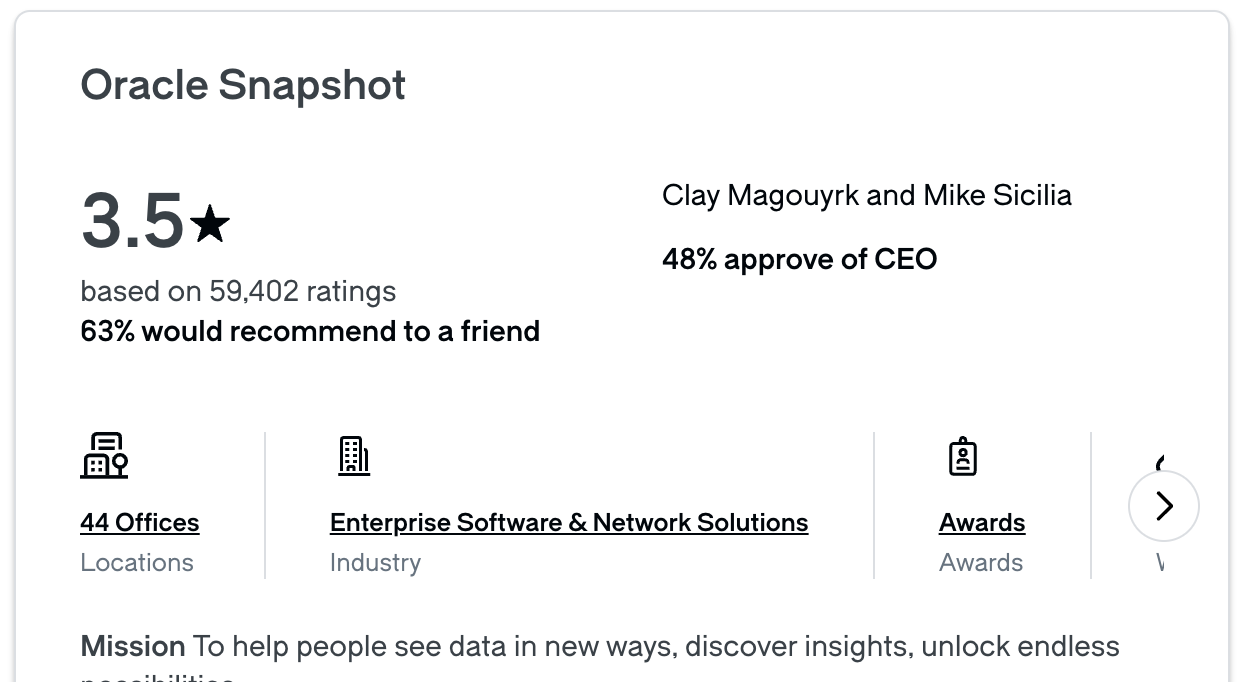
The only takeaway here is don’t choose Oracle. However, one search of Glassdoor and HR could have told you that.
Should you delegate your ERP rollout strategy to HR?
I offer this mostly in jest. It’s a provocation and an opportunity to think about those three big empty seats on most ERP rollout projects: HR, recruiting, and the learning and development team. But also to make a point: You can’t discount the human factor when so much of this—eight out of eight contributing factors, in Birmingham’s case—have to do with whether people acted in accordance with the plan.
And if enforcing a drop-down field in an expense management app or ERP can teach us anything, software is just a scaffold. And employees treat it as a suggestion.