'%3e%3cellipse%20cx='185.202'%20cy='292.401'%20rx='236.2'%20ry='212.4'%20transform='rotate(180%20185.202%20292.401)'%20fill='url(%23paint0_radial_6113_7068)'/%3e%3c/g%3e%3cdefs%3e%3cfilter%20id='filter0_f_6113_7068'%20x='-130.996'%20y='0.000976562'%20width='632.398'%20height='584.8'%20filterUnits='userSpaceOnUse'%20color-interpolation-filters='sRGB'%3e%3cfeFlood%20flood-opacity='0'%20result='BackgroundImageFix'/%3e%3cfeBlend%20mode='normal'%20in='SourceGraphic'%20in2='BackgroundImageFix'%20result='shape'/%3e%3cfeGaussianBlur%20stdDeviation='40'%20result='effect1_foregroundBlur_6113_7068'/%3e%3c/filter%3e%3cradialGradient%20id='paint0_radial_6113_7068'%20cx='0'%20cy='0'%20r='1'%20gradientUnits='userSpaceOnUse'%20gradientTransform='translate(-43.0144%20248.324)%20rotate(-25.0248)%20scale(462.733%20514.489)'%3e%3cstop%20stop-color='%23FF9DDA'/%3e%3cstop%20offset='0.44'%20stop-color='%23F7FF9D'%20stop-opacity='0.52'/%3e%3cstop%20offset='0.84'%20stop-color='%23FF8B7B'%20stop-opacity='0.2'/%3e%3cstop%20offset='1'%20stop-color='%23F7FF9D'%20stop-opacity='0'/%3e%3c/radialGradient%3e%3c/defs%3e%3c/svg%3e)




See:
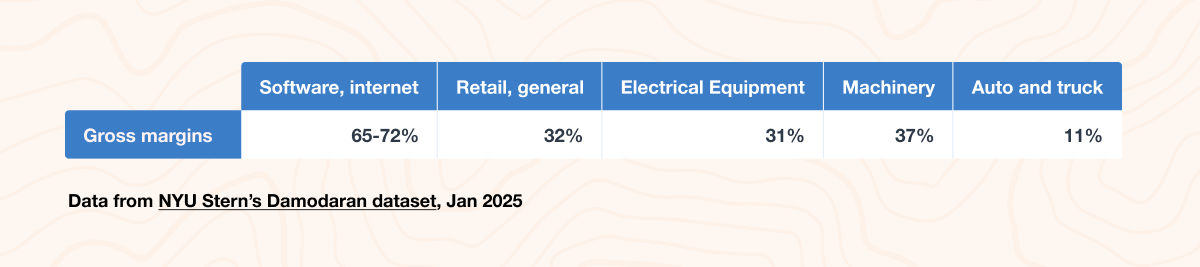
What separates software providers is, primarily, two things: the low marginal cost of selling additional units and the recurring subscription revenue. That is, whether you sell one or one thousand instances, the delivery cost is nearly the same, while customers owe you consistently and predictably.
But physical goods and subscriptions aren’t mutually exclusive. Your team can fold in additional revenue streams like this to expand your margins. In this article, we share all the questions to ask to evaluate this idea or make a case. We also tee up questions about the implications that physical goods and services companies aren’t typically aware of. For example, how to launch self-serve billing software and recognize subscription revenue in your ERP.
This is the first in a three-part series. Read how to launch a subscription (if you’ve already decided) and 10 examples of physical goods companies that launched subscription billing models.
What sort of subscription would you offer?
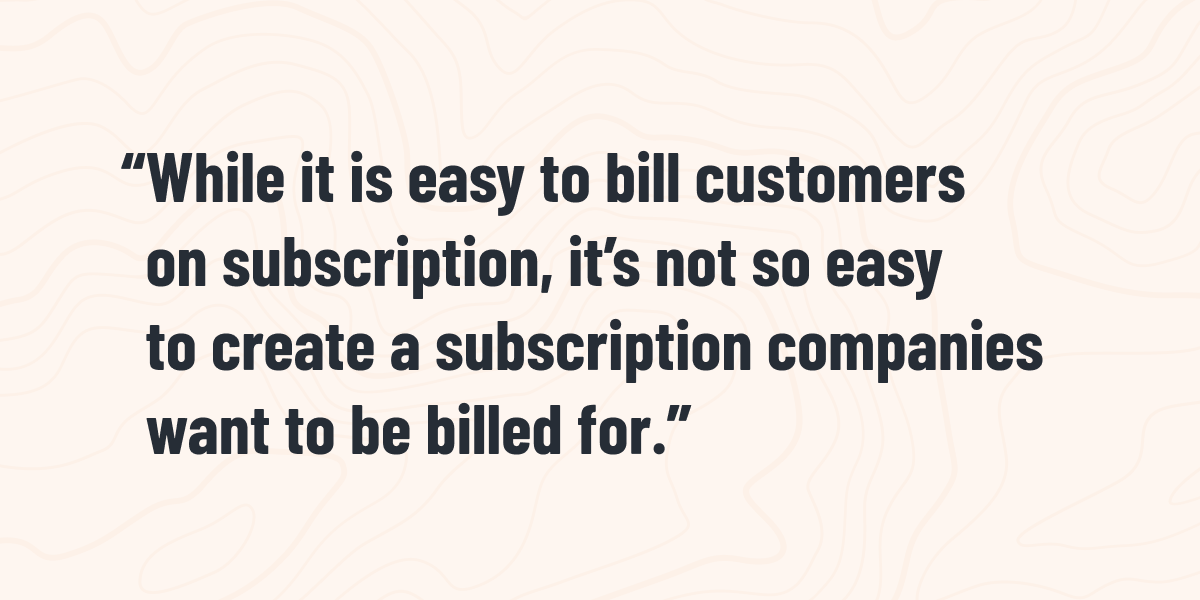
Subscription revenue companies have high margins, though there is some survivorship bias at play here. For every profitable software company, there are dozens that are not and fail. Venture capital firms are happy if 1 in 10 portfolio companies is a major success. This is because while it is easy to bill customers on subscription, it’s not so easy to create a subscription that companies want to be billed for.
We’ve all seen this recently with companies bolting “AI” offerings onto longstanding software products. Those software companies tend to struggle to monetize these afterthought offerings because they don’t meet a real customer need—see Microsoft’s disappointing Copilot sales. Similarly, of all the 2010s subscription box companies, few achieved enduring profitability. Many were sunk by high customer- acquisition costs paired with high churn because they just didn’t create enough value.
This is all to say, the model alone is not enough. Begin any subscription conversation by talking to your sales and delivery teams. Ask them:
Where can subscriptions resolve existing customer pain?
Look at your current customer complaints. The tire manufacturer Goodyear did, and heard that its corporate delivery fleet customers felt it was difficult to maintain tires to prevent blowouts. So Goodyear launched a fleet subscription service. Now it charges not by the tire, but by the mile. Goodyear can use its vast trove of data and actuarial science to safeguard its margins, while giving trucking companies the certainty they crave.
Read about 10 other subscription examples →
Or, consider the solar field operator Omnidian. It gathered so much data in operating commercial solar panels that it was able to develop an algorithm that could predict maintenance issues long before they became a problem. The company now sells a sort of solar output guarantee on subscription to consumers. They pay a monthly fee, and Ominidian predicts outages and dispatches technicians if needed.
Or consider all the equipment manufacturers that lease or loan their equipment to customers and recoup the cost by charging ongoing maintenance or usage fees. This helps them help customers to keep big new capital expenditure costs off their balance sheet, and resolves a major sales objection.
Good subscription offerings should help customers. Start with where there’s existing pain.
(Note: For all of these to be successful, the companies needed the infrastructure to track usage; they achieved success through plenty of testing.)
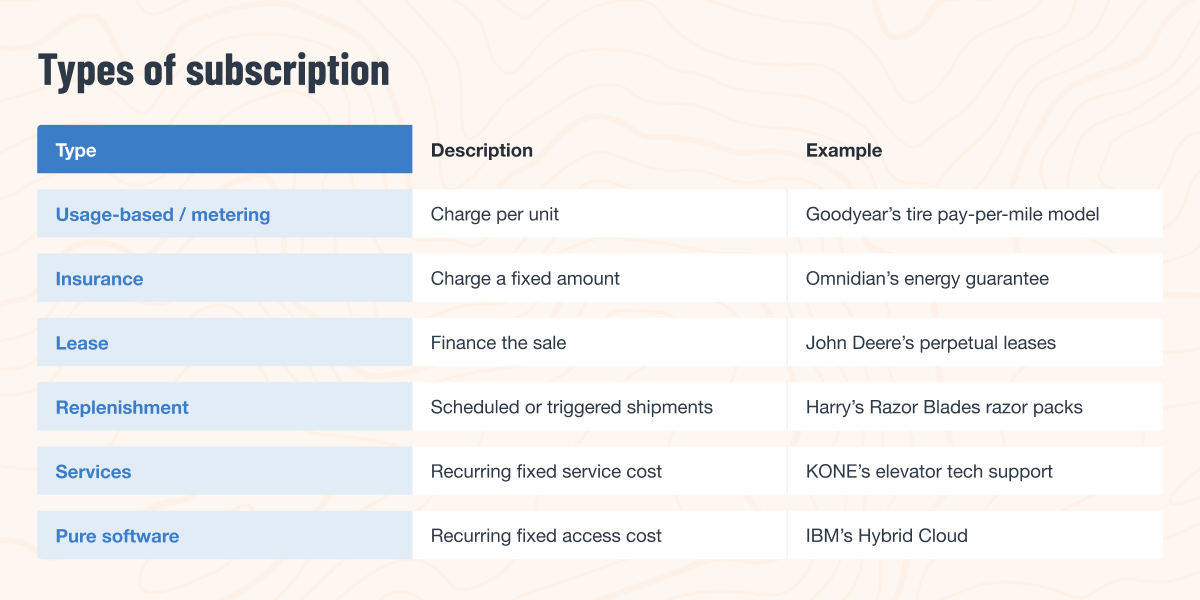
Which type of subscription solves your customer’s pain?
There are six subscription models, which are not mutually exclusive—you can mix and match components. As much as you can, align the model with the way your customer prefers to pay. John Deere has faced lawsuits from farmers who thought they were purchasing harvesters, but in fact, were buying into a form of perpetual lease. Bottom line: Be transparent. Subscriptions are only valuable if churn remains low.
Can your ERP and other systems recognize subscription revenue?
Subscription offerings, especially self-serve ones, introduce complexities. Customers are accustomed to signing up for other recurring services via a credit card online, and will probably want to manage their own accounts—which means you may need a software portal and billing tools. You’ll also need to plan how specifically that subscription works. Can customers cancel early? If they cancel mid-month, are they refunded partially, or do they retain access until the next billing cycle?
These questions are not just operational, but have accounting treatment implications. Depending on whether you are trying to maximize the customer experience or trying to be efficient, you could come to a different conclusion on what you want your policy to be.
Further, will you bundle the subscription offering with your traditional goods and services into one “solution” bundle, which helps with marketing but complicates accounting? Are there dependencies between various products? Must you align service periods with other contracts?
Key considerations:
Are there multiple subscription SKUs?
Will you bundle subscription services with non-subscription services?
How will you organize all this on the invoice such that customers understand?
If leasing, are you prepared to deal with ASC 842 leasing considerations?
How will you service, staff, and support the subscription?
Does the subscription create new service, hosting, and developer costs?
Is launching a subscription worth it to your business?
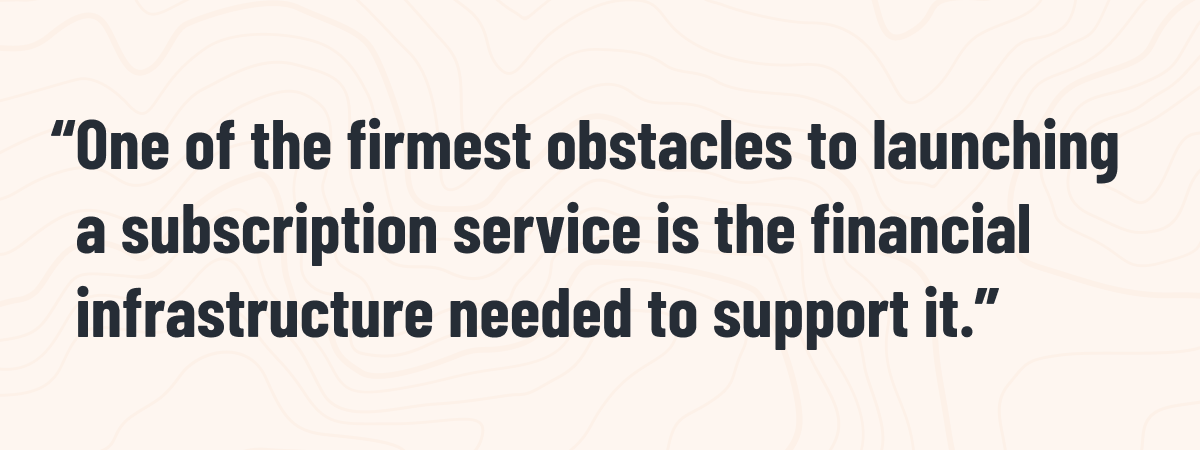
One of the firmest obstacles to launching a subscription service is the financial infrastructure needed to support it. Finance and accounting teams often underestimate this. If your ERP was built for manufacturing and uses the base unit of a “product” as a discrete item, there may be no way to charge and account for subscription or usage revenue. This makes experimentation costly. If feedback takes weeks or months to implement, the service will take far longer to reach the margins you’re seeking.
Further, if your finance and accounting teams are entirely dependent upon an ERP administrator and developer to make changes, that too will drive up costs. If they want to alter prices on a tier, edit contracts ex post facto, or create a new line item, this means weeks of building up a spec and then IT hours or contractors.
Analyze your current ERP and ask:
Can my finance and accounting people make updates on their own?
Does it offer built-in subscription offerings and related accounting measures?
Can it account for ASC 606, ASC 842, and IFRS 15 revenue?
Does it offer a sandbox environment to rapidly test changes?
Also consider whether the subscription revenue complements or cannibalizes existing revenue. The ideal situation is that the subscription is purely additive: a support offering to complement a physical good, like a harvester or elevator. This creates the potential for “attached” cross-sell and upsell revenue. The less ideal scenario is where a subscription that invalidates your prior product—like a cellular device that replaces expensive on-premise networking equipment. Perhaps that becomes necessary for you to stay competitive. But it becomes a strategy question.
Don’t overlook the internal cost of change management either. How will you explain the subscription offering internally and externally? Retrain teams, and revise the compensation structure to encourage sales? Build a go-to-market motion that attracts and converts new customers at a reasonable cost?
Subscriptions can increase your margins—if your backend permits them
What matters more than anything is that your subscription solves an existing customer problem. The more evidence you can have that there is existing demand—including competitive offerings with comparable numbers—the surer you can be that this is a worthwhile bet. And the more flexibly your systems like your ERP allow you to launch, test, and tweak pricing models, the cheaper it becomes to launch said pilot.
But make no mistake: It’s still launching a new offering, attendant with most of the risk and complexities of physical goods or services. Just with excellent upside.
Next up: How to launch a subscription offering step-by-step.