'%3e%3cellipse%20cx='185.202'%20cy='292.401'%20rx='236.2'%20ry='212.4'%20transform='rotate(180%20185.202%20292.401)'%20fill='url(%23paint0_radial_6113_7068)'/%3e%3c/g%3e%3cdefs%3e%3cfilter%20id='filter0_f_6113_7068'%20x='-130.996'%20y='0.000976562'%20width='632.398'%20height='584.8'%20filterUnits='userSpaceOnUse'%20color-interpolation-filters='sRGB'%3e%3cfeFlood%20flood-opacity='0'%20result='BackgroundImageFix'/%3e%3cfeBlend%20mode='normal'%20in='SourceGraphic'%20in2='BackgroundImageFix'%20result='shape'/%3e%3cfeGaussianBlur%20stdDeviation='40'%20result='effect1_foregroundBlur_6113_7068'/%3e%3c/filter%3e%3cradialGradient%20id='paint0_radial_6113_7068'%20cx='0'%20cy='0'%20r='1'%20gradientUnits='userSpaceOnUse'%20gradientTransform='translate(-43.0144%20248.324)%20rotate(-25.0248)%20scale(462.733%20514.489)'%3e%3cstop%20stop-color='%23FF9DDA'/%3e%3cstop%20offset='0.44'%20stop-color='%23F7FF9D'%20stop-opacity='0.52'/%3e%3cstop%20offset='0.84'%20stop-color='%23FF8B7B'%20stop-opacity='0.2'/%3e%3cstop%20offset='1'%20stop-color='%23F7FF9D'%20stop-opacity='0'/%3e%3c/radialGradient%3e%3c/defs%3e%3c/svg%3e)




However, those that are successful tend to have carefully designed that service. There are many types of subscription offerings and details to consider.
If your team is considering launching a subscription offering, this is your step-by-step guide to designing that offering and accounting for it.
This is the second in a three-part series. Read should you launch a subscription to build a case and 10 examples of physical goods companies that launched a subscription for inspiration.
1. Assess your back-office financial systems
Subscriptions may sound simple, but charging, managing, and recognizing subscription revenue is non-trivial. If your current ERP provider launched in the 1990s, it almost certainly does not support this, which means you’ll need additional applications. That results in paying for more software and, potentially, middleware connectors and/or developer hours to integrate. Plus ongoing maintenance.
A common example is purchasing a bolt-on billing system to handle all the logic of giving customers a portal where they can manage adds/changes/cancellations. If that system can integrate with your ERP, great. If not, your team will have to build spreadsheets and/or internal tools to convert the transactions and recognize the revenue.
Spreadsheet accounting may suffice for your pilot program. Product experts would tell you to “do the manual thing now” and figure out how to systematize it later. However, spreadsheets can’t be the whole plan, otherwise the system won’t scale. Start auditing those AR, billing, and GL systems now.
ERP system requirements to support subscription revenue:
Revenue recognition for subscription revenue (ASC 606, ASC 842, IFRS 15 compliance)
Billing system capabilities: recurring billing, hierarchical invoicing, and license management
Ability to create an automated order-to-cash workflow tied to fulfillment
Integration with the tax system, so the tax team can review
Integration between CRM and ERP
Integration between ERP and manufacturing system to manage inventory
There are also other knock-on considerations beyond accounting: You’ll need a contract management workflow and legal review for the subscription agreements, a way to support hierarchical invoicing (say, in the event of franchise customers, third-party billing, or multi-segment businesses), and an easy way to handle ex post facto changes. You’ll need to detail carefully how you handle cancellations, renewals, and evergreen contracts. Customers will expect subscription-like offerings to be easy and self-serve.
2. Design your subscription model
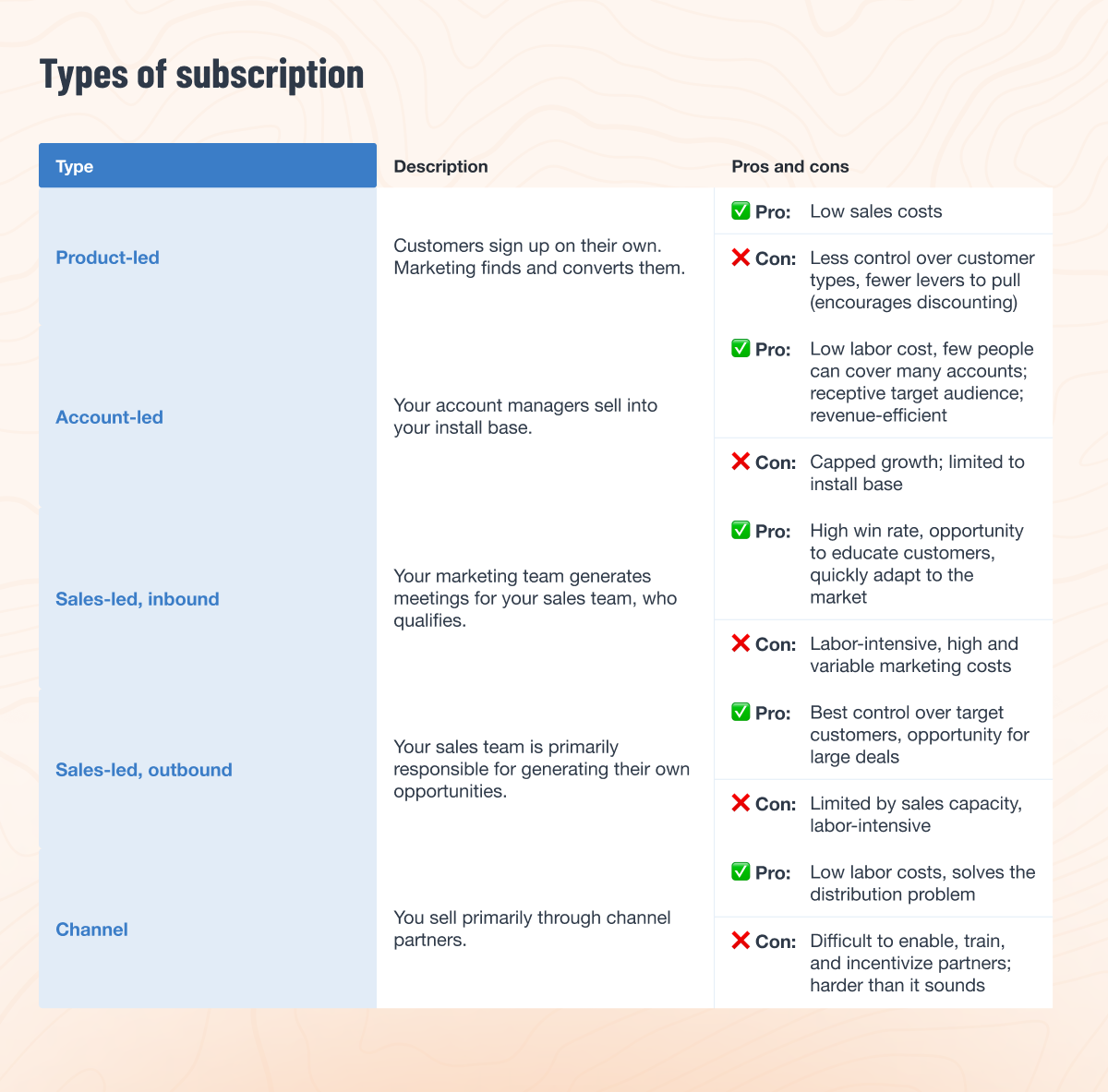
There are six types of “subscriptions” which include pure software, pre-purchased services, leases, and usage-based. They are not mutually exclusive. You can create something that blends several, like a replenishment model that fails over to a usage-based model if customers run over their contract.
Lean on your team’s expertise to lay out several scenarios and model the cost structure to figure out what margins you can reasonably expect, the impact if this service will cannibalize any existing revenue, and the alternatives your customers will evaluate—including doing nothing.
3. Plan your go-to-market motion
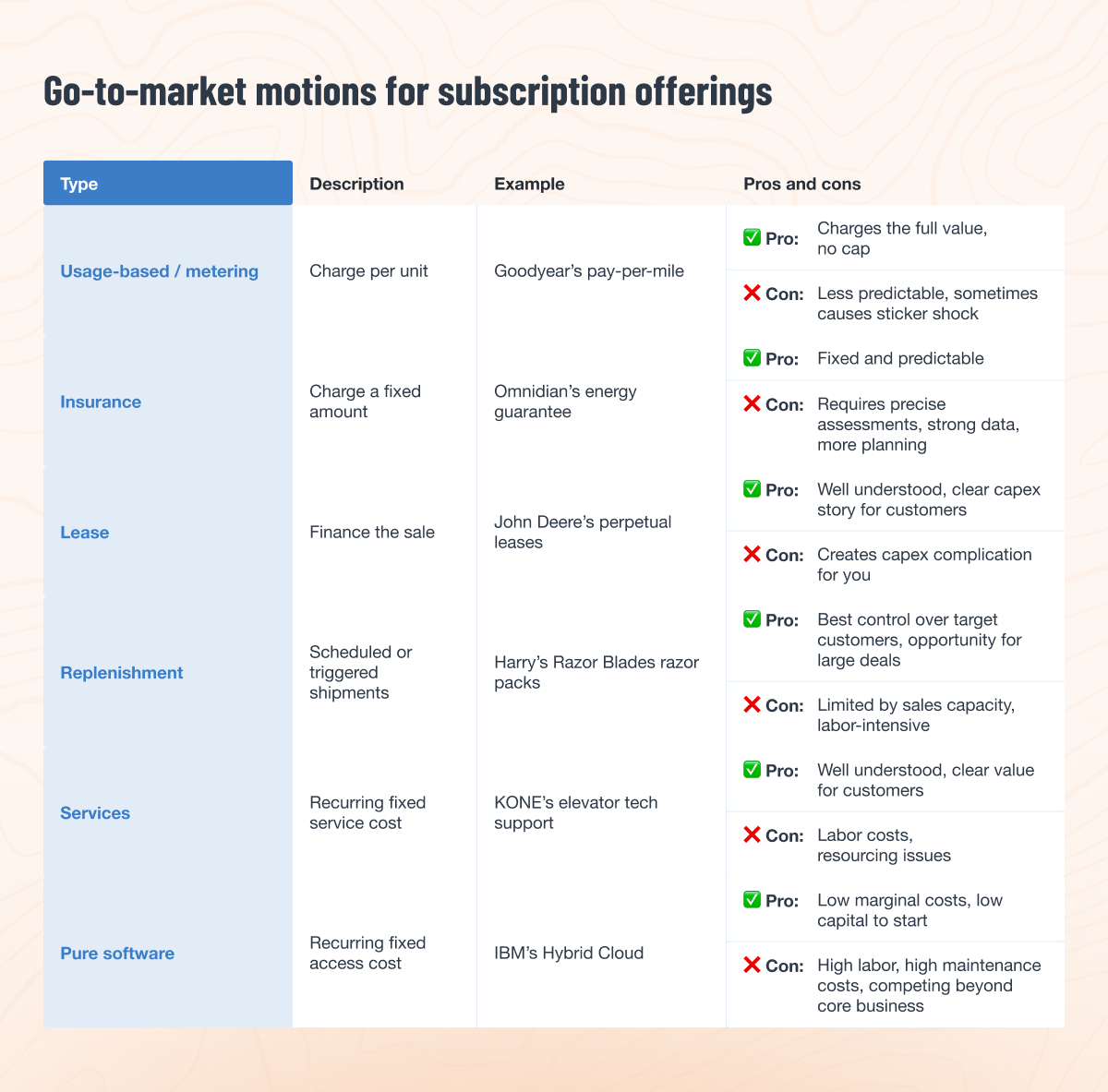
Just as important as what you are offering is how you will offer it. Is it a standalone offering or dependent upon another product? Will you sell to customers who primarily transact with your competitors? What type of go-to-market motion will you consider? Many subscription-based companies struggle with high customer-acquisition costs, which eat into their gross margin.
We also cannot overstate the importance of properly implementing your financial technology to scale and training your teams. Even a modest subscription offering can have vast change management implications. If your finance team must recognize the subscription revenue or update contracts by hand and request bank transactions from multiple entities and dozens of banks, the service won’t scale. Retraining sales and marketing departments is also very difficult. You’ll likely have to rewrite compensation plans to get the attention and focus you want, which means pushing this project until the next fiscal year.
Go-to-market implications to consider:
How you’ll have to retrain your service delivery teams
Sales and marketing costs, including retraining
Pricing, packaging, and interdependencies with other products
The cost of diverting team attention away from your core
Customer support and the communication plan
Payment processing and customer data security
4. Pilot and validate
Always run a pilot with a limited customer segment first, before rolling out the change. In some cases, that means the lowest-risk customer segment—that’s where the margins are low and reward is high. In other cases, it means targeting the most savvy group of customers, who will be excited to beta test a product and be forthcoming with feedback.
Test your AR and accounting operations end-to-end before that launch and make it easy to report bugs. Make it clear to any customers that this is a test, and sell them on the benefit that you are co-building this offering with them. With feedback, you will mold it to their needs. That verbal pact and substantively responding to their feedback, may be enough to preserve the relationship if things go wrong.
Wisdom for launching a subscription pilot:
Launch a minimum viable version of the product
Put up with the difficult, manual workarounds if necessary to prove traction
Build feedback loops in from the start
Measure against clear, predefined success criteria
Decide go/no-go criteria in advance—not later
Invest more in training/messaging than you think
5. Scale the service
If the subscription offering meets your criteria for moving forward, invest in systematizing the infrastructure before rolling it out to other customer segments. In particular, recognizing that subscription revenue. If your ERP or billing software does not make this automated—if people, Excel, and custom data loading tools are involved—this will eat into those gross margins you’re chasing.
Build out the subscription product team:
Identify a product champion who will manage the product's rollout and growth
Refine and improve your go-to-market, test channels and compensation plans
Hire product marketers for competitive intelligence and market research
Forecast the product's growth and resource accordingly
Reinvest in improving the product experience
Common subscription launch pitfalls
The most common reason a new subscription fails is when the company didn’t adequately design that service to solve a real customer need. The second most common reason is financial systems, and that's because billing for and recognizing subscription revenue is complex. It is something the accounting standards board cares about. And scaling the model is only possible when you have automated processes and controls in place.
Perhaps the biggest thing you can do today to begin this process is to reevaluate your ERP. A modern ERP coded in the past few years probably comes with all the subscription billing and accounting tools you need out of the box. Launching a subscription isn’t cause enough to switch ERPs. But you have to consider what else it opens up for your team. A finance leader whose teams can support new currencies, markets, and billing models on their own without an administrator are in a position to help lead the company. That’s the future of finance—agile, and in charge of its own systems.