'%3e%3cellipse%20cx='185.202'%20cy='292.401'%20rx='236.2'%20ry='212.4'%20transform='rotate(180%20185.202%20292.401)'%20fill='url(%23paint0_radial_6113_7068)'/%3e%3c/g%3e%3cdefs%3e%3cfilter%20id='filter0_f_6113_7068'%20x='-130.996'%20y='0.000976562'%20width='632.398'%20height='584.8'%20filterUnits='userSpaceOnUse'%20color-interpolation-filters='sRGB'%3e%3cfeFlood%20flood-opacity='0'%20result='BackgroundImageFix'/%3e%3cfeBlend%20mode='normal'%20in='SourceGraphic'%20in2='BackgroundImageFix'%20result='shape'/%3e%3cfeGaussianBlur%20stdDeviation='40'%20result='effect1_foregroundBlur_6113_7068'/%3e%3c/filter%3e%3cradialGradient%20id='paint0_radial_6113_7068'%20cx='0'%20cy='0'%20r='1'%20gradientUnits='userSpaceOnUse'%20gradientTransform='translate(-43.0144%20248.324)%20rotate(-25.0248)%20scale(462.733%20514.489)'%3e%3cstop%20stop-color='%23FF9DDA'/%3e%3cstop%20offset='0.44'%20stop-color='%23F7FF9D'%20stop-opacity='0.52'/%3e%3cstop%20offset='0.84'%20stop-color='%23FF8B7B'%20stop-opacity='0.2'/%3e%3cstop%20offset='1'%20stop-color='%23F7FF9D'%20stop-opacity='0'/%3e%3c/radialGradient%3e%3c/defs%3e%3c/svg%3e)




In the modern age, it’s not a great sign. It suggests that the ERP doesn’t fully support your business, and that your team is either afraid or unable to alter it. Perhaps they once tried making a change that broke an integration before quarter end, and misconfigured the tax codes, and now everyone fears making updates. This is common with ERPs coded in the dotcom era, like NetSuite. They weren’t built with any concept of a test or a “back button.” Your team cannot save their work. They cannot revert.
Which is why having what we call a “live” sandbox changes so much. It frees anyone and everyone to instantly test changes. They can now know precisely what will happen if they make an update. And if it goes wrong, roll it back.
First off, what is an ERP sandbox?
A sandbox is a snapshot copy of your ERP in which your team can run harmless tests. They can, for example, build a new AP approval workflow, try it, and ensure it works before pushing it live.
A sandbox typically includes:
A place to build customizations.
Isolated development and testing environments, so you can build and test separately.
Built-in automated testing—it will catch bugs for you.
Version control so you can revert to a prior state.
That’s a sandbox in theory. In practice, the details make all the difference.
The live sandbox difference—NetSuite and Everest side by side
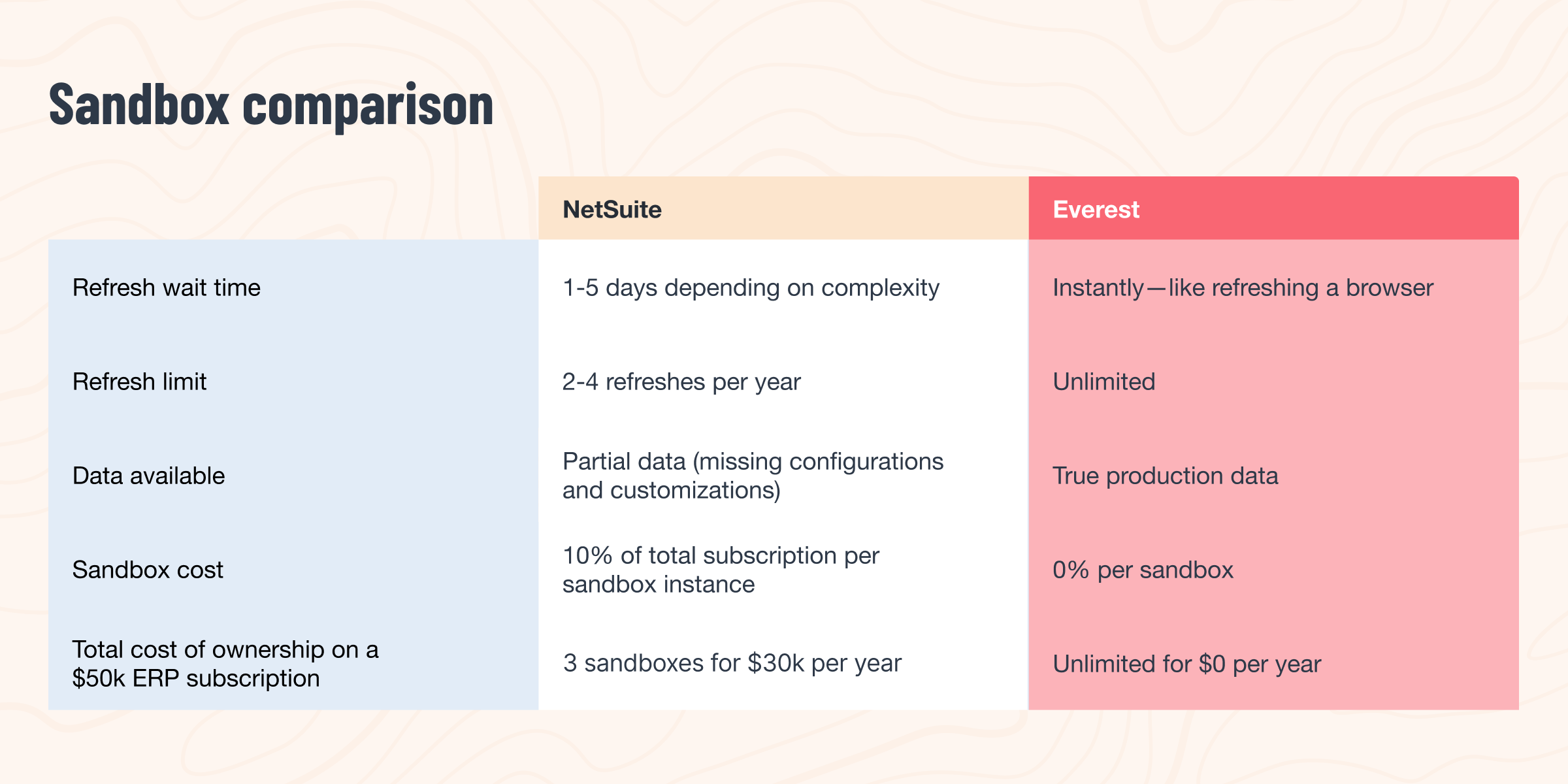
Older ERPs are limited because they were built to be static. This is good for consistency, but also assumes your business will never change. Adding extensions and launching new business models were an afterthought. This is why old ERPs contain digital fault lines and data silos. Which is why their sandboxes are 1) expensive, 2) slow, and 3) partial—they cannot show you recent data.
In building Everest, we had the luxury of planning an ERP that was designed to be changed. Because it is changeable, the data model remains unified—you can report on all parts. This is the difference between introducing new pricing models on the fly versus months of testing while the market moves on. The result is measurable in how fast your team can execute period closes, find answers, and adapt to support functional leaders. It’s how Primary Health migrated from NetSuite to Everest in just a few months. (More on that later.)
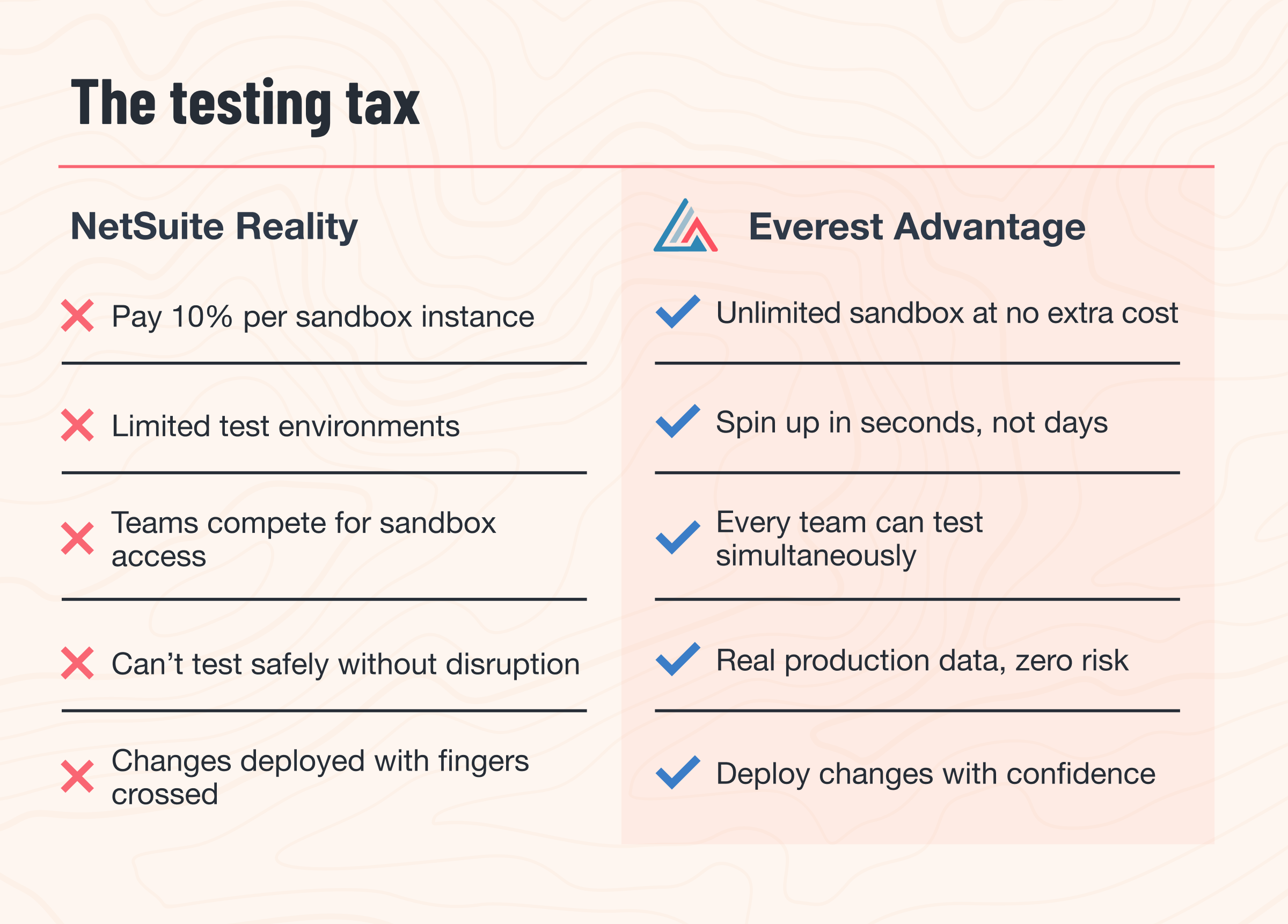
This can save you from what we call the “NetSuite change tax”: When changes are difficult, teams avoid them, which affects the business. Or they take far longer, as when your finance manager doesn’t know who else has made changes in the sandbox and must ask around before making further changes. This can cause one team’s projects to hold up another’s, and so hold up the company.
Then, you must request the refresh and wait another 1-5 days until complete.
Further, your NetSuite sandbox test isn't a real test—it doesn’t use your recent production data, only a snapshot of data at the time you “set” the sandbox. And you can’t revert after pushing it live. NetSuite developers typically screenshot the configurations before implementing a substantial change, or use a tool like HappySoup or Salto to record it, then go live over a weekend to see what really breaks.
For a whole generation of NetSuite engineers, this is just how business systems work. They’re aware of live sandbox-type technology in other software they use, but not in ERP.
Unless, of course, you rebuild that ERP from scratch.
In the five years we spent building Everest with all the modules from the ground up, Everest’s product team applied all the obvious developer operations methodologies. The sandbox includes all live production data, if you desire. Because of the architecture, refreshes are instant. As a result, testing is essentially free.
This is why Primary Health was able to switch off NetSuite so quickly when they realized it wasn’t working. They’d invested over $200,000 in a custom NetSuite implementation and despaired as the launch date pushed back repeatedly. After launch, there were bugs. They calculated that 80% of their important processes still relied on spreadsheets—like reconciliations and reporting.
Primary Health launched Everest and was able to rapidly test changes. They could implement a configuration in the sandbox, see what it would do to real reports, make another change, refresh, and see. Every person could test as much as they liked. Nobody created a bottleneck for others’ changes. The sandboxes were so intuitive, Primary Healths’ executives now log in to model scenarios themselves.
Everest’s Live Sandbox opens up new possibilities
So what’s possible when you have a live sandbox? Eight things:
You eliminate change risk
Your team can create an exact replica of your production system as a sandbox in seconds. No waiting weeks for IT to provision test environments or scheduling sandbox access.
You eliminate bottlenecks and configuration pileups
With traditional sandboxes, everyone has to wait for the sandbox owner to “promote” those changes to the live production instance. Because there are few sandboxes and because they are slow, it requires coordination. Everyone must wait. With live sandboxes, anyone can make configuration changes, test, and push live in an automated, secure way. No more waiting for others.
There’s no more guessing
You or your team can test with actual production data in a completely isolated environment. See exactly how changes will impact your real business operations. If the change isn’t as you’d expect, you can refresh just as quickly as you can refresh your browser.
This is a crucial difference: With NetSuite sandboxes, you get the data you captured when you created the sandbox. If you spend two months in the sandbox developing a new reporting module and want to try it with fresh data, you cannot. You must create another sandbox, which costs 20% of your subscription, and use third-party tools to move your work. Whereas in Everest, it’s all possible in two clicks.
You speed up work
Once validated, push changes to production with a single click, securely. Everest will notify you of conflicts and give you the option to reverse changes if needed. And you can segregate duties, implement approvals, and ensure everything’s compliant before you proceed.
Model M&A situations instantly
Test multi-entity consolidation, simulate acquisitions, or model divestitures using real data. Know the financial impact before the deal closes.
Test new pricing models
Model usage-based pricing changes, test tiered discounting, or simulate contract modifications before they go live. See the exact revenue impact before committing.
Train new team members risk-free
New hires can learn the system with real scenarios in a live sandbox. There is no chance of corrupting live data or making costly mistakes during onboarding.
You can implement Everest twice as fast
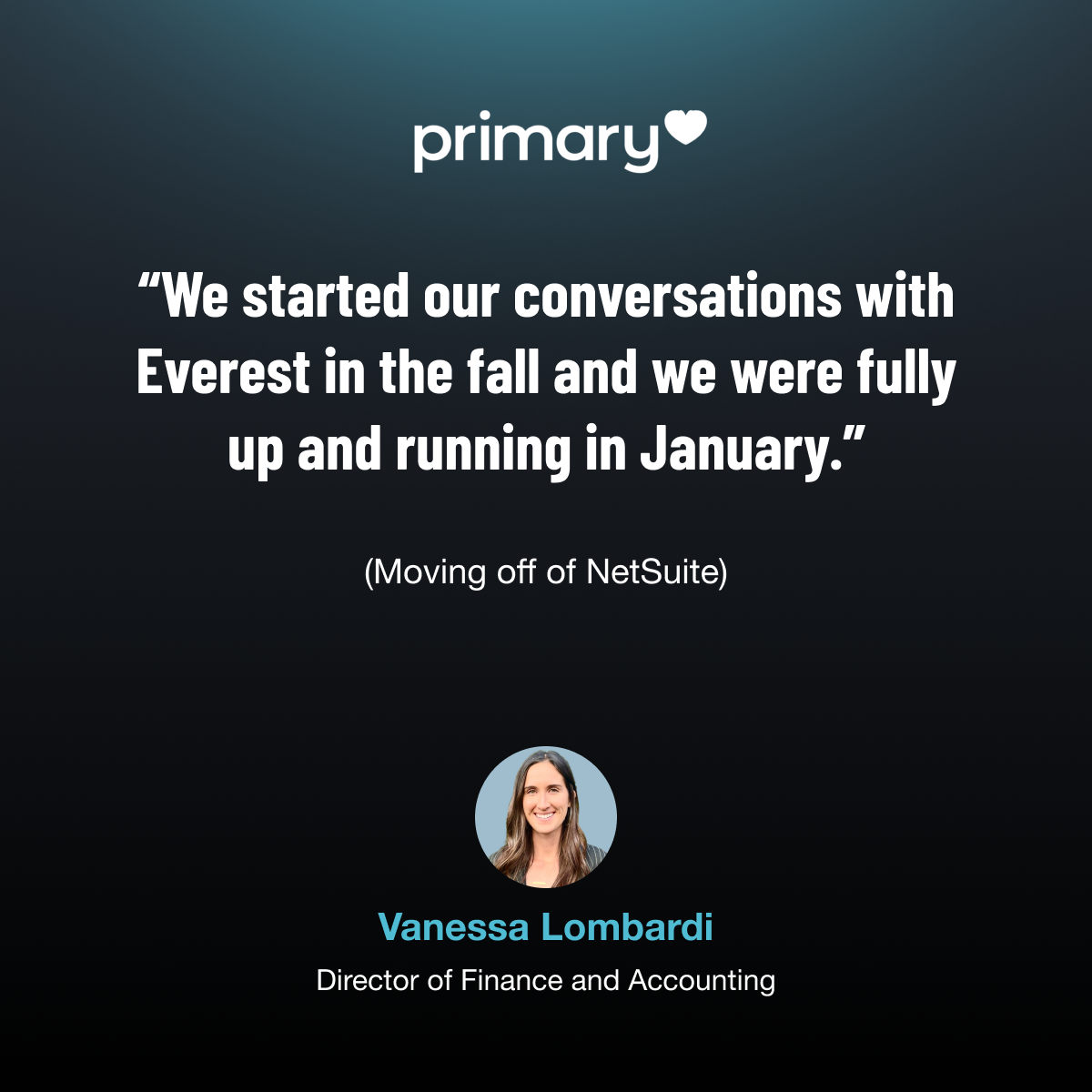
Primary Health purchased Everest in the winter and was up and running by January—a full NetSuite migration.
Now you can de-risk innovation
While NetSuite charges you extra to test and forces you to buy bolt-ons for core functionality, Everest gives you unlimited testing environments and native capabilities—all included. The difference is a finance team that can adapt to whatever comes next.