'%3e%3cellipse%20cx='185.202'%20cy='292.401'%20rx='236.2'%20ry='212.4'%20transform='rotate(180%20185.202%20292.401)'%20fill='url(%23paint0_radial_6113_7068)'/%3e%3c/g%3e%3cdefs%3e%3cfilter%20id='filter0_f_6113_7068'%20x='-130.996'%20y='0.000976562'%20width='632.398'%20height='584.8'%20filterUnits='userSpaceOnUse'%20color-interpolation-filters='sRGB'%3e%3cfeFlood%20flood-opacity='0'%20result='BackgroundImageFix'/%3e%3cfeBlend%20mode='normal'%20in='SourceGraphic'%20in2='BackgroundImageFix'%20result='shape'/%3e%3cfeGaussianBlur%20stdDeviation='40'%20result='effect1_foregroundBlur_6113_7068'/%3e%3c/filter%3e%3cradialGradient%20id='paint0_radial_6113_7068'%20cx='0'%20cy='0'%20r='1'%20gradientUnits='userSpaceOnUse'%20gradientTransform='translate(-43.0144%20248.324)%20rotate(-25.0248)%20scale(462.733%20514.489)'%3e%3cstop%20stop-color='%23FF9DDA'/%3e%3cstop%20offset='0.44'%20stop-color='%23F7FF9D'%20stop-opacity='0.52'/%3e%3cstop%20offset='0.84'%20stop-color='%23FF8B7B'%20stop-opacity='0.2'/%3e%3cstop%20offset='1'%20stop-color='%23F7FF9D'%20stop-opacity='0'/%3e%3c/radialGradient%3e%3c/defs%3e%3c/svg%3e)




Malaya’s company was acquired by a Dutch conglomerate, and the 19-hour difference between Amsterdam and Kuala Lumpur was the least of her troubles. Her boss was a seething tyrant. He’d lash out for the smallest mistakes on team calls. He refused to talk to her. He only communicated in long, bulleted emails. It felt unfair. And yet, it felt unfair on her boss Jonas’ side as well. He was shocked he’d been assigned an employee whose work was so inconsistent. Who seemed to regard deadlines as optional, and who would say she’d do something but then not. Why couldn’t she listen? Why couldn’t she learn?
Malaya and Jonas were locked in a conflict that had nothing to do with the technology and everything to do with invisible signaling. Their company’s ERP system was meant to be one uniform fabric spread across all those regions and operations—the “single source of truth project,” as executives billed it. But in between chairs and keyboards are people, whose actions are guided by culture.
This is all according to a team of researchers in Belgium who studied global IT rollouts and, in particular, ERP. They were able to propose process management changes for rollouts for Asian clients with a measurable positive impact. These rollouts took into account changes related to language and listening habits, hidden assumptions, confrontation, and “perceived” lies.
In this article, common cultural barriers to ERP implementation and what can be done about it in an organization determined to unify its global operations.
The three cultural modes that encourage miscommunication
When an acquiring conglomerate in Asia purchases a business in Belgium, who must adapt to whom? Should managers strive to integrate with host cultures, or host cultures strive to adapt to their international managers? These are questions with no singular answer. But we should all consider just how great the differences in meaning behind everyone’s words can be.
Our example employees, Malaya and Jonas, are real professionals interviewed in the study. They’re each well-adapted to their local work environments but nevertheless struggle to communicate. This is because so much of communication is, in fact, unspoken.
“Words are but one facet of communication. We often fail to realize that culture sets the container,” write the three authors of the study, Identifying Cross-Cultural Communication Barriers on Global IT Rollout Projects. Ethnographers understand this through a system that attempts to explain various cultures’ relationships with deference and candor.
There are three categories: linear-active, multi-active, and reactive.
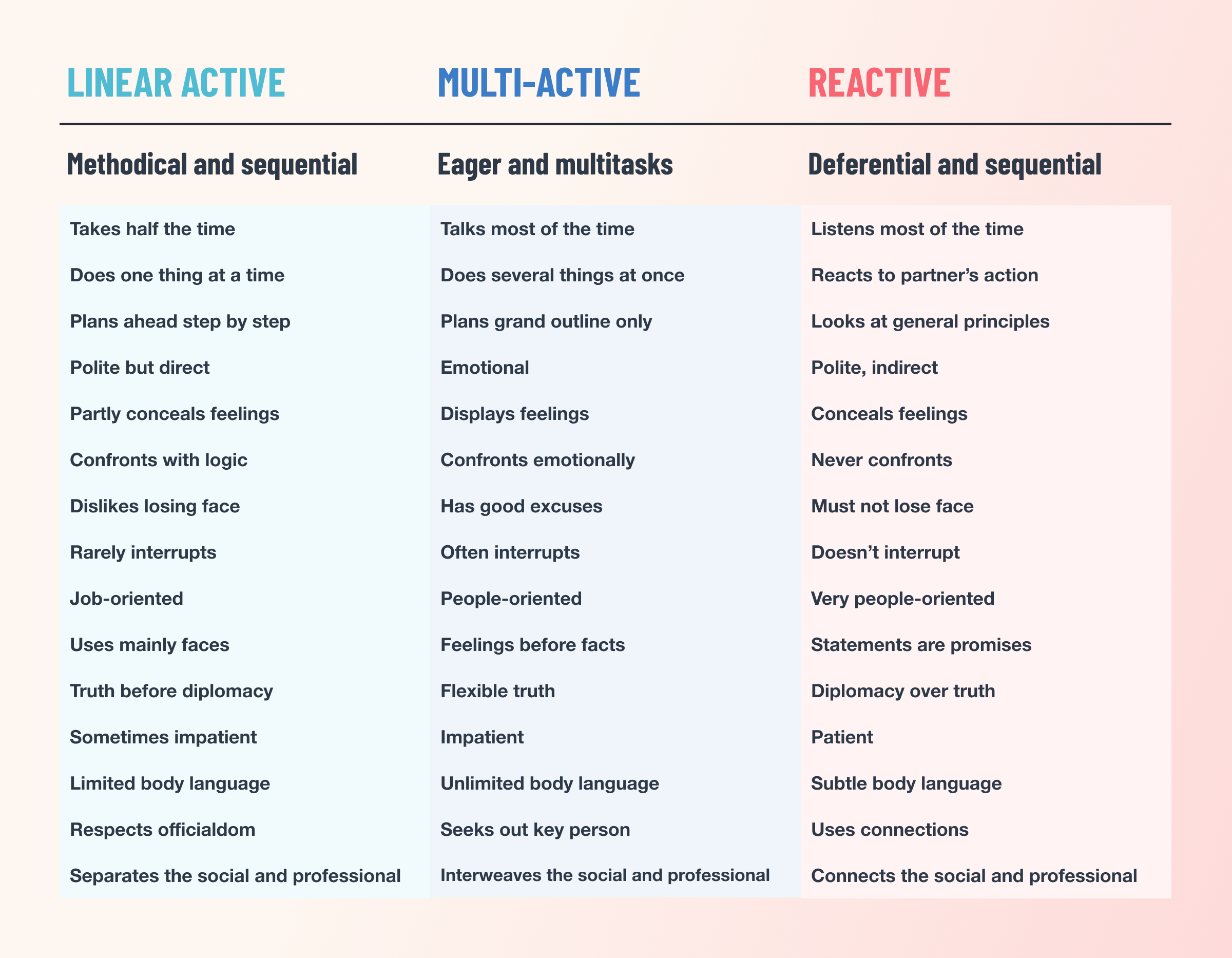
Like so much ethnographic work, these assumptions can be approximately true at the cultural level, yet are almost never predictive of any one individual. People are people and individuals are unique. But over a population, these assumptions tend to hold explanatory power. Especially when two cultures on opposing sides of the chart interact.
[Lewis model]
When linear active cultures manage reactive cultures, the work halts
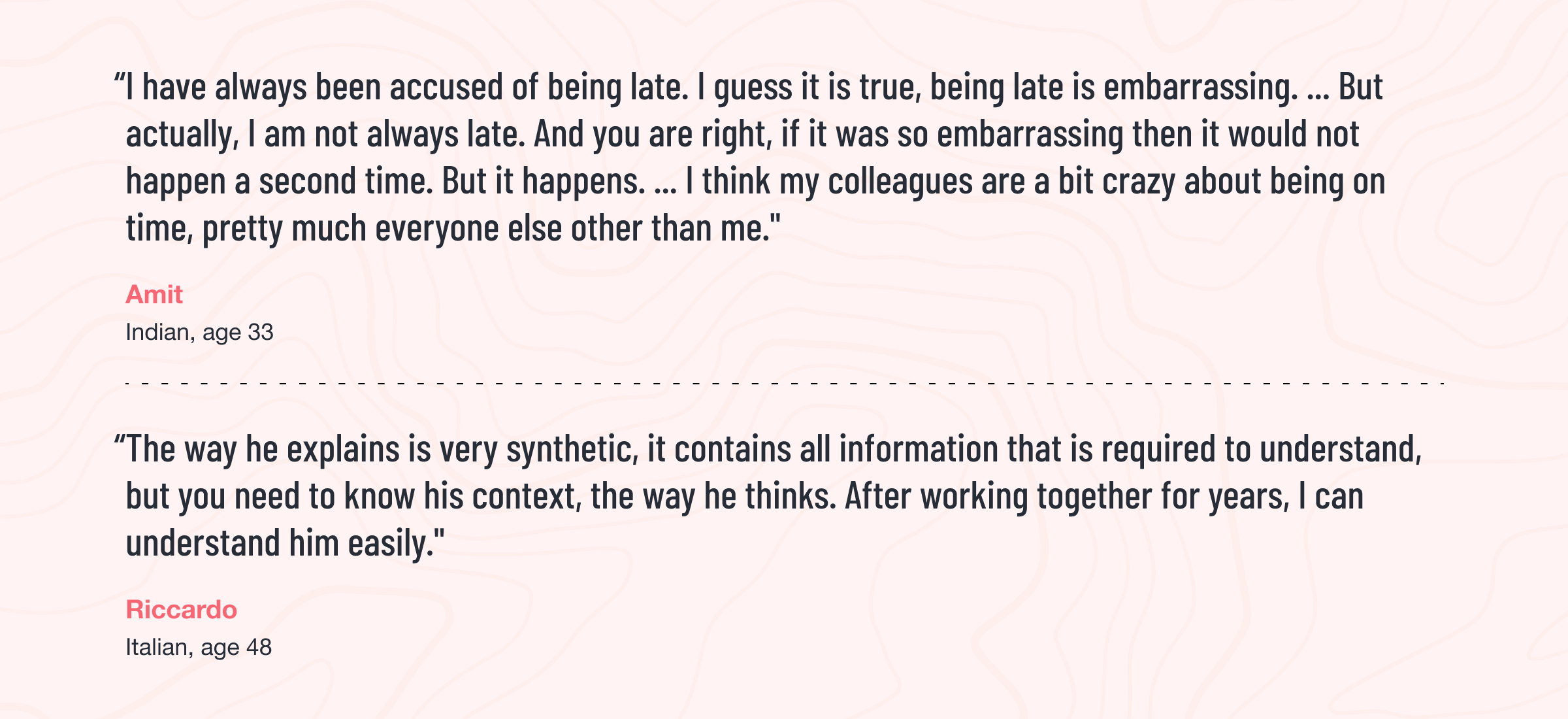
When managers in linear-active and multi-active cultures manage those in reactive cultures during ERP rollouts, they tend to miss most of the communication occurring and grow frustrated. Their reactive subordinates expect the relationship to dictate the work, and for plans to be fluid. Whereas their managers expect the work documentation to speak for itself. Subordinates will expect to discuss each topic multiple times from various angles, going deeper into the details each time. Whereas linear active managers will expect their terse instructions to suffice.
This is what was happening for our example boss, Jonas. Managing employees in Kuala Lumpur, he and those like him said the following:

And on the other end, Malaya and her team felt exasperated. They were patiently waiting for their boss to fulfill his duty to fully explain. But he wouldn’t. He’d stop short. Then he’d get upset in ways that seemed disproportionate to the situation.
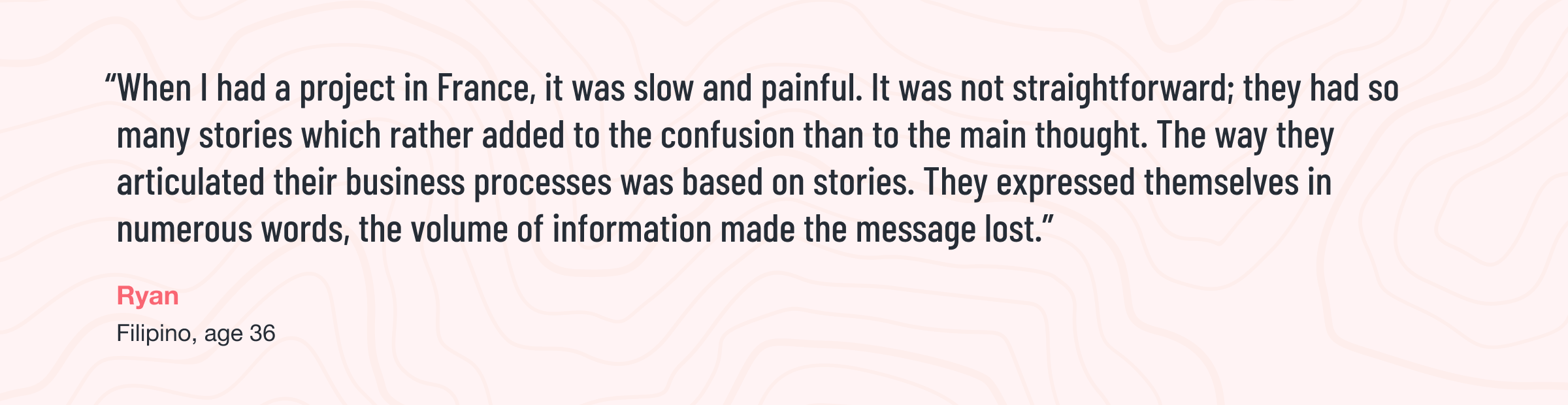
In countries like France, Poland, Lithuania, and Belgium, which straddle the line between linear-active and multi-active, they tend to communicate in stories and expect subordinates not to lose the thread. But this assumption is rarely stated and creates confusion.
In a linear-reactive mismatch, reactive employees will tend to say yes but then not act. Not because they don’t want to, but because they haven’t been given what they need to proceed. They are culturally dissuaded from asking, and blocked until they hear. The respectful thing for them to do is wait. But that’s a big problem for time-bound ERP rollouts.
A good way to bridge this divide, the study’s authors conclude, is for the linear-active managers to accept more responsibility for creating shared context. Such managers must repeatedly explain their expectations and thinking, in ways that may feel excessive to them. They should define terms like “customer” and create informal channels where employees can seek redress or request information.
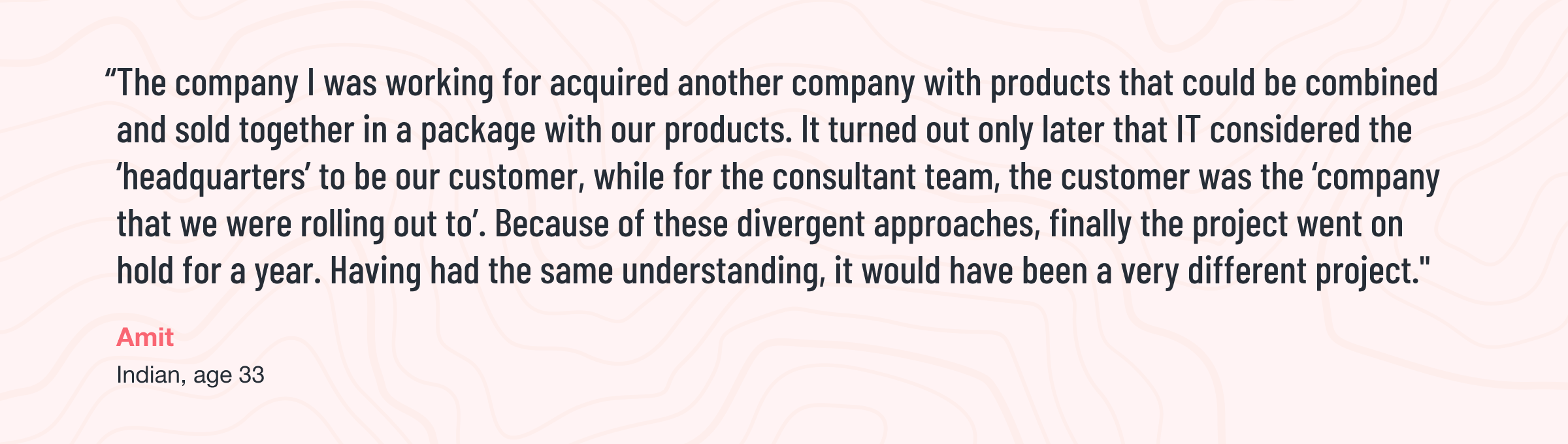
Some cultures confront, others conceal
Malaya and Jonas manage confrontation very differently. In many Northern European countries like the Netherlands, subordinates are encouraged to challenge their boss’ thinking. Bosses (mostly) accept this. All parties see it as part of an empirical process of navigating toward a clearer truth.
In many Asian cultures, such as Malaysia, this is unthinkable. Such direct confrontation is uncommon and evokes a great deal of second-hand embarrassment from those present. They still communicate the same information, but in subtler ways. For a boss to berate an employee can be destabilizing. And for a subordinate to challenge a boss is rare. There’s a cultural script encouraging everyone to maintain public harmony and defer to those of greater age or rank, while seeking private redress. This may mean employees follow a superior’s incorrect instructions against their own conviction.
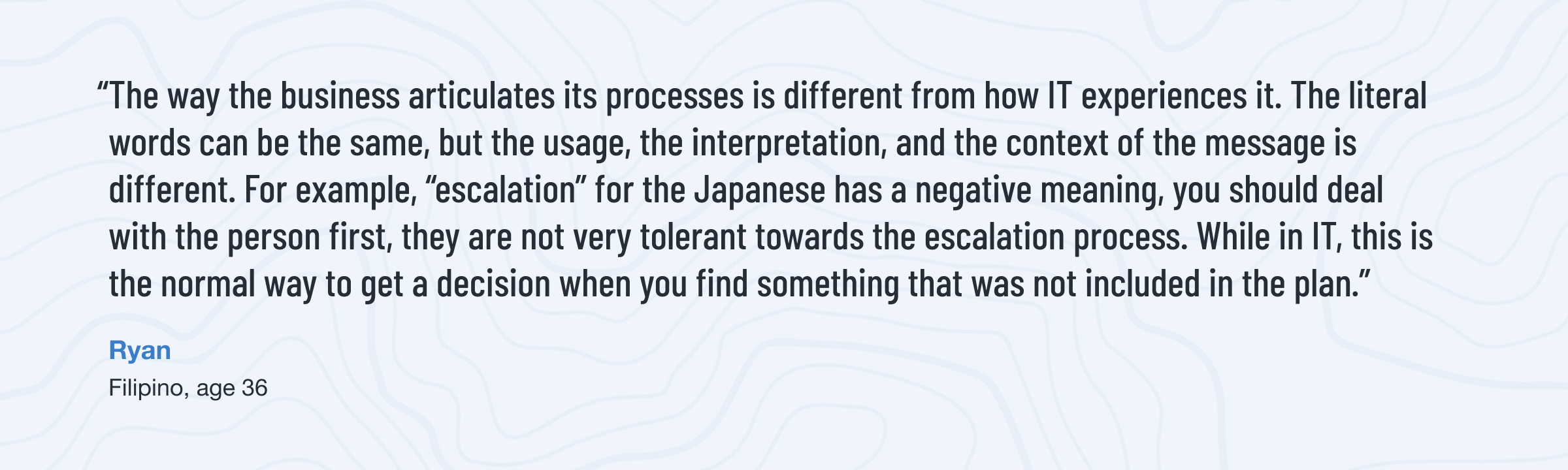
Picture a reactive office in Asia being managed by a linear-active boss from Sweden. The employees are unlikely to tell their superior when the ERP project status is in danger. Just the opposite, they’re likely to commit white lies to cover for their boss. They prize team cohesion far more. But of course, this has its downsides.
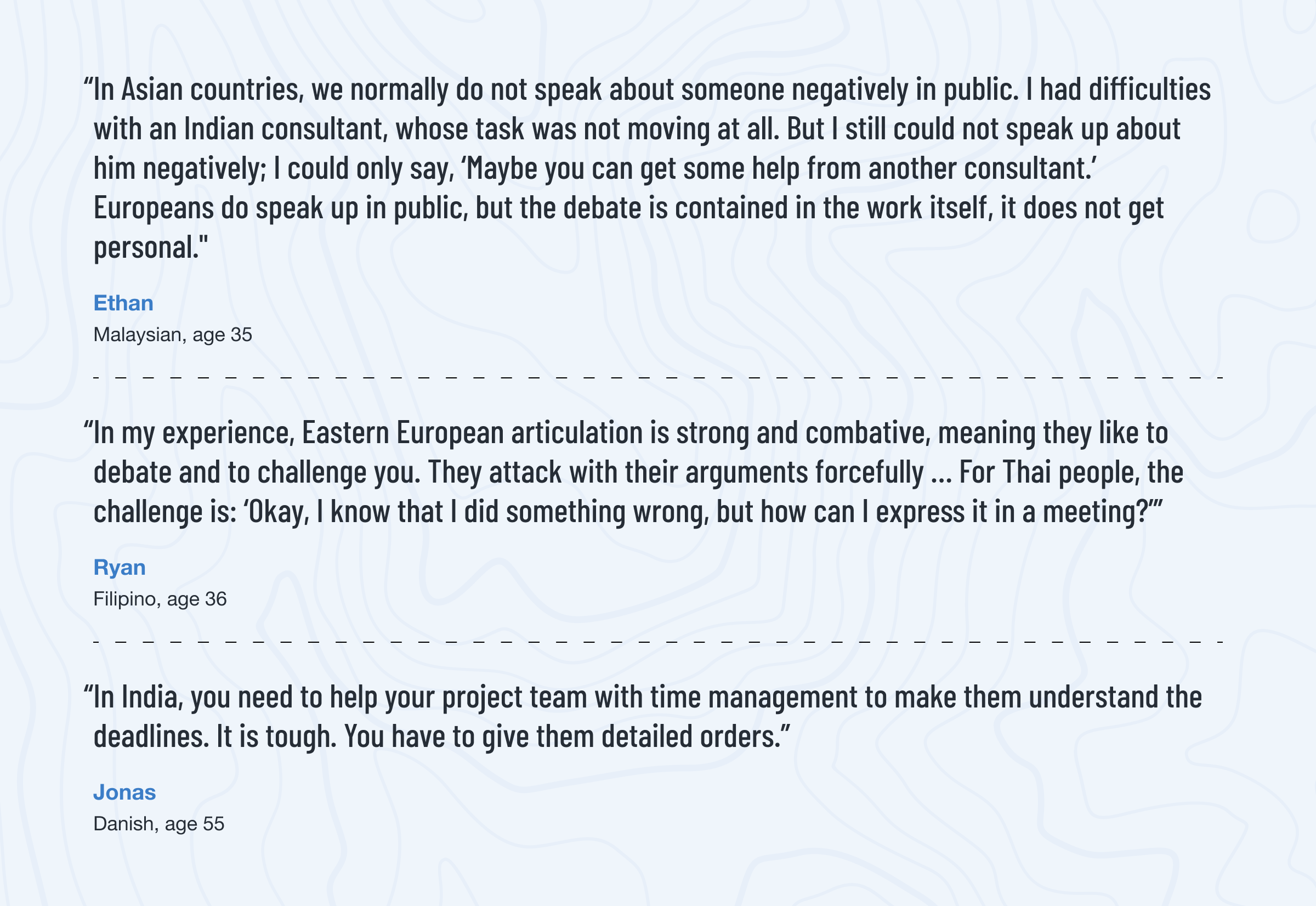
Linear-active and multi-active cultures may miss all the ways reactive cultures are giving feedback—but which are, to the outside, nearly invisible: strategic silence, non-verbal cues, and only voicing feedback outside of work in social settings, like at a bar.
For our advice on managing conflict, we’ll flip the hierarchy: For reactive cultures managing multi-active or linear-active, you can’t assume the employees will read the subtext of your communication. It’s best to be literal and to know that if the feedback is subtle, it will be deemed unimportant. Norwegians, for example, expect direct feedback on the job, in the moment, and with a literal description of how they have erred. Cohesion is valued less than candor; and in fact, in these cultures, candor can create cohesion. People feel more secure when nothing is unstated.
Time can be a fixed concept or an informal contract
Different cultures have very different relationships to the use of time. This is among the most common sources of miscommunication and grievance in ERP implementation. In reactive or multi-active cultures, the barrier around working time is less well-defined. In the ERP study, a Polish-worker auto-declined an Indian boss’ invitation to talk out of hand, without explanation, because it was outside working hours. The boss took offense. In reactive cultures, there’s more of a “do or die” mindset.

This difference in how they think about time has a direct impact on the number of hours you’d want to allocate to various regions. Multi-active and reactive cultures may expect more onsite time and discussion than linear-active cultures. Multi-active cultures value the trust built through that additional time. Reactive cultures expect, as we’ve discussed, to cover the topic in concentric circles of deepening detail. The ERP study’s authors found that this had a direct and expected impact on cost—consultants needed more hours to accomplish work in various regions.

No plan, however detailed, is sufficient to “sell the idea” in a region whose culture implicitly requires more time to circulate such conversations through dialogue.
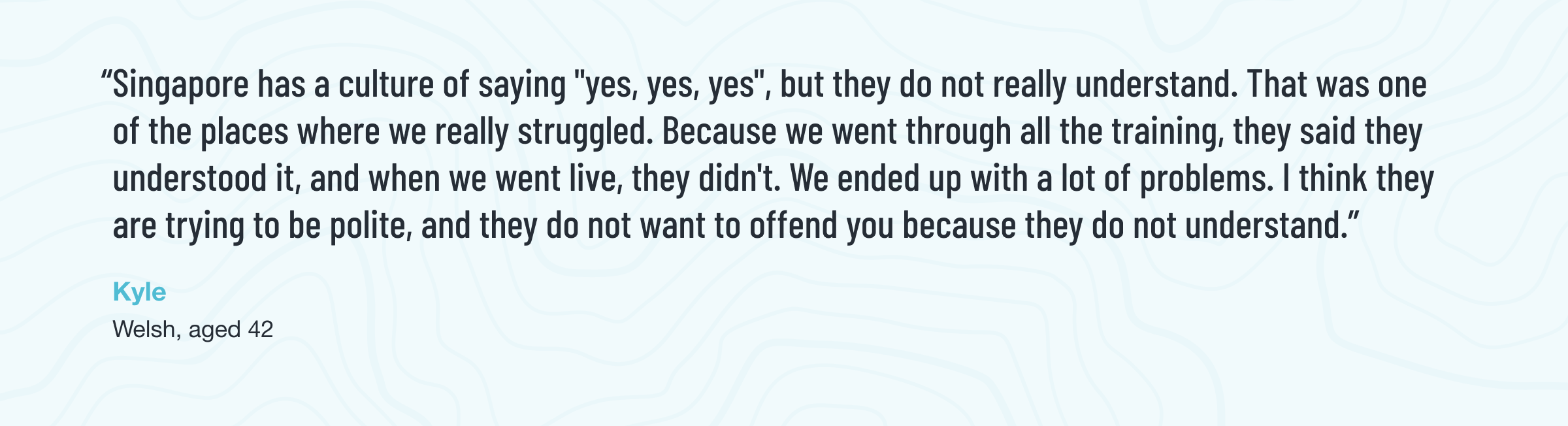
Time variance also raises the potential for conflict. Linear-active study interviewees expected training to happen faster than it did in reactive regions. One group was surprised to find that Singaporean employees responded enthusiastically to the training but did not acquire the concepts. By the time the managers realized that skills gap, the implementation team lost valuable months. It was stressful on the Singaporeans too. They waited in deference to their boss’ seemingly haphazard and incomplete rollout.
Implications for global ERP implementations? Account for culture
Just to restate the obvious, it’s foolhardy to assume that anyone from a linear-active or reactive culture fits these generalizations exactly—any more than one individual born in 2002 can speak for “all of Gen Z.” Individuals are individuals, and this analysis is interesting and relevant only at the population level—where probabilistically, these issues are likely to arise. And at the level of a global ERP rollout, we’d argue they have merit.
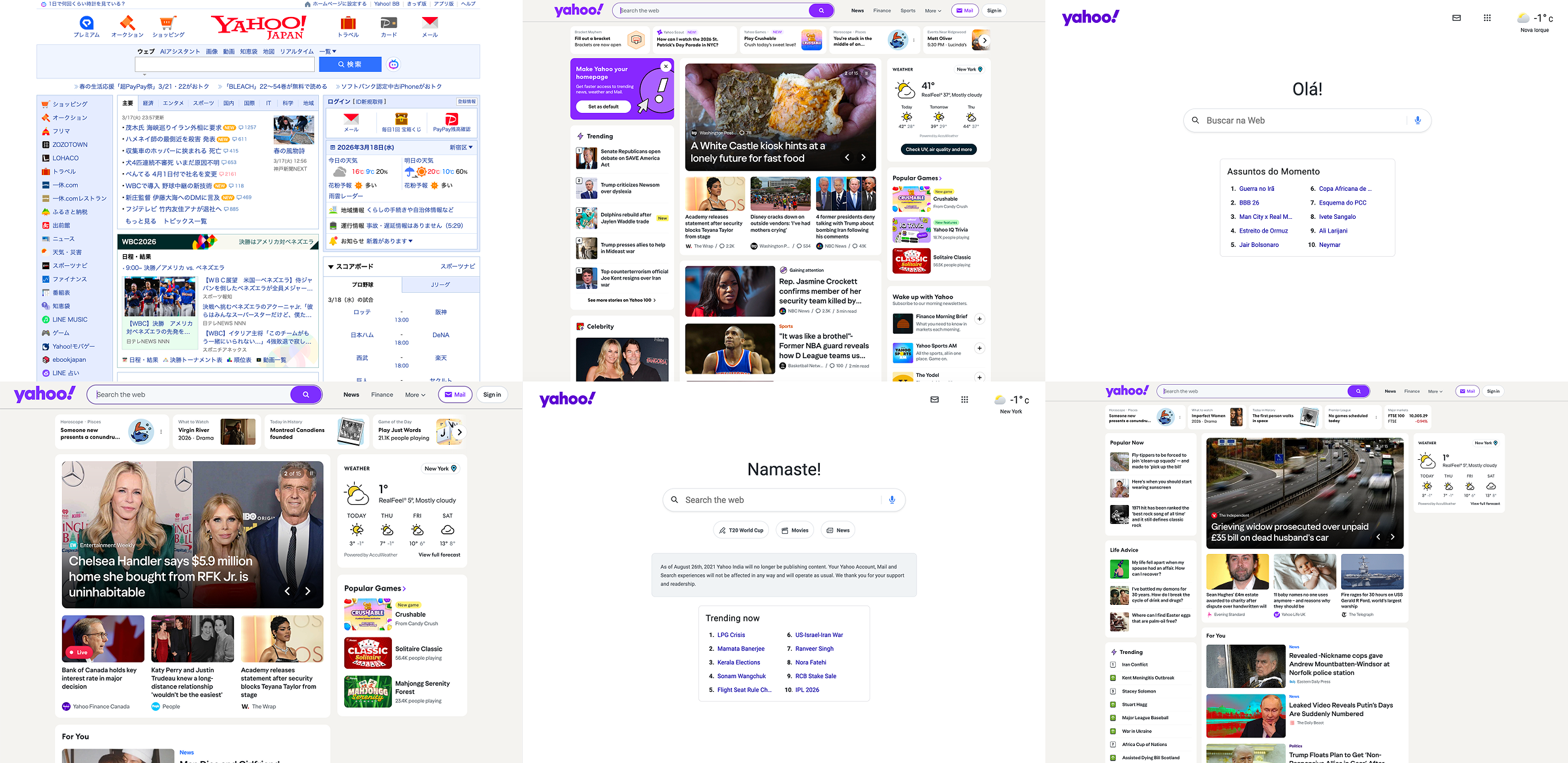
Because however strong a software is, the same interface stretched across a dozen regions is not in fact the same interface if everyone is viewing it from a completely different cultural vantage point. Even if it’s the same language. A “Click here” can mean “Don’t,” and as Malaya and Jonas learned, a “Yes” can just as easily mean “No.” It’s up to the rollout team to localize and translate.
Pictured, how just one website—Yahoo—appears in different regions.