'%3e%3cellipse%20cx='185.202'%20cy='292.401'%20rx='236.2'%20ry='212.4'%20transform='rotate(180%20185.202%20292.401)'%20fill='url(%23paint0_radial_6113_7068)'/%3e%3c/g%3e%3cdefs%3e%3cfilter%20id='filter0_f_6113_7068'%20x='-130.996'%20y='0.000976562'%20width='632.398'%20height='584.8'%20filterUnits='userSpaceOnUse'%20color-interpolation-filters='sRGB'%3e%3cfeFlood%20flood-opacity='0'%20result='BackgroundImageFix'/%3e%3cfeBlend%20mode='normal'%20in='SourceGraphic'%20in2='BackgroundImageFix'%20result='shape'/%3e%3cfeGaussianBlur%20stdDeviation='40'%20result='effect1_foregroundBlur_6113_7068'/%3e%3c/filter%3e%3cradialGradient%20id='paint0_radial_6113_7068'%20cx='0'%20cy='0'%20r='1'%20gradientUnits='userSpaceOnUse'%20gradientTransform='translate(-43.0144%20248.324)%20rotate(-25.0248)%20scale(462.733%20514.489)'%3e%3cstop%20stop-color='%23FF9DDA'/%3e%3cstop%20offset='0.44'%20stop-color='%23F7FF9D'%20stop-opacity='0.52'/%3e%3cstop%20offset='0.84'%20stop-color='%23FF8B7B'%20stop-opacity='0.2'/%3e%3cstop%20offset='1'%20stop-color='%23F7FF9D'%20stop-opacity='0'/%3e%3c/radialGradient%3e%3c/defs%3e%3c/svg%3e)




It’s not entirely clear what’s caused CFOs and controllers to be more involved in direct business unit strategy. Possibly, trade disruption and tariffs drew them into component-level conversations. Perhaps the top economies have grown so financialized that there’s nowhere that a CFO’s input is not welcome. Perhaps world events are moving too fast to not consider the financial impact of each decision. The net result is that CFOs are more engaged in setting strategy than at any time in the past few decades.
We believe this means CFOs and controllers are poised to be the new pivotal transformation role. In this article, we present a menu of options we are seeing finance teams ask for help executing because they need their financial and back-office technology to move fast enough for those strategies to work.
This story is adapted from our newest guide, 30 lessons from 30 years of ERP.

9 moves in the new CFO playbook
1. Go international sooner
It’s anecdotal, but we are seeing companies interested in scaling internationally earlier. That’s partly because of containerization and digitization, but also out of necessity: Companies selling long tail goods are looking farther across borders for their right-fit customers for a longer list of products. CFOs play a key role because every crossing creates complexity in trade, security, financial data, and payments. Notably:
New e-invoicing requirements (France, India, etc.)
VAT, trade law, and tariffs
Managing multiple accounting books and entities
Managing exceptions to those sub-ledgers
Localizing costs and multi-currency conversions
Data sovereignty and storage
New entities and holding companies
2. Manage people globally with global people data
People are your biggest cost, and that data tends to live in silos. People management and payroll data lives separate from expense data lives separate from timesheets lives separate from vendor data lives separate from the ledger. Add in the ruptures across databases and regions. CFOs who make a push to consolidate these systems can ask new questions of their global organization such as:
Where is talent moving?
How much is that talent worth?
How is each talent market changing?
Where should centers of excellence be located?
Is the geographic pay scale helping or hurting retention?
What is the best global coverage/footprint?
How can our finance systems help us support the CEO’s talent strategy?
For companies with unionized workforces, this can substantially inform legal and labor conversations.
3. Rapidly test new business and pricing models
Software startups routinely enjoy 80% gross margins. Add-on insurance offerings, credit card programs, and impulse goods are even more profitable. Could launching a new, high-margin revenue stream transform your revenue mix?
Unfortunately, acting on this idea with a legacy ERP is prohibitively difficult. Implementing a subscription billing tool alone requires evaluating half a dozen bolt-on options with a committee over months and then accepting that revenue recognition is now so complex, it must be done by hand in a spreadsheet.
That’s why an AI-native ERP could be one of the highest-return transformations you pursue in the coming years. Transitioning to a more flexible tech stack can allow you to launch new pricing or business models in weeks or months. When you can run rapid tests, you can de-risk transformation. Instead of gearing the entire company up to make a big push and announcement, you can experiment locally with one team or region. When something works, you can approve a larger rollout, and look prescient.
Consider:
Commercializing in-house tools and IP
Launching a gift card program
Going direct to consumer
Offering a self-serve ‘product-led growth’ model
Offering a lease program to expand your market
Launching a new sub-brand in a new market
Re-packaging and relaunching an old service
Giving customers a portal to self-serve and upgrade/downgrade
Implement software to better bill for overages
Offering a usage-based or ‘consumption’ billing model
Read: Should you launch a subscription? →
4. React to new legislation
Agile finance teams can see regulation as a time-bound opportunity. If you react quickly, you can be the only allowable vendor in a region and give your sales team an unbeatable advantage. Consider scouring key provisions and requirements in any of the 144 countries that now have data protection laws, which discerning buyers will care about. Arm your sales team with those ‘landmines.’ In the U.S., Indiana, Kentucky, and Rhode Island’s digital data protection statutes come into effect, and California will start enforcing its Delete Act this year.
Similarly, the IMF’s new, stricter anti-money laundering provisions will go into effect this year. Companies with stronger financial technology to help them prove they can monitor transactions and observe sanctions are at an advantage. Inform your prospects.
5. Integrate new tools
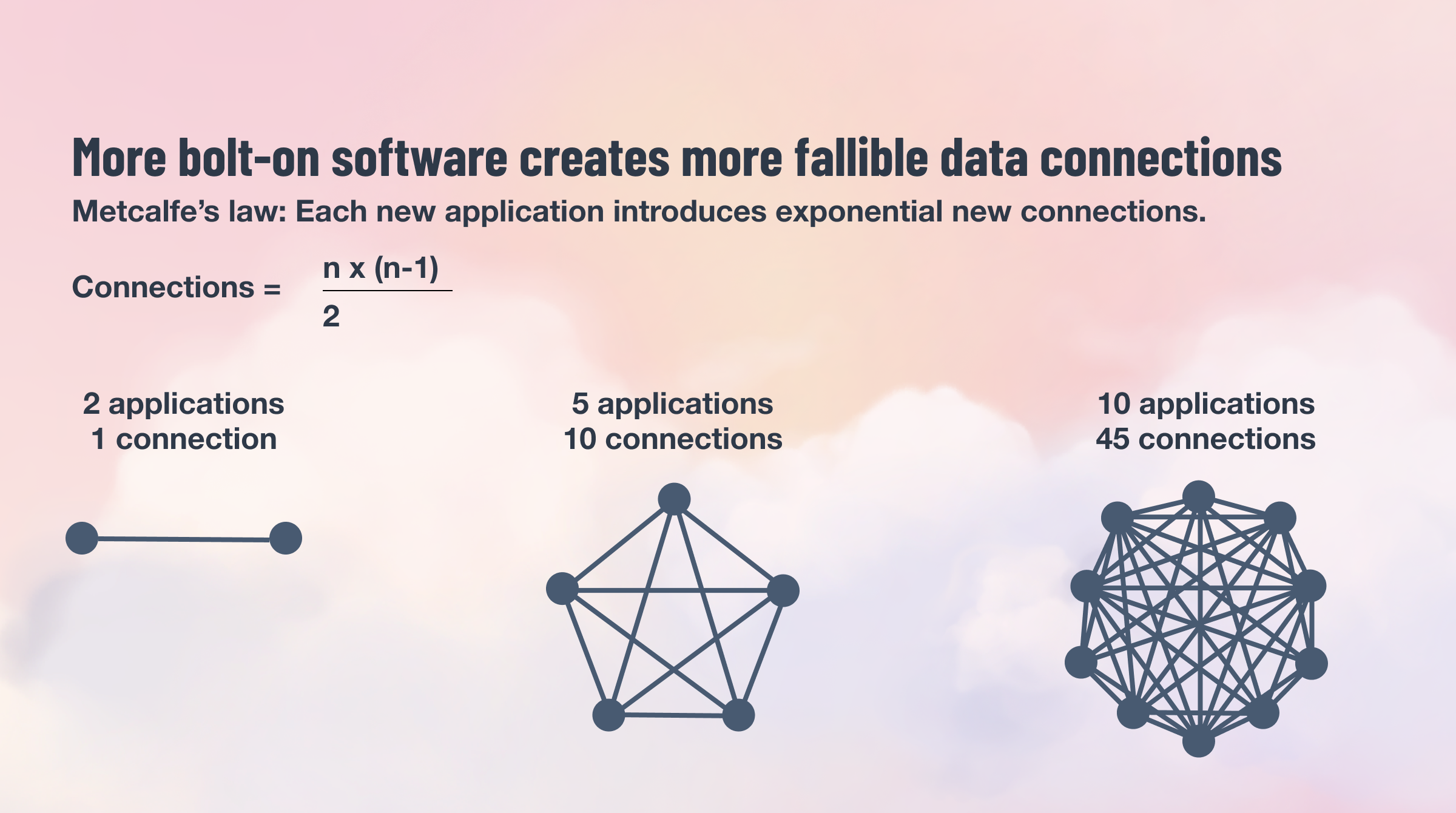
When your team can’t predict next quarter, flexible finance systems matter more. Your team may suddenly identify that they need a faster way to reconcile cash, an expense management interface employees actually use, or more recurring insight into inventory and supply chain. How do you adapt in-quarter? Bolt-on software may seem an attractive option. But the average company has 300 such subscriptions, and half are unused, says the software review site G2.
Further, bolt-ons promise “seamless” integrations. Practical experience reveals they are rarely so. At this point, the “best-of-breed versus “best-of-suite” debate is basically settled. New tools will add unexpected cost and complexity: More data silos, maintenance toil, cloud costs, and training.
Sometimes that bolt-on tradeoff is so good that it is worth it. But where you can consolidate systems and achieve 70% or more of the functionality, that’s typically a wiser move. If only because of your ability to report on those financial information flows.
This isn’t an argument against periphery software. Only an argument to consider that hidden total cost of ownership, and to be mindful of the drag that dozens of extra applications have on your ability to report.
6. Better manage into tax and assets
If your organization leaves tax up to its various regions and entities, there’s likely a lot of hidden efficiency. Especially if you outsource your tax preparation to many regional firms. Tax and asset data belong in your ERP system, where you can run cross-sectional reports to ask:
Where should assets move and be housed on their journey to distribution?
Are there new geo-based tax loss harvesting or depreciation opportunities?
Can we move capital or recognize losses in preferential regions?
These decisions require up-to-date asset information, overlaid with an understanding of all those various tax laws. For example, there may be substantial savings to arguing that digital goods originated in (“manufactured,” in Massachusetts tax law) or were consumed in states other than what the IRS would naturally assume. Recent tax law litigation in New York, in particular, is worth looking into—taxation may hinge heavily on where remote workers are located.
7. Unify data and reporting
Configuring and maintaining the right statutory reporting requirements across regions takes a small army that your team likely does not have. But when finance teams have an ERP system that can handle multi-entity, multi-currency, and multi-book accounting and reporting, they can start to automate intercompany reporting. The ideal end state is that they can finally abandon the data loading work and macro-laden spreadsheets for faster closes and better audit-readiness.
Financial leaders who achieve this gain a finer-grained look into all their regions and aspects of their spend like, for example, cloud costs. Every company is now, to some degree, a software company. All the subscriptions your team pays for add up. Those costs are especially worrisome if your product or tech team are building those costs into the services you offer. We’ll provide an example.
Say your team builds a new digital customer support service powered by a particular LLM model. Say this LLM model is heavily subsidized by venture capital. Eventually, that LLM will switch into profitability mode and raise prices as high as tolerable. Now, you have an uncapped embedded cost that can erode your margins.
This is the decade of catching issues like that, preemptively and automatically, for other teams.
8. Manage orders and inventory
Everest’s product team is convinced that separate order and inventory systems won’t scale past this decade. You need inventory in the same system as contracts, orders, and accounting. Otherwise, you can't manage inventory levels as fast as, say, new tariffs arise, and will have to constantly increment and reconcile them. That can become many people’s full-time jobs. Yes you can build an integration. But that’s a third software, likely a paid master data management tool like Syncari or iPaas integrator like Dell Boomi, and it will never be as seamless or scalable as this all existing natively in one system.
When reevaluating your financial stack, make unified orders and inventory a top priority, so you can:
Inform procurement and reinforce the supply chain
Decide where to manufacture components to what level
How to make the process more turnkey
Decide what to build or buy
Identify risks to core IP
Experiment with new loan/lease models
Make billing simpler, services plus hardware
9. M&A or fundraising
Financial data should inform early M&A and fundraising conversations earlier. Business development teams we talk to tell us they want more self-serve access to cross-sectional financial data so they can evaluate synergies. Or, to more easily look up a business unit’s track record, and inform the build-versus-buy recommendation with data.
This level of access isn’t typical today. Between those development teams and that data are analysts and accountants who are already overworked and underresourced. The challenge is that whatever cluster of business intelligence software they’ve implemented, it’s not self-serve. It doesn’t draw information from the whole business, so it doesn’t save that finance team time. They still must pull data and assemble reports.
Again, this seems to be an argument for an ERP with fewer bolt-on software, better central data management, and business intelligence that doesn’t require an administrator. Or, all three. Primary Health, for example, replaced NetSuite and its aging reporting suite with Everest ERP and found the usability was so great, executives now log in to run their own reports. They use the live sandbox feature to create a fictional “duplicate” view of the entire company’s finances to run scenarios.
Tech isn’t the only answer, but it can be an accelerant
People and process remain critical. But there’s no discussing software today without mentioning AI, and AI is the first technology in history to radically reduce system complexity. It’s working its way into software to allow everyone to chat conversationally with tech, both to manipulate those systems and extend their functionality. It’s conceivable that with a newer ERP with AI-building tools, your team can “prompt” a treasury management app on their own, no IT support required.
That is a serious advantage. It means that as CFOs and controllers are poised to have more say over business strategy, the gap between what they can achieve with a legacy ERP and a new, AI-native one, will only grow. Leaders who are ready to envision fully automated functional leader reporting and books that close themselves will set themselves apart. They’ll create an advantage that makes their company the financially fittest.