'%3e%3cellipse%20cx='185.202'%20cy='292.401'%20rx='236.2'%20ry='212.4'%20transform='rotate(180%20185.202%20292.401)'%20fill='url(%23paint0_radial_6113_7068)'/%3e%3c/g%3e%3cdefs%3e%3cfilter%20id='filter0_f_6113_7068'%20x='-130.996'%20y='0.000976562'%20width='632.398'%20height='584.8'%20filterUnits='userSpaceOnUse'%20color-interpolation-filters='sRGB'%3e%3cfeFlood%20flood-opacity='0'%20result='BackgroundImageFix'/%3e%3cfeBlend%20mode='normal'%20in='SourceGraphic'%20in2='BackgroundImageFix'%20result='shape'/%3e%3cfeGaussianBlur%20stdDeviation='40'%20result='effect1_foregroundBlur_6113_7068'/%3e%3c/filter%3e%3cradialGradient%20id='paint0_radial_6113_7068'%20cx='0'%20cy='0'%20r='1'%20gradientUnits='userSpaceOnUse'%20gradientTransform='translate(-43.0144%20248.324)%20rotate(-25.0248)%20scale(462.733%20514.489)'%3e%3cstop%20stop-color='%23FF9DDA'/%3e%3cstop%20offset='0.44'%20stop-color='%23F7FF9D'%20stop-opacity='0.52'/%3e%3cstop%20offset='0.84'%20stop-color='%23FF8B7B'%20stop-opacity='0.2'/%3e%3cstop%20offset='1'%20stop-color='%23F7FF9D'%20stop-opacity='0'/%3e%3c/radialGradient%3e%3c/defs%3e%3c/svg%3e)




In this article, I explain how Everest’s approach to security is designed to help you rest easy. For more information, I recommend reading our updated security policy which serves as a promise to our customers and partners.
Security has never been more important
Today's ERP systems face a perfect storm of challenges. They're processing more sensitive data than ever, confronting more sophisticated cyber threats, navigating an ever-undulating sprawl of regulatory requirements, and must adapt to the innovations, opportunities and challenges coming from AI—all while trying to maintain operational efficiency.
Three key factors contribute to the scale of the challenge:
The security landscape has evolved. Modern threats and regulations have outpaced traditional security measures, creating a widening gap between protection needs and capabilities.
Many organizations rely on "bolted-on" security solutions. The threat and regulatory landscape looked very different when most ERP systems were developed. ERP vendors and their customers are spending considerable—and sometimes, excessive—effort to meet today’s requirements. These afterthought implementations often result in greater complexity, higher costs, and a less flexible system, which can create more problems than they solve.
There's a significant disconnect between business and IT teams. When security is relegated solely to IT administrators and security teams, it creates a misalignment between business requirements and technical implementation, making it difficult to achieve either effectively.
The new paradigm must be security-first
The question we should be asking is not, "How do we make security less burdensome?" But rather, "How can our ERP solution enable business success and efficiency while ensuring security?" It should be innate, and an enabler.
A modern approach to security should deliver:
Trust: Confidence that your data is protected with state of the art security mechanisms and can withstand evolving threats
Control: Enables clear oversight of data access aligned with your risk appetite
Compliance: Seamless adherence to relevant regulations
Flexibility/Adaptability: The ability to react to evolving requirements
All of this should be based on a sound understanding of the evolving threat-landscape as well as the regulatory environment. This understanding must cover both the business-level as well as the technical and operational level, and lead companies to consistently innovate and evolve their security and compliance approach.
The path forward
This isn't about sacrificing security for usability or profit, nor blocking innovation or digital transformation for the sake of security. It is about integrating security into the fabric of business operations, applications and platforms, enabling informed risk-based decisions. Which brings me to the Everest security approach.
The Everest security approach
At Everest, we designed our security and compliance approach with all the above challenges and elements in mind. We have had the luxury of building a platform from scratch, based on all the lessons of the last 30 years of ERP.
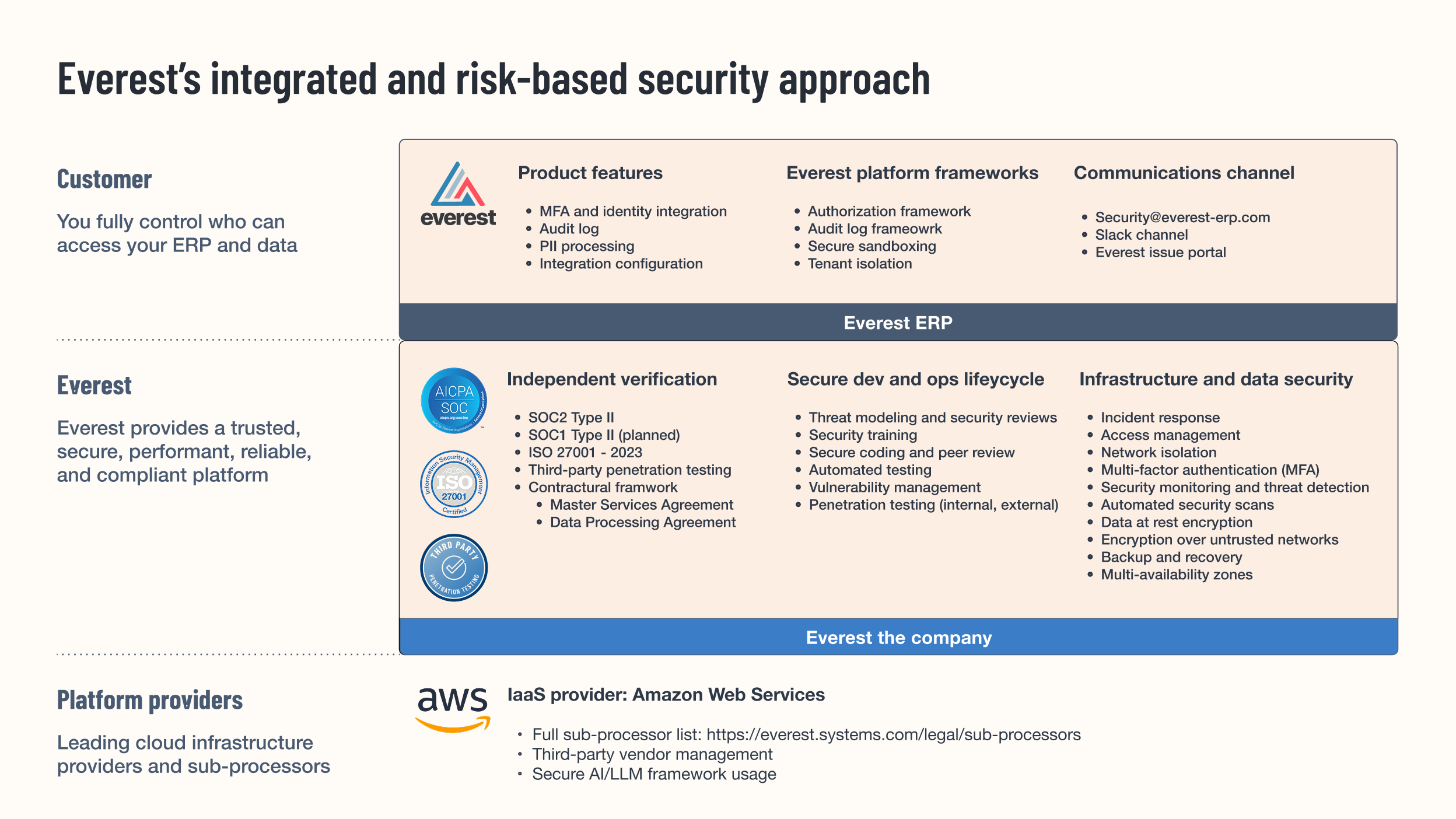
Security and Compliance is built into every layer of our ERP platform—from the underlying infrastructure to the applications you use every day. We operate under a risk-based security approach, meaning we continuously adapt our defenses to meet evolving threats, regulatory changes, and your business needs.
Your Role as a Customer
Security is a shared responsibility. While Everest secures the platform, you control who accesses your data. This means managing your users, roles, and permissions; deciding on your authentication method or identity provider; handling integrations with external systems; and naming a security contact within your organization. You also play a key role in reporting suspected incidents and cooperating with Everest on their resolution.
Independent Verification
Last but not least, our program is independently verified through SOC2 Type II attestation, ISO 27001 certification, and regular third-party penetration testing. We don’t make guarantees we cannot keep and we invite trusted third-parties to ensure our security is up to the standards our customers need to focus and run their businesses.

Choosing Everest means entrusting us with your critical data, operations, and ultimately your company's future. We know you need complete confidence in your technology partner to focus on growth and business success. That is why we apply our risk-based security approach to all our activities—so we stay on top of today's and tomorrow's security and compliance challenges.
Learn more about our approach in the security policy.