'%3e%3cellipse%20cx='185.202'%20cy='292.401'%20rx='236.2'%20ry='212.4'%20transform='rotate(180%20185.202%20292.401)'%20fill='url(%23paint0_radial_6113_7068)'/%3e%3c/g%3e%3cdefs%3e%3cfilter%20id='filter0_f_6113_7068'%20x='-130.996'%20y='0.000976562'%20width='632.398'%20height='584.8'%20filterUnits='userSpaceOnUse'%20color-interpolation-filters='sRGB'%3e%3cfeFlood%20flood-opacity='0'%20result='BackgroundImageFix'/%3e%3cfeBlend%20mode='normal'%20in='SourceGraphic'%20in2='BackgroundImageFix'%20result='shape'/%3e%3cfeGaussianBlur%20stdDeviation='40'%20result='effect1_foregroundBlur_6113_7068'/%3e%3c/filter%3e%3cradialGradient%20id='paint0_radial_6113_7068'%20cx='0'%20cy='0'%20r='1'%20gradientUnits='userSpaceOnUse'%20gradientTransform='translate(-43.0144%20248.324)%20rotate(-25.0248)%20scale(462.733%20514.489)'%3e%3cstop%20stop-color='%23FF9DDA'/%3e%3cstop%20offset='0.44'%20stop-color='%23F7FF9D'%20stop-opacity='0.52'/%3e%3cstop%20offset='0.84'%20stop-color='%23FF8B7B'%20stop-opacity='0.2'/%3e%3cstop%20offset='1'%20stop-color='%23F7FF9D'%20stop-opacity='0'/%3e%3c/radialGradient%3e%3c/defs%3e%3c/svg%3e)




All eyes are now on the company’s CFO, controller, and head of supply chain. Surely they can see past the present whiplash to what artificial intelligence will really mean for labor and value, and find some mechanism for controlling the cascading volatility.
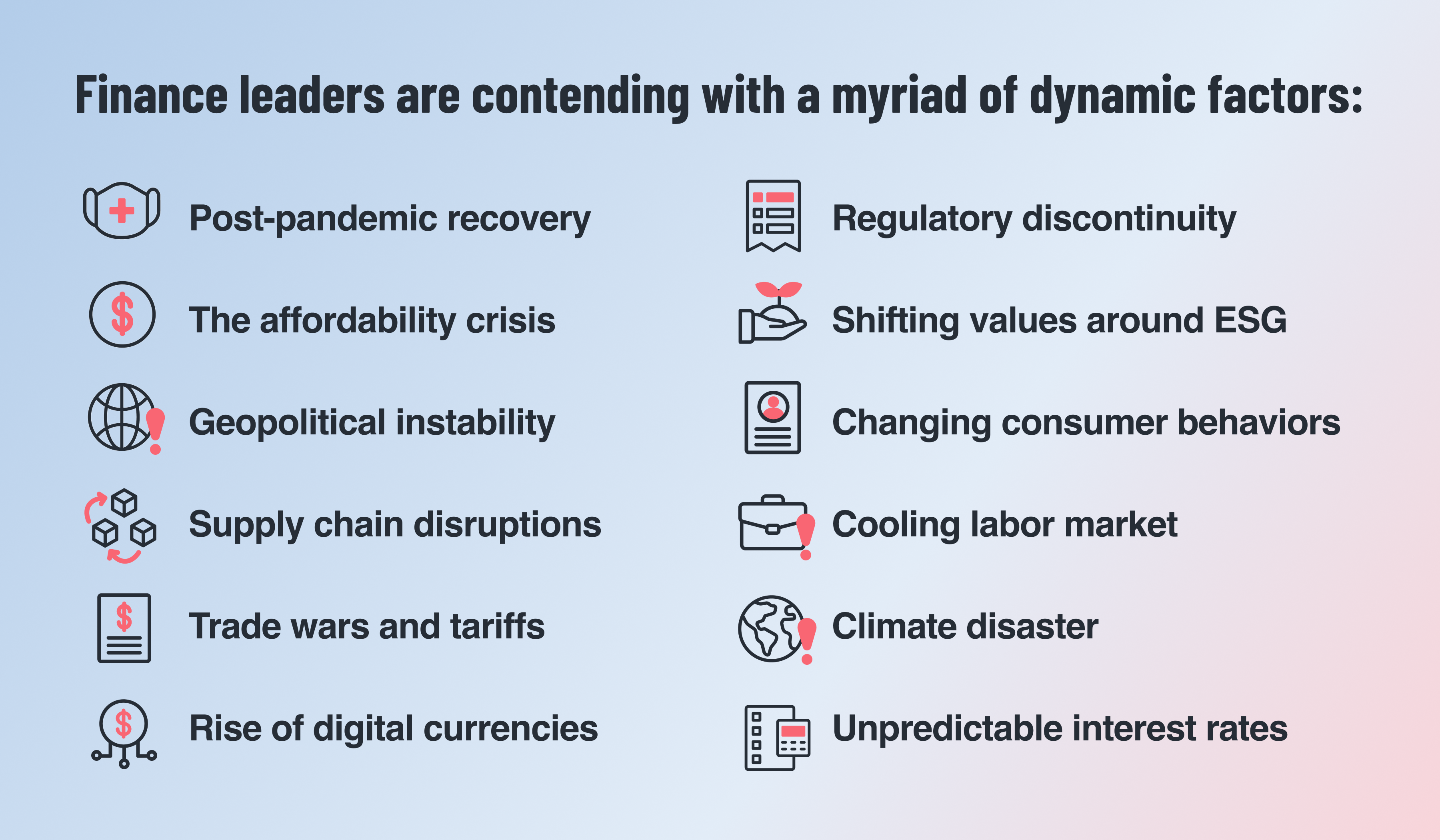
We have a term for this: polycrisis. It’s now a fixture of Davos breakout sessions and describes something more than temporary bad luck. It captures an economic storm front of multiple global stressors lashing at and amplifying one another. The concurrent crises ricochet and produce harms far in extreme of the sum of their parts.
In this article, advice on navigating the storm.
Why should I worry?
Climate disruption alone is a sizable crisis. The world has little hope of hitting emissions or temperature targets, and already, the climate is creating food shortages and now spurs 90% of migration. War and geopolitical fragmentation has fractured supply chains—Russia's invasion of Ukraine increased wheat prices 2%, the U.S. invasion of Iran caused gas prices to spike 13%, and retributive tariffs caused untold calamity in 2025. Interest rates, inflation, and technological disruption create an operating environment of risk and also, in Churchillian fashion, great potential reward.
These factors aren’t new. Their fury, frequency, and synchronicity are.
Strong financial leaders aren’t awaiting certainty—they are constructing it
If the only certainty is change, change-makers are building their financial systems to handle volatility. They’re accepting that sometimes it’s worth paying a premium for optionality, and figuring out where to sign shorter-term agreements in domains that will shift rapidly, like with major LLM vendors. They are, by contrast, going long on technologies that allow them to be more reactive and adaptive.
For example, AI-native ERPs that allow them to “bring their own model” and swap models at will so they aren’t locked into one ecosystem. And the tools to allow users of that ERP to modify its interface and launch new intra-ERP applications. CFOs want their teams to have the ability to create specifications and prompts to build their own treasury management tool rather than spend six months evaluating a bolt-on software that may soon grow outdated.
They are, in short, building financial stacks that are built for change, with the ability to withstand shocks.
They are focusing less on scorekeeping and more on ‘scenario architecture’
This is perhaps oversimplistic, but traditional CFOs were the stewards of historical truth. They set budgets and agendas and held business units and leaders to fiscal account. But these activities are too far downstream for a CFO today to be effective. In the past, a major retailer might have a few seasons in which to prove out the success of a new apparel, whereas today, they need quicker validation and a supply chain flexible enough to iterate, pivot, or cancel production based on consumer tastes.
In a polycrisis, CFOs find scenario planning much more effective. Not reviewing a perfectly balanced historical chart of accounts that don’t predict the future, but a map of messy possible futures. CFOs we talk to say they are more actively engaged further upstream in business-level strategy than ever. In such a financialized environment, financial strategy is company strategy. We may not know Netflix’s motives in offering to purchase Time Warner, but we do know that the shuffle has left their greatest combined rival saddled with an atrocious $80 billion in debt, and Netflix happily pocketing a $2.8 billion breakup fee.
This moment calls for true, multi-variate planning and far, far more analysis than yesterday’s analysts could ever provide. Which means the only plausible way to stay flexible is to experiment with AI tools.
They’re rebalancing the treasury amidst turbulence
The era of near-zero interest rates is long behind us, and so is the pathological lack of discipline such an environment inspired. But gone as well as predictable interest rates. The Federal Reserve is locked in a test of wills with the U.S. government, and less able to moderate the U.S. dollar’s (so far, mild) decline as a reserve currency. Currency volatility is up, especially in emerging markets and elevated base rates have CFOs dealing with repriced financing costs appearing like scattered brush fires.
Cash management is once again a board-level concern, and something CFOs must answer for. And something for which they have few tools to answer, but better data and an ability to quickly move capital across borders.
They’re brushing up on geopolitics as a core competency
Without condescending to discuss today’s politics, executives at $1 billion and up companies are, increasingly, political figures. They are asked to contribute to campaigns and repatriate jobs and contribute inadvertently to political agendas like no time since the Gilded Age. It’s often a job with no good options, for responding in any way to trade policy, sanctions, and export controls can be seen as coded communication.
CFOs in sum face similar calculus to politicians, and must grow skilled in that domain that the late political journalist Sir David Frost described as “The art of letting the other guy have your way.”
They’re pursuing sustainability goals by any other name
Environmental and social governance (ESG) is now decidedly out of favor. Never mind that this souring comes at a time when clean energy has tipped over into being the more efficient option (it accounted for 90% of new capacity in 2024), governance is a given, and diversity is a proven tool for creative problem- solving. Many companies have found it politically convenient to abandon their ESG programs even while they grapple with the very real cross-border climate risks on their global operations.
The realpolitik CFO today is stripping the ideology from their frameworks while continuing to pursue those same tenets on their financial merits. A reported 84% of CFOs have already changed their business to make it more environmentally sustainable, and 65% say they can measure the direct cost of failing at that transition in real time.
They’re leaning into human leadership
In crisis, employees seek stability, and that’s something any CFO can provide. For nothing is stable, save for the perception of it. The CFO in this polycrisis, we would argue, needs a degree of relatable humility. To convey certainty, they don’t need to be certain in the outcome, only the path. Dropping the corporate platitudes for a simple but true “We don’t know yet but here’s what we’ll do” goes a long way. It can help calm the nerves of a global workforce that is feeling it doubly hard at home.
The affordability crisis is real, and housing and food are a far greater percentage of the average worker’s income than 50 years ago. Many are saddled with debt. Many entered the workforce in time for one economic downturn and have now faced two plus, a pandemic. It’s important to maintain your connection to the frontlines, be seen walking the factory floor, and if recording a video about eating burgers, know most people will find it strange if you call it a “product.”
It’s a human skill, not a financial one. But it may prove the most important modern competency.
Agility will mean more ERP change management
The leaders and organizations who manage through the polycrisis will not be those who predicted it most accurately, for no one predicted the sequencing of the past six years. Even on the eve of the great financial crisis, three quarters of the U.S. Survey of Economic Forecasters were confident the U.S. was not in recession … three months into what would later be understood to have been the Great Recession.
Rather, the successful CFOs will surf. They’ll build financial apparatuses and teams and fiscal instruments that allow them maximum flexibility to sense and adapt. They’ll focus more on organizational behavior and change management. And they’ll use those tools to construct certainty, influence the architecture of those unfolding scenarios, brush up on geopolitics, and not lose sight of the human element. For that’s the core to the business that is, after all, on a historical basis, the most adaptable.